
Low threshold and take the casting route
The casting shape and structure can be verified without mold opening, and it is suitable for prototyping, process verification and small batch production.
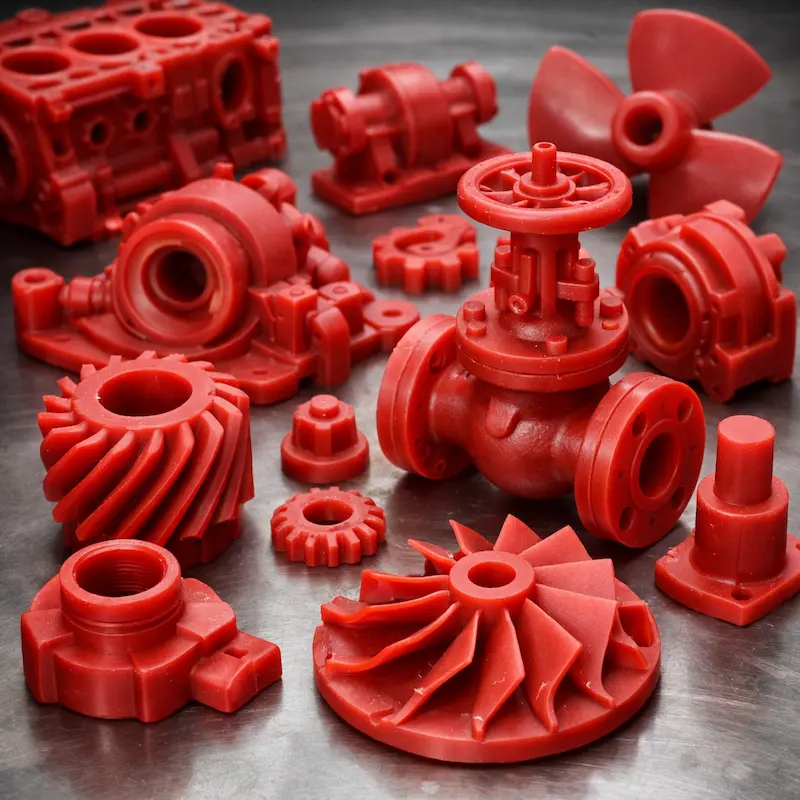
Red Wax front-end molding for lost-wax/investment casting, the goal is not "direct use of printed parts," but rather to achieve more complex and finer casting shapes.
Quote checklist: Upload your 3D model and, when available, a 2D drawing. Identify the required process, material, quantity, critical dimensions, finish, appearance standard, and target delivery date.
Engineering note: Values below are typical reference ranges. Final manufacturability, tolerances, material condition, surface finish, cost, and lead time depend on the drawing, geometry, quantity, and selected process.
Upload CAD files and mark critical features for an engineering review before production.
| Process | 3D printinged wax patterns (for lost wax/investment casting routes) |
|---|---|
| Color | Red (the wax model is used for subsequent dewaxing/burning out and pouring, and does not have "printed appearance display" as the main goal) |
| Accuracy | ±0.2 mm (used for wax pattern shape restoration; finished product size needs to be evaluated based on casting shrinkage and subsequent processing) |
| Minimum wall thickness | 0.6mm (for thin-walled structures, it is recommended to conduct a casting feasibility review and thicken or reinforce if necessary) |
| Service temperature | 50–70℃ (for process evaluation; specific dewaxing/loss-on-ignition window is subject to the casting route) |
| Tensile strength | 10–20MPa |
| Density | 0.95 g/cm³ |
| Applications | Jewelry, decorative pieces, fine metal pieces Casting route pattern making with small batch production; Suitable for complex curved surfaces, small textures and high-detail restoration needs |
| Not suitable | Projects that need to be "printed and used directly as final parts" (it is recommended to choose resin/nylon/metal 3D printing or CNC); or scenarios that have extremely strict final size/tolerance requirements and cannot process compensation (subsequent processing allowance needs to be evaluated) |
| Finishing | None (Red Wax usually goes directly into the dewaxing/burnout/pouring process; the finishing of the finished product is completed by the casting process) |
| Typical lead time | Related to model size, quantity and casting route assessment; clear delivery and expedited options will be given after uploading the file |
The casting shape and structure can be verified without mold opening, and it is suitable for prototyping, process verification and small batch production.
Suitable for high-detailed appearances (textures, decorative lines, patterns, etc.) and complex geometric shapes.
If the end goal is metal parts (strength, temperature resistance, texture), Red Wax can serve as a smoother front-end molding option.
It is more friendly to small parts and high appearance requirements, and facilitates rapid iteration and repurchase.
| Material | Key Advantages | Mainly applicable | Not suitable |
|---|---|---|---|
| White SLA Resin (SLA) | The appearance is delicate and the details are well expressed, suitable for painting/screen printing and other appearance schemes. | Appearance prototypes, review samples, display parts, assembly verification | The final casting route for metal products (Red Wax is more suitable) |
| Black SLA Resin (SLA) | Black is more like a finished product and has a stronger display/photography effect | Display/review/photography samples, light load assembly verification | Finished product goals that require metal strength/temperature resistance and metal texture |
| Tough SLA - Yellow-Green (SLA) | Enhanced toughness based on details/appearance, more suitable for light functional validation | Snap verification, assembly verification, light load function verification | In the end, metal parts are required or a casting process route is required. |
| White Nylon (SLS) | More stable functionality, wear-resistant and fatigue-resistant, suitable for complex structures and batch typesetting | Structural validation, assembly parts, wear-resistant moving parts, small batch functional parts | Metal finished products are required (Red Wax/metal craftsmanship is more suitable) |
| HP Nylon - Gray (MJF) | Better batch consistency and dimensional stability, suitable for repeated delivery | Small and medium batch functional parts, assembly positioning parts, repetitive parts | The goal of metal finished products taking the casting route (Red Wax is more suitable) |
Red wax is mainly used for Lost Wax/Investment Casting Front-end molding: What is printed is a "wax model", and what is finally obtained is a "finished metal product".
If your final goal is metal parts, Red Wax is usually a smoother route; if you need to "use it directly after printing", it is recommended to choose resin/nylon/metal 3D printing or CNC.
The advantage of Red Wax is that it can quickly obtain a wax pattern that can be used for casting at a lower cost, avoiding the need to invest in the development of metal molds from the beginning.
Common reference values for Red Wax:
Thin walls, sharp corners, and slender cantilevers are more likely to cause risks during the dewaxing/burnout/pouring stages. It is recommended to undergo DFM review after submitting the file, and we will give suggestions for thickening/reinforcement/rounding etc.
We support mainstream 3D/2D project files:
Recommended practices:
The goal of Red Wax is to enter the casting process, so it is usually No finishing such as painting/screen printing/electroplating of printed parts is required., instead:
If you need to "display/use directly after printing", it is recommended to choose materials such as SLA resin or nylon.
Common risks come from thin-walled, elongated structures and sudden changes in thickness:
Recommendations: The wall thickness should be as uniform as possible, reinforce key points, round off sharp corners, design in separate parts when necessary, and plan connection/gate areas on non-critical surfaces.
You do not need to provide your own gate/riser solution, but it is recommended that you at least state:
We will conduct a DFM review based on the documents and give casting-oriented suggestions and risk points.
Red wax is the "patterning material", and the final metal and surface effects are mainly determined by the casting route and finishing (such as polishing, electroplating, sandblasting, etc.).
Please write clearly in the remarks: Metal material(such as stainless steel/brass/silver, etc.) with surface target(Polishing/brushing/electroplating, etc.) to facilitate our evaluation of detail retention and processing allowance.
Usually not required. Appearance display samples are more suitable for:
Red wax is more suitable for the "finished metal product" route.
Red wax quote is usually strongly related to the following factors:
For a more accurate quote, it is recommended to clearly note "final metal material + surface target + allowable gate location + critical dimensions".
The lead time depends on the model size, quantity and whether casting route evaluation and process connection are required. After uploading the documents, we will give you a clear lead time and expedited options.
Expediting usually gives priority to ensuring lead time, but it may require trade-offs in gate planning, appearance modification or process arrangement; it is recommended to clarify the key appearance surface and allowable modification range in advance.
For faster and more accurate evaluation, please provide/explain when uploading the file:
You only need three steps: Upload drawings → Confirm project evaluation and quote → Production and delivery after confirmation. We will provide simultaneous feedback on manufacturability suggestions (DFM) and risk points.