
Sanding (controlling “marks”)
Black is more likely to show support points and minor scratches; it is recommended that more fine polishing and transition processing be performed on the display surface.
Standard Resin-Black is the most commonly used SLA standard resin choice.
Quote checklist: Upload your 3D model and, when available, a 2D drawing. Identify the required process, material, quantity, critical dimensions, finish, appearance standard, and target delivery date.
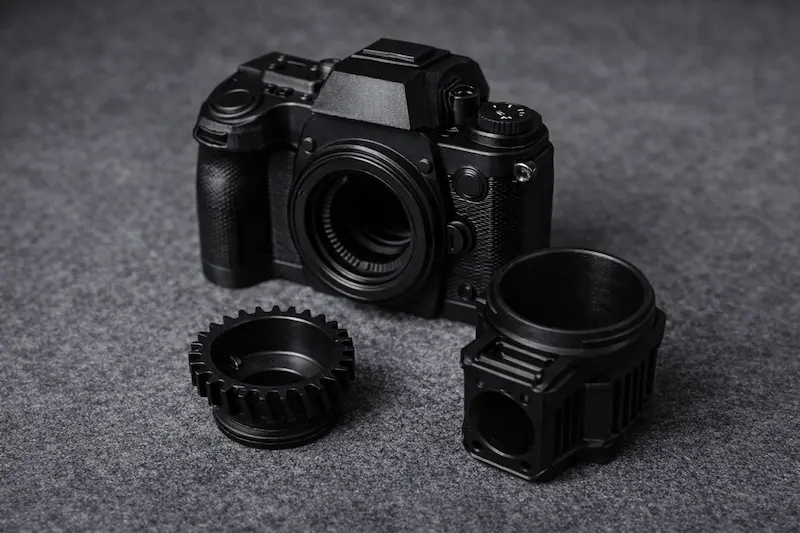
Engineering note: Values below are typical reference ranges. Final manufacturability, tolerances, material condition, surface finish, cost, and lead time depend on the drawing, geometry, quantity, and selected process.
Upload CAD files and mark critical features for an engineering review before production.
| Process | SLA light-curing 3D printing (standard photosensitive resin) |
|---|---|
| Color | Black (more like finished product appearance; more sensitive to marks, it is recommended to define display surface and appearance standards) |
| Layer thickness | 0.05–0.10 mm (commonly used); 0.025 mm high-precision mode (increased lead time/cost) |
| Dimensional tolerance | ±0.20 mm or ±0.20% (whichever is greater); it is recommended to mark the tolerance or note "accuracy first" for the key hole/datum surface |
| Minimum wall thickness | Appearance non-structural ≥0.8–1.0 mm; general structure ≥1.2–1.5 mm; stress/near screws ≥2.0 mm |
| Minimum aperture | Direct forming hole ≥1.5–2.0 mm; it is recommended to reserve allowance for assembly holes/mating holes and ream/ream holes |
| Text/texture | The height of embossed characters is ≥0.4 mm; the depth of concave characters is ≥0.3 mm; the line width is ≥0.25–0.30 mm (larger is recommended for painting/vacuum plating parts) |
| Hardness | Shore D 80–88 (varies with formulation/post-cure) |
| Tensile strength | 35–55 MPa (common range; typically stronger but more brittle after post-cure) |
| Elongation at break | 6–20% (General-purpose black resin is more “appearance/rigid”; if toughness is required, it is recommended to choose tough resin) |
| Service temperature | 60–80℃ (common reference range; for high temperature requirements, it is recommended to choose high temperature-resistant resin) |
| Surface roughness | Ra ~1–3 μm (related to layer thickness/direction); grinding + spray coating can further enhance the “finished product feel” |
| Density | Approximately 1.1 g/cm³ |
| Recommended maximum unit size | Depends on equipment and placement; oversized pieces can be disassembled and spliced or other processes can be evaluated |
| Accuracy level | Standard accuracy / high accuracy (remark "key hole/critical surface/tolerance requirements" required) |
| Optional colors | Natural black color; can be spray-painted into matte/semi-matte/high-gloss textures (it is recommended to provide reference pictures or effect requirements) |
| Assembly enhancements | support Threaded inserts; Please indicate the thread specifications (such as M2/M3/M4), quantity and location; please note if tapping/expanding/reaming is required |
| Finishing | Polishing, painting, screen printing, vacuum plating, threaded inserts |
| Post-cure instructions | Post-curing can improve strength/temperature resistance and dimensional stability, but may increase brittleness; post-curing is usually recommended for cosmetic parts |
| Typical lead time | Related to size, quantity, placement and finishing; clear delivery and expedited options will be given after uploading the file |
Black is more likely to show support points and minor scratches; it is recommended that more fine polishing and transition processing be performed on the display surface.
It can be made into matte/semi-matte/high-gloss and other textures to significantly enhance the finished product. It is recommended to note reference pictures or surface texture targets.
Suitable for logos, scales and other graphic information; it is recommended to provide vector files and location and size instructions.
Used for metallic texture/reflective effect and visual enhancement; suitable for product demonstration samples (base treatment and surface requirements need to be evaluated).
Used for screw assembly and repeated disassembly; suitable for parts that require fixing, assembly verification or small batch assembly (please note the thread specifications, quantity and location).
Suitable for display, review and photo-taking scenarios; dark appearance makes it easier to create demonstration samples with uniform texture.
Suitable for small characters, chamfers, textures and thin structures; it is easier to "present" details when used for appearance review.
Suitable for assembly verification, interference inspection and first version trial fitting of structures; key holes/critical surfaces can be noted as “accuracy priority”.
Supports grinding, painting, screen printing, and vacuum plating; optional when screw connection/repeated disassembly and assembly is required Threaded inserts Improve reliability.
| Material | Key Advantages | Mainly applicable | Not suitable |
|---|---|---|---|
| White Nylon (SLS) | The functional type is more stable, does not require support, and is suitable for complex structures and low- to medium-volume typesetting. | Structural validation, assembly parts, wear-resistant moving parts, small batch functional parts | Ultimate mirror appearance, ultra-high precision fit (requires secondary processing/process change) |
| Black Nylon (SLS) | Both are functional types; the black appearance is more resistant to dirt and is suitable for functional parts with color requirements. | Assembly parts, structural parts, wear-resistant parts, batch functional parts | The ultimate mirror appearance and high-precision combination |
| HP Nylon - Gray (MJF) | Better batch consistency and dimensional stability, suitable for repeated delivery | Small and medium batch functional parts, assembly positioning parts, repetitive parts | Ultimate mirror appearance (still needs spray coating/finishing) |
| HP Nylon & Fiberglass - Black (MJF GF) | Stronger rigidity and dimensional stability, suitable for load-bearing structural parts/positioning parts | Load-bearing structural parts, assembly positioning parts, functional parts with priority on dimensional stability | Fasteners that require a certain degree of elasticity/toughness (needs evaluation) |
| Tough SLA - Yellow-Green (SLA) | A more refined appearance with greater detail; and more impact resistant than standard resins | Appearance + prototype with certain toughness, buckle verification, light load function verification | Complex structure mass layout, wear-resistant for long-term use (better with nylon) |
Standard Resin-Black is often used in appearance prototypes, display parts and photographic samples. Its advantages are concentrated in:
If your goal is drop resistance, fatigue resistance, or long-term durability, it is often recommended to evaluate alternatives such as tough resin or nylon (SLS/MJF).
Photosensitive resin - black is more "show and verify" and not suitable for withstanding high impact or long-term mechanical load:
If you are torn between "appearance + certain toughness", you can directly note the usage scenario, and we will suggest alternatives such as tough resin/nylon.
It is recommended that you refer to the key requirements marked in the drawings/notes; you can also refer to the parameters on this page:
If there are key assembly dimensions/positioning holes, it is recommended to provide 2D markings or mark the key dimensions in the remarks, and we will evaluate and confirm them individually.
We support mainstream 3D/2D project files:
Recommended practices (helps to provide faster and more accurate quotes):
Black SLA Resin quote not only depends on the volume, but also is affected by the following factors:
In order to get a quote that is closer to your goal, it is recommended to write clearly in the remarks: Appearance requirements + purpose (display/review/assembly/verification) + quantity and lead time.
Black SLA Resin finishing friendly, common options:
If you need a "close to finished product" display effect, it is recommended to note: Reference image/target texture (matte/glossy) + appearance surface definition + acceptable trace standard.
Black is more likely to "show marks" under light. Common marks include:
For a cleaner look, common practices:
It can be used for assembly verification and light-load structural validation, but you need to be cautious about "repeated disassembly and assembly of buckles/screws":
If you want to do functional validation (long-term force/impact), it is recommended to note the usage conditions and we will recommend more matching materials.
Photopolymer-black is more likely to be at risk on the following structures:
Tips to reduce risk:
The color of the black body is usually stable, but different batches, post-curing and surface finishes may cause slight differences:
Tip: Black has obvious reflection differences under different lighting and shooting conditions. It is recommended to indicate the use environment (exhibition lighting/photo studio/indoor office light).
Common lead times (excluding logistics) are usually 1–3 working days, which actually depends on the structure complexity, quantity and finishing:
Expediting is available but may:
In order to get a faster and more accurate quote, it is recommended that you provide/explain when uploading the file:
You only need three steps: Upload drawings → Confirm project evaluation and quote → Production and delivery after confirmation.
After uploading the file, we will provide feedback as soon as possible quote with Manufacturability recommendations(DFM), and provide placement and finishing plans according to your appearance/delivery requirements.