

Support Hours: 09:00–18:00 (GMT+8) · Messages and quote requests are accepted 24/7.
Mass production delivery services: CNC / injection molding / sheet metal / die-casting mass production, combined with DFM review and quality system, to achieve consistency and traceable delivery

Mass production delivery service

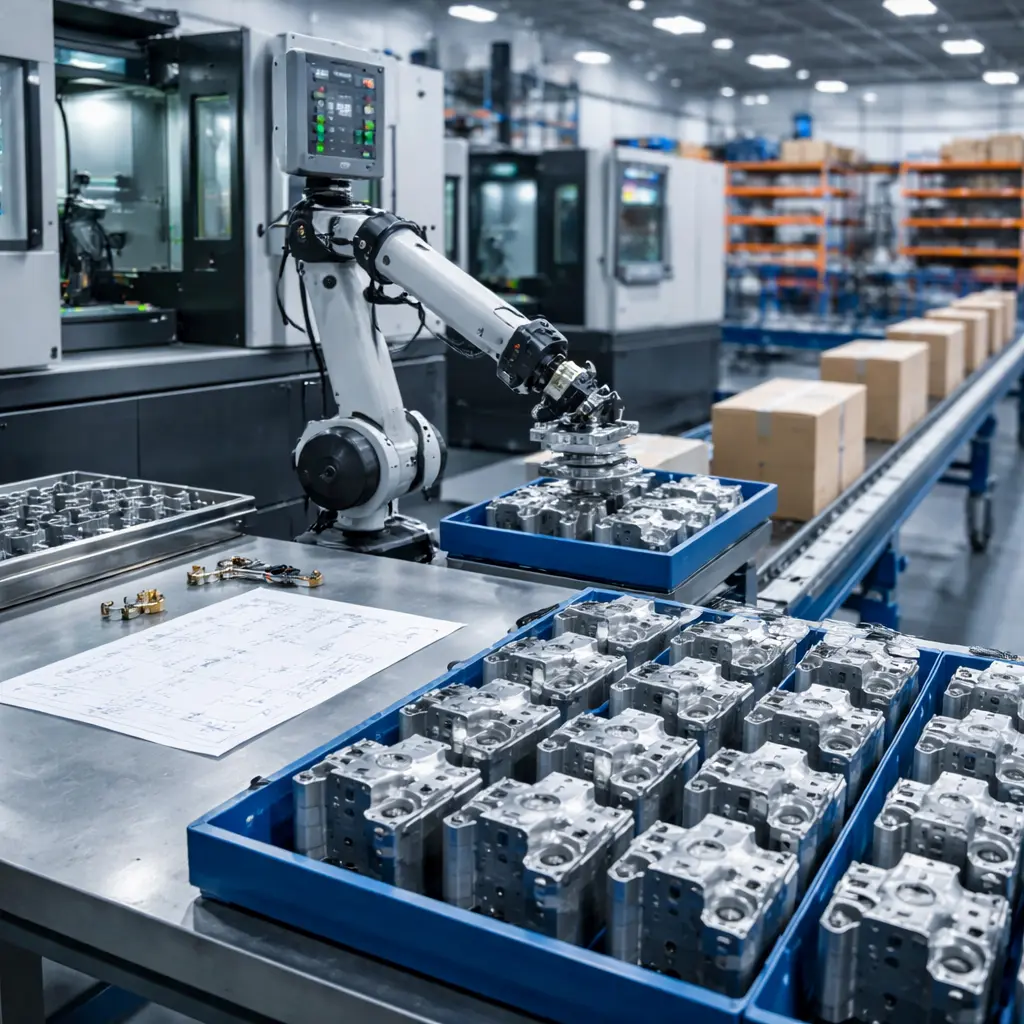
For products entering the batch stage Stable manufacturing with consistent delivery. Pass Mass production process path (CNC / injection molding / sheet metal / die casting) + DFM Engineering Review + process quality control, leaving fluctuations in the introduction stage and stability in the delivery stage, reducing the risk of batch defects, rework and delivery out of control, and supporting a smooth climb from trial production to large-scale mass production.

For you if you are doing:

Design freeze (or close to freeze) has been completed and needs to be established Mass production benchmark, critical dimension control with Inspection standards.
Need to start from trial production Quick climb to Stable mass production, and hope that the yield, lead time, and cost can be predictable.
in CNC batch / injection molding / sheet metal batch / die casting To choose between them, you need to first clarify the process window and mass production risks.
hope to build Traceable quality evidence chain(First article/process/shipment) to avoid rework and customer complaints at the batch stage.
Upload drawings · Get mass production quote View delivery capabilities
Encrypted file storage and access control support the signing of non-disclosure agreements (NDA), and intellectual property and drawing information are protected.

Core Competencies | Core Competencies for Mass Production Delivery

The key to mass production delivery is not "can do it", but "can deliver it stably". We use mass production gate control, parameter standardization, cross-process collaboration, quality consistency and delivery rhythm management to solidify the trial production conclusions into reusable mass production benchmarks to support stable delivery from ramp-up to large-scale mass production.

  1. Mass production feasibility confirmation

    Review trial production conclusions and key risks before mass production, confirm Is the process frozen?, Are tolerances and materials finalized?, and default alternative, to avoid making changes while doing it in the batch phase.

  2. Standardization of process parameters

    Confirm the processing path, tool/fixture/mold plan, solidify key parameters and inspection methods, and form Reusable mass production benchmark, reduce batch drift.

  3. Multi-Process Mass Production Collaboration

    Select the most appropriate mass production process based on part attributes: CNC(Functional parts/high-precision parts), sheet metal(Shell/structural parts), Injection molding(Plastic parts in bulk). Avoid forcing a single process to improve cost and lead time controllability.

  4. Quality control and batch consistency

    Do it when needed FAI/First Article Confirmation, the mass production stage is Critical Dimensions and Assembly Sampling inspection and batch data archiving support traceability and rapid review.

  5. Delivery and supply cadence management

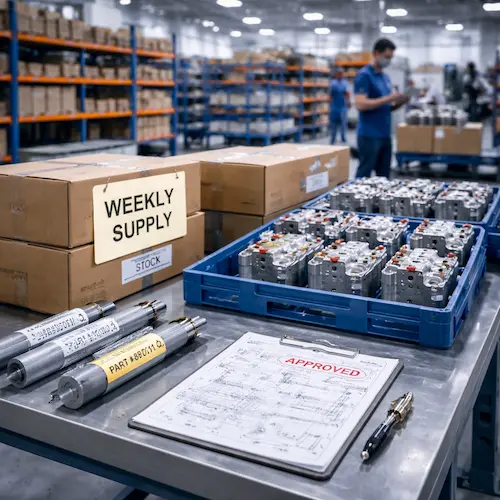
    Align project cadence with inventory strategy, support Single batch delivery or Batch/rolling delivery, making production capacity and delivery more predictable.

Common scenarios for mass production delivery

Pay more attention to mass production and delivery The first stable, Continuous supply with Deliver at pace. We focus on versions, tolerances, materials and inspection standards to help you change delivery from "made" to "continuously predictable".

The product is officially launched: the first batch of deliveries to the market and continuous replenishment and volume expansion

Product officially launched

For the launch node, priority is given to ensuring the stable delivery of the first batch, and supporting the rhythm of subsequent replenishment and volume expansion to avoid the "rollover" of the first batch from affecting the market window.

Typical requirements:

First batch delivered to the market
Continuous replenishment and volume expansion
Predictable quality and delivery
Project-based delivery: engineering project system integration and node-based delivery of components

Project delivery

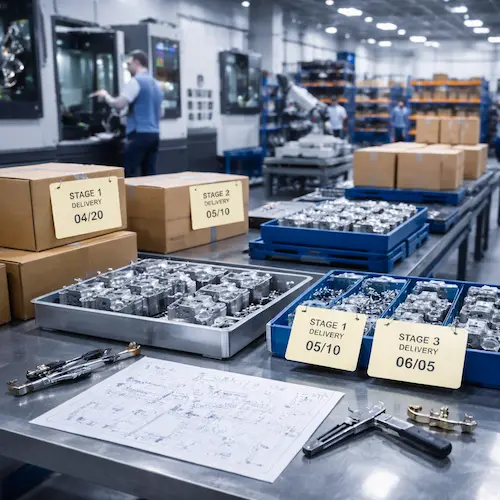
For engineering projects and system integration, components are delivered in stages according to milestones, matching the rhythm of assembly and joint debugging, and reducing waiting and rework.

Typical requirements:

Engineering Projects/System Integration
Deliver parts by node
Batch consistency and traceability
Long-term supply cooperation: fixed parts models and continuous supply of multiple batches

Long-term supply cooperation

For mature models or stable demand, parts models and standards are locked to support continuous supply in multiple batches, making the supply-demand relationship more stable.

Typical requirements:

Fixed part model
Continuous supply across multiple batches
Stable quality and lead time
Multi-Process Combined Product: Metal structure with plastic casing and functional component assembly collaborative delivery

Multi-Process Combined Product

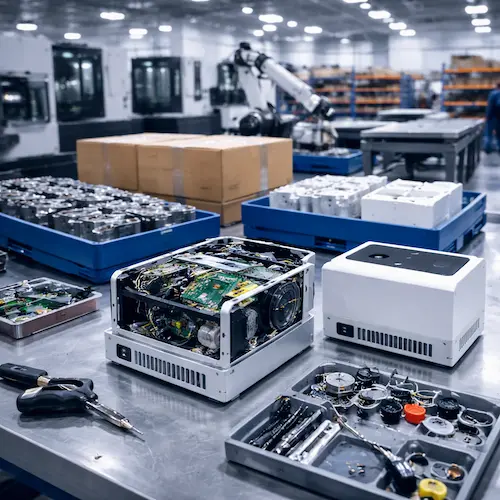
For the delivery of complete machines or components, multiple processes are coordinated in parallel, standards and rhythms are unified, and assembly risks caused by "out of synchronization of different processes" are reduced.

Common combinations:

Metal structure + plastic casing
Functional parts + assemblies
Delivery by set / delivery in batches

Mass production delivery service process

  1. Upload drawings and mass production requirements

    • Supports 2D/3D file formats such as STEP, IGES, STL, DWG, DXF, etc.
    • Can be supplemented with quantity ladders, delivery pace, appearance standards, critical dimensions/benchmarks and inspection requirements
    • Service Timeliness: 1–5 minutes to complete infrastructure analysis
  2. Engineering review and mass production path suggestions

    • Identify mass production risks (tolerance chain, clamping and deformation, mold accessibility, finishing consistency, packaging and transportation)
    • Recommended mass production process path (CNC batch/injection mold opening/sheet metal batch/die casting) and control points
    • Service Timeliness: Standard parts 30–60 minutes to output preliminary review direction
  3. Quote confirmation aligned with quality standards

    • Output mass production quotes, material/finishing suggestions, delivery rhythm and production capacity planning
    • Align inspection plan (first article/process/shipment), random inspection rules and judgment standards
    • Service Timeliness: Complete project review and quote feedback within 24 hours (depending on complexity)
  4. Trial production introduction and process control implementation

    • Carry out first article confirmation and process control point setting to form batch executable standards
    • If necessary, conduct small batch trial production verification first, and then enter large-scale mass production.
    • Typical rhythm: After trial production is confirmed, rolling delivery will be delivered by week/batch (specified by project)
  5. Batch delivery and quality evidence chain output

    • Delivered in batches and provided with necessary quality documents (inspection records/dimensional reports, etc.)
    • Support version iteration and change control (ECN) to maintain delivery consistency
    • Service Timeliness: Domestic logistics 1–7 days, international shipping by destination

The connection between mass production delivery and pre-production stage

Mass production delivery does not start from "ordering and producing", but from "establishing standards". We condense the early prototype/trial production conclusions into executable process paths and quality standards for mass production, so that mass production does not rely on experience but on stable delivery of the system.

Consolidate trial production conclusions into mass production standards

We not only deliver finished products, but also solidify key constraints into mass production standards: key dimensions/benchmarks and inspection methods, appearance judgment and samples, material grades and batch management, finishing parameters and color number consistency, packaging and transportation protection, etc. Let each batch be executed according to the same standard, reducing batch fluctuations and re-inspection costs.

Principle = solidified standards + consistent execution + traceable evidence
  • Lock down key dimensions/datums and inspection methods (“what to focus on”)
  • Define appearance standards and boundaries (what needs to be determined)
  • Curing process window and control points (requires "how to stabilize")

Typical transition path: from trial production to large-scale mass production

Based on structural stability, quantity ladder, and cost targets, the mass production path can be advanced in stages to ensure verification and closed loop at each step, rather than a one-time risk of large-scale production.

Path = engineering review → trial production introduction → process solidification → stable mass production
  • Trial production → CNC batch: Multiple varieties, small batches/rapid ramp-up
  • Trial production → Injection molding mass production: After the structure is stabilized, it will enter large-scale manufacturing.
  • Trial production → Die casting mass production: For large-scale delivery of metal structural parts

Through "standard solidification + process closed loop + supply chain collaboration", the risk is left in the introduction stage, and only in the batch stage can the yield rate be stable, lead time is controllable, and quality is traceable.

Work with us to achieve stable mass production delivery

All uploaded content is treated securely and confidentially.

FAQs