
Polishing (de-gating and trimming)
Castings usually require de-gating/rising and trimming transitions. The higher the polishing level, the "cleaner" the appearance, but the cost and cycle time will also increase.
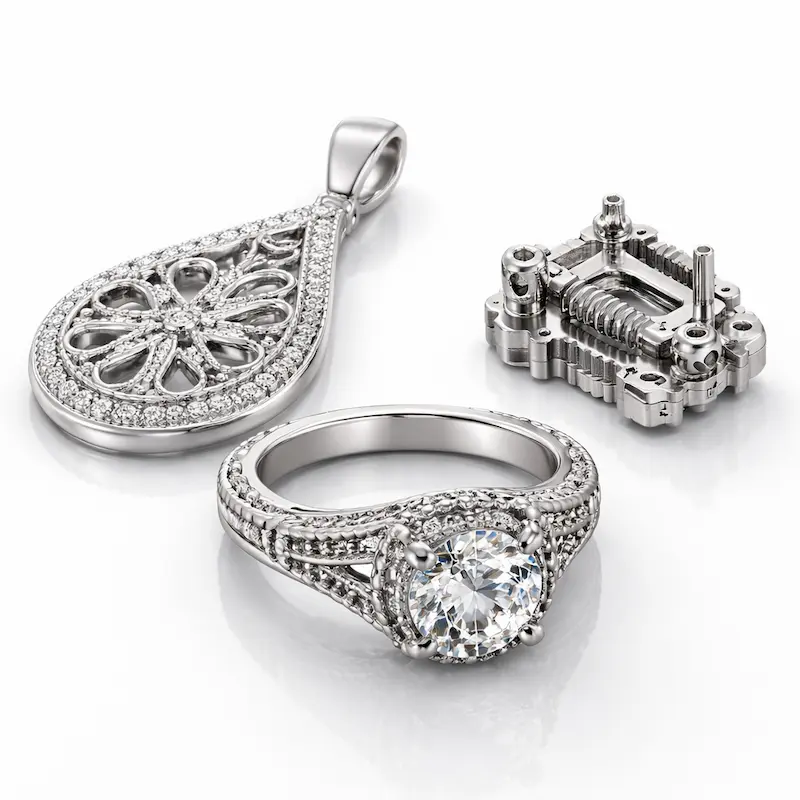
Platinum – Lost-Wax Casting, Polished front-end molding for lost-wax/investment casting, the goal is not "direct use of printed parts," but rather to achieve more complex and finer casting shapes.
Quote checklist: Upload your 3D model and, when available, a 2D drawing. Identify the required process, material, quantity, critical dimensions, finish, appearance standard, and target delivery date.
Engineering note: Values below are typical reference ranges. Final manufacturability, tolerances, material condition, surface finish, cost, and lead time depend on the drawing, geometry, quantity, and selected process.
Upload CAD files and mark critical features for an engineering review before production.
| Process | Wax model 3D printing + lost wax/investment casting + finishing (grinding/polishing, etc.) |
|---|---|
| Finished product target | Platinum metal finished product (closer to the texture and corrosion resistance of the final piece) |
| Accuracy | ±0.2 mm (wax model/process reference; finished product needs to be evaluated based on shrinkage and subsequent processing) |
| Minimum wall thickness | 0.6mm (thin walls/sharp corners are recommended for casting DFM review, thickening or reinforcement if necessary) |
| Service temperature | 50-70℃ (process reference; specific dewaxing/burnout window is subject to the casting route) |
| Tensile strength | 10-20MPa (process reference data) |
| Density | 0.95 g/cm³ (process reference data) |
| Applications | Suitable for complex shape molding and small batch production that require casting, such as jewelry, decorative parts, and fine metal parts; display/review projects that require corrosion resistance and finished metal texture. |
| Finishing | Grinding, polishing, electroplating (nickel/chrome/gold), sandblasting, tapping |
| Typical lead time | Related to structural complexity, quantity, gate plan and finishing level; clear delivery and expedited options will be given after uploading the file |
Castings usually require de-gating/rising and trimming transitions. The higher the polishing level, the "cleaner" the appearance, but the cost and cycle time will also increase.
Suitable for display parts and finished parts that require high metal texture. If mirror/high gloss is required, please specify the appearance and reference standards in the remarks.
Used for appearance enhancement, color uniformity or functional requirements. It is recommended to provide target effect (color difference tolerance/gloss) and appearance surface definition.
Suitable for even, fine and matte surfaces, and can also weaken minor trimming lines. It will have a "blunting" effect on fine textures/sharp edges and needs to be evaluated in advance.
Used for screw assembly, positioning and functional connections. Please indicate the thread specifications (M2/M3/M4, etc.), quantity and location, and mark the key fit tolerances.
There is no need to directly invest in expensive molds, and the shape and process feasibility can be verified faster, which is suitable for prototypes and small batches.
Suitable for small-sized fine structures, decorative textures and complex geometries, improving the design freedom of finished products.
Compared with resin/nylon samples, they are closer to the texture and corrosion resistance of the final product, making them suitable for finished product-level display and review.
Supports combinations of grinding, polishing, electroplating and sandblasting, and selects the appropriate appearance grade based on the target texture and budget.
| Material | Key Advantages | Mainly applicable | Not suitable |
|---|---|---|---|
| red wax | Wax mold making for lost wax/investment casting, lowering the mold opening threshold and suitable for complex shapes | Casting route pattern making, process verification, small batch casting | Use directly after printing (need to change resin/nylon/metal printing) |
| Brass (wax cast-polished) | Strong metal texture, good appearance, and large finishing space (grinding/polishing/electroplating) | Decorative parts, display parts, small fine metal parts | Scenarios that require extremely high strength or tight tolerances and do not allow finishing |
| Stainless steel 316L | Corrosion-resistant, suitable for end-use parts; can be sandblasted/polished and combined with finishing to improve assembly accuracy | Corrosion-resistant functional parts, end-use parts, small batch metal parts | Extremely mirror-like appearance but very budget/time sensitive project (finishing level needs to be evaluated) |
| Black SLA Resin (SLA) | Exquisite appearance and strong details, suitable for display/photography samples; fast delivery and more controllable costs | Appearance confirmation, sample review, display/photography, light load trial assembly | Requires real metal texture/temperature resistance/corrosion resistance final parts target |
| Tough SLA - Yellow-Green (SLA) | More impact-resistant than standard resin, taking into account both appearance and certain functional validation | Snap verification, assembly verification, light load function verification | The final route to metal platinum finished products |
it suits the need Real platinum metal finished product items, especially jewelry, decorative pieces and small fine metal parts:
We support mainstream 3D/2D project files:
It is recommended to also note: end use, critical appearance surface, allowable gate location, target surface (grinding/polishing/sandblasting/electroplating) and critical tolerance requirements.
Castings require gates/risers and subsequent cutout trimming. If the appearance and prohibited areas are not specified:
It is recommended to specify in the remarks: which surfaces must be clean and which locations are allowed to be cut and polished.
Lost wax/investment casting has the risk of process shrinkage and deformation, especially thin-walled, large-plane, and thin-thickness mutation structures.
To ensure critical dimensions more reliably, it is recommended that you:
Thin walls and fine textures are common "high-risk areas" in wax casting. Suggestions:
If it contains structures such as hollows, fine characters, closed cavities, etc., it is recommended to conduct a DFM review first to improve the yield.
Common optional finishing includes: grinding, polishing, electroplating (nickel/chrome/gold), sandblasting, and tapping.
If you need a display effect close to the finished product, it is recommended to note: Target texture (mirror/matte/brushed) + key appearance surface + acceptable mark standard, and provide reference pictures is better.
The choice depends on the quality of the finished product you want and the preservation of texture details:
The pursuit of "most like the finished product" is usually Grinding + Polishing(Re-plating if necessary).
Electroplating creates a coating that theoretically brings about minor dimensional changes. Recommendations for mating holes/mounting surfaces:
Tapping can be done, but it is recommended to mainly use "finishing threads", which is more stable and reliable:
Common risks in casting include pores/shrinkage cavities, deformation of slender parts, insufficient feeding at sudden changes in thickness, etc.
Recommendations for reducing risk:
Delivery time is strongly related to structural complexity, quantity, casting schedule and finishing level:
You only need to write down the delivery target and appearance standards in the remarks, and we will provide feasible process combinations and expedited options.
It is recommended to confirm 1-2 samples first, and then lock the process parameters into small batches:
Yes. If you only verify the appearance/size/assembly relationship without insisting that the final product is platinum, the usually cheaper and faster solution is:
Write "Appearance verification first/assembly verification first" in the remarks, and we will recommend a more matching material and process route.