
Polishing (Basic Delivery)
Used to remove gate cutouts and minor surface defects to obtain a more uniform look and feel; please clarify the appearance surface and acceptable mark standards.
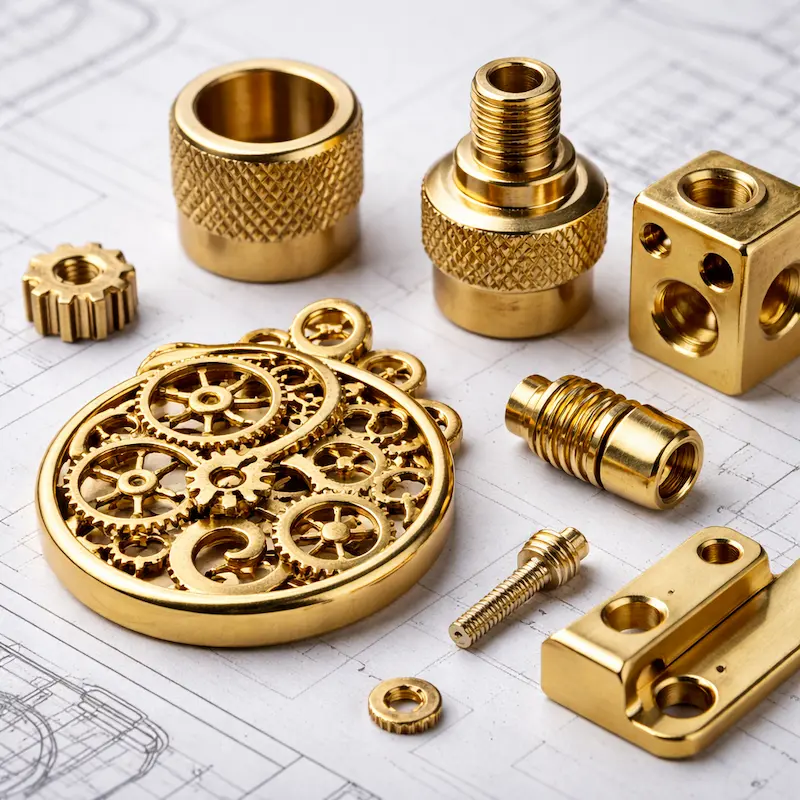
Brass – Lost-Wax Casting, Polished front-end molding for lost-wax/investment casting, the goal is not "direct use of printed parts," but rather to achieve more complex and finer casting shapes.
Quote checklist: Upload your 3D model and, when available, a 2D drawing. Identify the required process, material, quantity, critical dimensions, finish, appearance standard, and target delivery date.
Engineering note: Values below are typical reference ranges. Final manufacturability, tolerances, material condition, surface finish, cost, and lead time depend on the drawing, geometry, quantity, and selected process.
Upload CAD files and mark critical features for an engineering review before production.
| Process | Wax pattern + investment casting (investment casting) + polishing (delivered as real brass metal piece) |
|---|---|
| Color/appearance | Brass metal color; can be adjusted to mirror, matte or specific metallic colors through polishing/sandblasting/electroplating |
| Applications | Decorative parts, handicrafts, small mechanical parts, structural assembly parts |
| Key Advantages | Complex shapes are easier to achieve; real metal texture; ample space for finishing (polishing/plating) |
| Limitations | Ultra-thin walls, extremely deep pores/slits, and extremely precise fits need to be evaluated; gate and trimming strategies need to be clearly defined on the appearance surface. |
| Minimum wall thickness recommendations | Recommended ≥1.0–1.5 mm (Thin-walled/large-area surfaces are recommended to be thickened or reinforced to improve mold filling and yield) |
| Minimal detail advice | It is recommended to leave sufficient depth and width for thin lines/small characters/textures; if electroplating/sandblasting is required, it is recommended to further enlarge the details to avoid "eating the texture" |
| Hole location and thread | It is recommended to reserve allowance for assembly holes/precision holes and process them twice; it is recommended to tap threads (cooperate with tooling positioning if necessary) |
| Surface effect | Delivered based on polishing; polishing/sandblasting/electroplating can further enhance the finished product feel and consistency. |
| Finishing | Grinding, polishing, electroplating (nickel/chrome/gold), sandblasting, tapping |
| Typical lead time | Related to structural complexity, quantity, pouring plan and finishing; clear delivery and expedited options will be given after uploading the file |
Used to remove gate cutouts and minor surface defects to obtain a more uniform look and feel; please clarify the appearance surface and acceptable mark standards.
Suitable for decorative parts, display parts and jewelry/decorative parts; it may have a "rounding" effect on sharp corners and fine textures, so it is recommended to communicate the appearance goals.
Optional nickel/chromium/gold plating solutions can achieve specific metal colors and higher consistency; it is recommended to provide reference drawings and usage environment instructions.
Used to obtain a uniform matte surface and weaken small trimming marks; there will be a certain "eating of details" on small text/textures.
It is recommended to re-process the assembly holes/threads to ensure fit and consistency; please note the thread specifications (M2/M3/M4...) and key fit requirements.
Delivered as brass metal parts, the texture, weight and touch are closer to the final product, suitable for display and final product verification.
Complex surfaces, hollowing, and decorative details are easier to achieve; suitable for crafts and small precision structural parts.
Grinding/polishing/sandblasting/electroplating can quickly enhance the "finished product feel" and improve appearance consistency and visual effects.
It has a cost advantage compared to precious metals, and can meet assembly and functional requirements through tapping/secondary processing.
| Material | Key Advantages | Mainly applicable | Not suitable |
|---|---|---|---|
| red wax | More suitable for wax model and process verification, with low starting cost and fast iteration | Wax pattern verification, modeling confirmation, sample confirmation before casting | Long-term use as final parts (needs to be upgraded to metal castings) |
| Platinum (wax cast-polished) | Precious metal final parts, the finished product has stronger quality and value attributes | Jewelry, decorative pieces, small high-value parts | Highly cost-sensitive large/volume items |
| Black SLA Resin | The cosmetic parts have strong details, a good finished product feel, and fast iterations. | Appearance prototypes, review samples, display pieces | Final parts that require a realistic metallic feel and metal strength |
| Tough SLA - Yellow-Green | Appearance + certain toughness, suitable for light load functional validation | Snap verification, light load assembly, functional validation | Real metal end parts and metal surface finishing requirements |
| Black Nylon (SLS) | The functional type is more stable, wear-resistant and fatigue-resistant, suitable for complex structures and small batches | Structural parts, wear-resistant parts, batch functional parts | Metallic texture/electroplated metal appearance final parts |
it suits the need Real Brass Metal Finish small parts and decorative parts, especially:
In a word: when what you want is Metal Finish + Upgradeable Appearance, Brass wax casting is a very cost-effective route.
We support mainstream 3D/2D project files:
In order to get a faster and more accurate quote, it is recommended to note at the same time: Purpose + critical appearance surface + gate prohibited area + target surface effect (mirror/matte/electroplating) + critical tolerance.
Wax casting requires gates/risers and trimming after casting. If not specified:
It is recommended that you mark on the drawings or notes: Display surface/key surface, No gate area, and acceptable trace standards (the clearer, the less communication costs).
Wax casting is friendly to complex shapes, but the following structures need to be evaluated:
If you "must retain" some details, it is recommended to emphasize them in the remarks, and we will give suggestions on structural optimization and process feasibility.
Sanding is usually the basic delivery (removal of gate cutouts and minor surface imperfections). Common combinations closer to the finished product appearance:
Suggested remarks: Target texture (mirror/matte/brushed) + appearance surface definition + acceptable mark standards.
Suggested principles: The key hole positions and threads are subject to secondary processing., more stable and consistent.
If you want to "fit it as soon as it is installed", please write down the tolerance target in the remarks, and we will give you a processing plan suggestion.
The quote of brass wax casting is not only based on the volume, but also usually widened by these factors:
Common risks in casting include: pores/shrinkage cavities, surface defects, slight deformation, etc. Tips to reduce risk:
After uploading the file, we will do a DFM and, if necessary, give structural adjustment suggestions to improve the yield.
Electroplating can significantly improve color consistency and corrosion resistance. In order to choose the right plan faster, it is recommended that you note:
If you are not sure about choosing nickel/chromium/gold, etc., we can make recommendations based on usage and reference pictures.
Delivery time depends on structural complexity, quantity, pouring scheme and finishing combination. Expediting is usually assessable but may:
The fastest way to get a note template of an executable plan: