
Support Hours: 09:00–18:00 (GMT+8) · Messages and quote requests are accepted 24/7.

Aluminum alloy AlSi10Mg metal 3D printing material (SLM AlSi10Mg / 3D printing aluminum alloy) is suitable for lightweight structural parts, heat dissipation/thermal conduction parts and complex structural integrated molding parts. It can be used for functional validation and end-use parts delivery; it supports finishing such as sandblasting and tapping; upload files for a fast quote and lead-time estimate.

Aluminum Alloy (AlSi10Mg)

Aluminum Alloy (AlSi10Mg) suitable for projects that combine "lightweight + heat dissipation/conduction + integrated complex structures," such as radiators, lightweight brackets, and complex runner components.

Aluminum alloy (SLM) Lightweight Heat dissipation/thermal conduction structure Complex structure integrated molding Internal flow channel Appearance prototype

Quote checklist: Upload your 3D model and, when available, a 2D drawing. Identify the required process, material, quantity, critical dimensions, finish, appearance standard, and target delivery date.

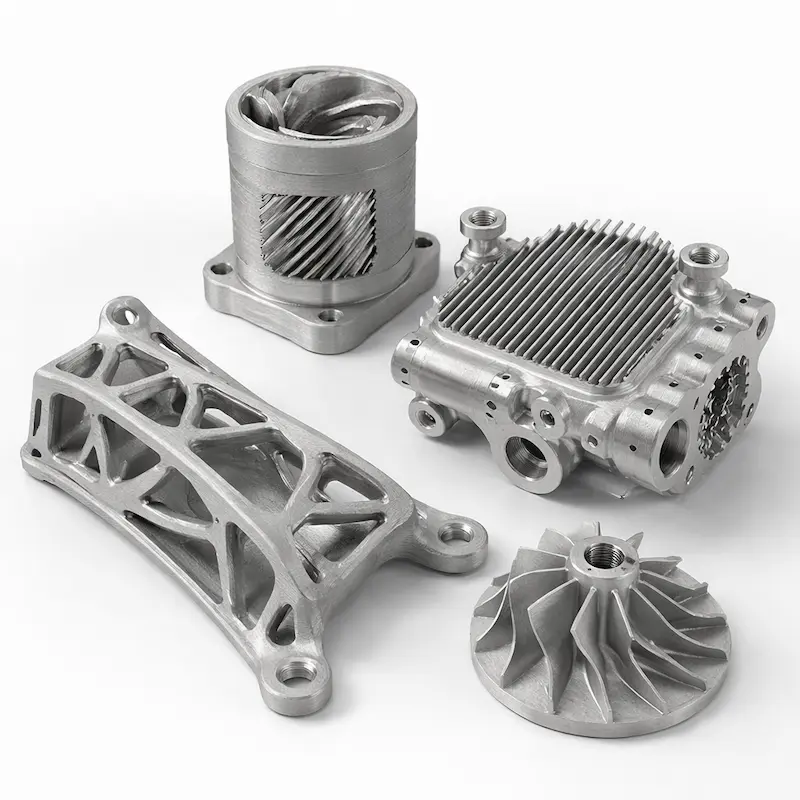
Aluminum alloy AlSi10Mg SLM metal 3D printing sample: commonly used for lightweight and heat dissipation/thermal conductive structural parts, suitable for one-piece molding of complex structures, supports sandblasting and tapping finishing

Key Material and Manufacturing Parameters

Engineering note: Values below are typical reference ranges. Final manufacturability, tolerances, material condition, surface finish, cost, and lead time depend on the drawing, geometry, quantity, and selected process.

Upload CAD files and mark critical features for an engineering review before production.

ProcessSLM metal 3D printing (aluminum alloy AlSi10Mg)
Material positioningLightweight + heat dissipation/heat conduction + complex structure integrated molding; suitable for functional parts and end-use parts
Dimensional tolerance (reference)±0.2 mm
Minimum wall thickness (reference)1.0mm
Temperature resistance (reference)200℃
Tensile strength (reference)320–460MPa
Density (reference)2.65 g/cm³
Threads and mounting holes Threads are usually recommended through Tapping Obtain more stable assembly quality; it is recommended to provide 2D markings for key mating holes/positioning holes and plan secondary processing paths (if higher assembly accuracy is required).
FinishingSand blasting and tapping
Typical lead timeRelated to structural complexity, quantity, support and finishing; clear delivery and expedited options will be given after uploading the file

Finishing

Sandblasting (appearance consistency and feel)

Used to improve the surface uniformity and look and feel of metal 3D printing, making the appearance more "industrially consistent". If there are requirements for the appearance surface, it is recommended to note the appearance surface and roughness preferences.

Tapping (reliable assembly)

Used to obtain more stable thread assembly quality. Please indicate the thread specification (M value), quantity, location and assembly method (screws/bolts/connectors) in the remarks.

Why choose aluminum alloy AlSi10Mg (metal 3D printing)

Lightweight and more friendly

Suitable for structural weight reduction and integrated design; reducing overall weight while meeting strength requirements (common in brackets, shells, and structural parts).

Thermal dissipation/thermal conduction structure is more suitable

It is more suitable for radiators, thermal conductive bases, parts with cooling fins and complex heat exchange structures, and can create more complex internal and external heat exchange forms.

Complex structure integrated molding

Multiple pieces can be combined into one, reducing welding/assembly points and improving structural integration; it has obvious advantages for complex internal structures.

Can be matched with assembly requirements

A more reliable thread assembly is achieved through tapping; for key hole locations and mating surfaces, more appropriate manufacturing and subsequent processing strategies can be planned during the planning stage.

Recommended Applications

  • Lightweight structural parts: Brackets, shells, connectors, weight-reducing structural optimization parts
  • Heat dissipation/thermal conduction projects: Radiator, thermal conductive base, heat exchange components with fins/porous structure
  • Complex structure/internal channels: Internal structure or integrated design that is difficult to machine with traditional CNC
  • Functional parts and end-use parts: Small batch delivery that requires metal strength, fast iteration, and no need to open molds

It is not recommended to use it directly (it is recommended to change the plan)

  • Structure is simple and cost sensitive: Evaluate CNC machining first (tends to be more economical)
  • Ultra-high assembly precision/mirror appearance: It is recommended to combine printing + finishing, or directly choose CNC
  • Completely closed lumen and sensitive to residual powder: It is necessary to ensure that powder can be discharged/cleaned, otherwise a closed structure is not recommended.
  • Do not allow any traces of support on the exterior surface: It is necessary to define the appearance surface in advance and evaluate the placement/support strategy

Design and DFM Guidelines

  • Thin wall/large surface control: The minimum wall thickness reference is 1.0mm; thin-walled large planes and long cantilevers are more likely to deform. Reinforcement, rounded corners and smooth transitions are recommended.
  • Internal flow channels must be able to discharge powder: Please reserve powder discharge holes and cleaning paths to avoid completely closing the cavity; for complex passages, it is recommended to conduct a DFM review first.
  • Keyhole/Datum Plane Recommended Planning Strategies: If assembly accuracy is a priority, it is recommended to provide 2D annotations and plan secondary processing paths at key hole locations.
  • Recommended thread tapping: Direct forming thread consistency is more affected; tapping is more stable, please indicate M specification, quantity and location.
  • The appearance surface is defined in advance: Sandblasting can improve the consistency, but roughening of the functional surface/sealing surface needs to be avoided. Please mark the appearance surface and functional surface.

Comparison with common metal/nylon materials

Material Key Advantages Mainly applicable Not suitable
Stainless steel 316L (SLM) Stronger corrosion resistance, suitable for moisture/salt spray and general metal terminal pieces Corrosion-resistant functional parts, end-use parts, complex structural parts Projects with the first goal of lightweight/thermal conductivity (AlSi10Mg is more suitable)
TC4 Titanium (SLM) High strength-to-weight ratio, performance priority High-end structural parts, lightweight end-use parts, and reliability-first parts Budget-sensitive general purpose lightweight/cooling parts (AlSi10Mg is more economical)
Die steel 1.2709 (SLM) High strength and good heat treatment performance, suitable for jigs/molds Jigs and fixtures, mold inserts, high-strength structural parts Parts focusing on heat dissipation/heat conduction and lightweight
White Nylon (SLS) Wear-resistant and fatigue-resistant, suitable for batch typesetting of complex structures, high cost performance Structural validation parts, assembly parts, wear-resistant moving parts Terminal pieces that require metal strength/temperature resistance and heat dissipation capabilities
Black SLA Resin (SLA) The appearance details are stronger and suitable for display and review Appearance prototypes, review samples, photographic samples Metal strength/temperature resistance/thermal conductivity requirements (AlSi10Mg is more suitable)

FAQs