
Support Hours: 09:00–18:00 (GMT+8) · Messages and quote requests are accepted 24/7.

TC4 Titanium SLM metal 3D printing material (Ti-6Al-4V / titanium alloy TC4 / SLM titanium alloy printing / metal additive manufacturing) is suitable for lightweight high-strength structural parts, corrosion-resistant functional parts and high-reliability end-use parts. It supports sandblasting and tapping (thread processing), and provides fast quote and delivery.

TC4 Titanium Alloy (Ti-6Al-4V)

TC4 Titanium Alloy (Ti-6Al-4V) is a high-performance metal solution, suitable for end parts where you have very high requirements for "strength-to-weight ratio, corrosion resistance, and reliability."

Titanium alloy (SLM) High strength to weight ratio Corrosion-resistant terminal pieces Lightweight structural parts Complex one-piece molding Tapable assembly

Quote checklist: Upload your 3D model and, when available, a 2D drawing. Identify the required process, material, quantity, critical dimensions, finish, appearance standard, and target delivery date.

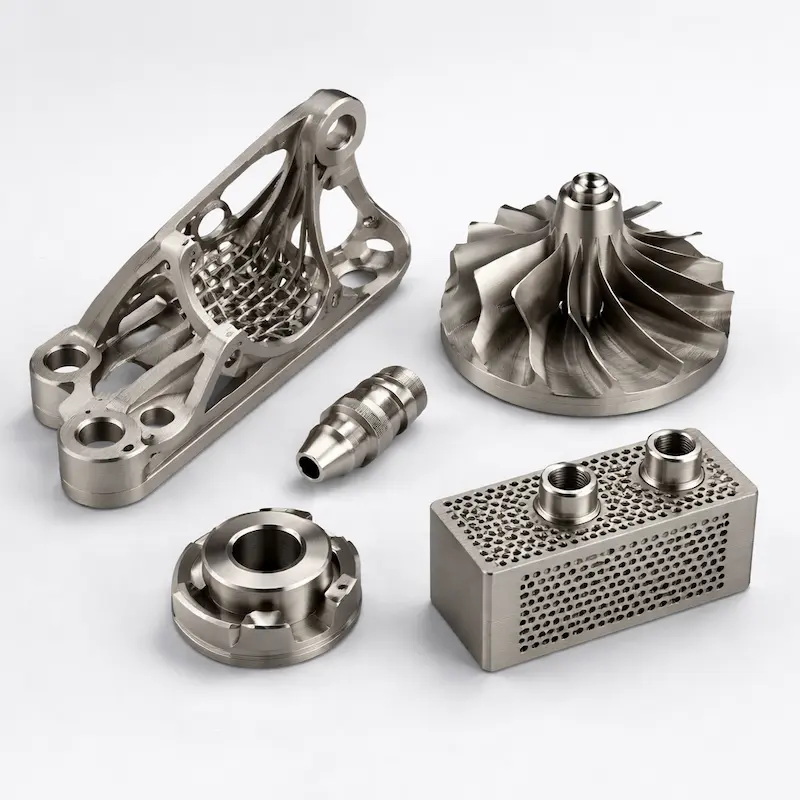
SLM titanium alloy TC4 (Ti-6Al-4V) metal 3D printinged sample: commonly used for lightweight, high-strength structural parts and corrosion-resistant functional parts, and can be sandblasted and tapped for assembly

Key Material and Manufacturing Parameters

Engineering note: Values below are typical reference ranges. Final manufacturability, tolerances, material condition, surface finish, cost, and lead time depend on the drawing, geometry, quantity, and selected process.

Upload CAD files and mark critical features for an engineering review before production.

ProcessSLM metal 3D printing (titanium alloy Ti-6Al-4V / TC4)
ColorMetallic color (sandblasting can obtain a more uniform matte texture; the texture target can be noted on the appearance surface)
Dimensional tolerance±0.20 mm (commonly used diameters; it is recommended to mark tolerances or note "precision first" for key holes/datum surfaces, which can be used in conjunction with machining strategy evaluation)
Minimum wall thickness≥1.0 mm (recommended value; residual stress and deformation risk need to be assessed for thin-walled/long thin structures)
Minimum apertureRecommended ≥2.0–3.0 mm (directly formed hole); it is usually recommended to reserve allowance and secondary processing/tapping for assembly holes/threaded holes
Text/textureThe height of convex characters is ≥0.5 mm; the depth of concave characters is ≥0.3–0.5 mm; the line width is ≥0.3–0.5 mm (the details will be slightly “softened” after sandblasting, so it is recommended to increase the size appropriately)
Tensile strength900–1100 MPa
Service temperatureAbout 350℃ (used for structural/functional validation in higher temperature environments; specific conditions are subject to working conditions and structure)
Density4.43 g/cm³
Surface roughnessRelevant to orientation/support/parameters; sandblasting can significantly unify the appearance and feel (but is not equivalent to mirror surface)
Accuracy levelStandard accuracy/accuracy priority (key hole position/datum plane and acceptance criteria need to be defined in remarks)
Assembly enhancements support Tapping Used for screw assembly; please indicate the thread specification (such as M3/M4), quantity, hole depth and effective thread length; if it is a high-strength fastening/repeated disassembly and assembly scenario, it is recommended to provide assembly conditions to evaluate a more stable structure and processing strategy
FinishingSand blasting and tapping
Lead timeRelevant to volume, quantity, wall thickness distribution, support complexity and whether tapping is required; clear lead time and expedited feasibility will be given after uploading the file

Finishing

Sandblasting (unified texture)

Sandblasting can quickly obtain a more uniform matte appearance, weakening the visual difference between layer patterns and support marks, and is suitable for improving the consistency of appearance surfaces/handpieces.

Tapping (reliable assembly)

Used for screw assembly and structural fixing. Please indicate the thread specifications, quantity, hole depth and effective thread length in the remarks, and provide 2D markings of key hole positions to facilitate accurate quote.

Why choose titanium alloy TC4 (SLM)

High strength-to-weight ratio (lightweight priority)

It significantly reduces weight while maintaining high strength, and is suitable for high-end structural parts, lightweight brackets and functional parts/end-use parts that prioritize performance.

Corrosion resistance and reliability

It is more stable to moisture, sweat, and general corrosive environments, and is suitable for long-term use or projects that require high material reliability.

Complex structure integrated molding

It is conducive to merging multiple parts into one, reducing assembly and welding; the advantage is more obvious for structures that are difficult to process in traditional processes (lightweight inner cavity/topology).

Assembly can be floor-mounted (sandblasting + tapping)

Sandblasting is used to improve appearance consistency, and tapping is used for thread assembly and structural fixation; for key hole locations, a more stable processing plan can be evaluated through the "precision first" strategy.

Recommended Applications

  • Lightweight and high-strength structural parts: Sensitive to weight, requiring high strength and reliability at the same time
  • Corrosion-resistant functional parts/end-use parts: Long-term use in humid or generally corrosive environments
  • Complex integrated structures: Want to reduce assembly, improve integration, or achieve difficult-to-process structures
  • Requires thread assembly: Can be tapped to achieve a more stable screw connection (please note the thread specifications and location)

It is not recommended to use it directly (it is recommended to change materials/processes)

  • Extremely cost-sensitive and simple in structure: Can evaluate traditional machining solutions such as CNC
  • Oversized parts/large flat surfaces with extremely demanding appearance: It is recommended to first evaluate the subassembly strategy and surface acceptance criteria
  • Requirements for hole position/fit limit accuracy: Usually required to cooperate with machining plan (please provide 2D annotation)
  • Only for appearance display and no strength requirement: Can evaluate more economical material systems such as resin/nylon

Design and DFM Guidelines

  • Please mark the key hole/datum plane in 2D: The "assembly confidence" of SLM depends on your definition of critical dimensions; it is recommended to provide PDF/DWG and mark the tolerance, or note "precision first".
  • Thin-walled and slender structures: Try to avoid ultra-thin large flat surfaces and long cantilevers; if necessary, reinforce reinforcements, add transition fillets, or assemble them in parts to reduce the risk of deformation caused by residual stress.
  • Uniform wall thickness with transitions: Avoid sudden changes in thickness and stress concentration at sharp corners; use fillets/chamfers to transition and keep the wall thickness more uniform, which will help stabilize molding and subsequent assembly.
  • Thread and Mounting Hole Strategies: It is recommended to leave a machining allowance and tap the threaded holes; please note the thread specifications, hole depth, quantity and location to avoid insufficient hole depth/thread length affecting assembly.
  • Appearance surface and sandblasting acceptance: Sandblasting will unify the texture but also "soften" the details; if there is an appearance surface, please define the appearance surface and acceptable texture standards to facilitate placement and processing strategy optimization.

FAQs