
Brushed
It is suitable for scenes such as chassis panels and decorative cosmetic parts that require a consistent texture direction; it is recommended to mark the drawing direction and visible surface in the drawings or notes.
Stainless steel_SUS316 is very commonly used in sheet metal fabrication Corrosion-resistant stainless steel One of the options.
Quote checklist: Upload your 3D model and, when available, a 2D drawing. Identify the required process, material, quantity, critical dimensions, finish, appearance standard, and target delivery date.
Engineering note: Values below are typical reference ranges. Final manufacturability, tolerances, material condition, surface finish, cost, and lead time depend on the drawing, geometry, quantity, and selected process.
Upload CAD files and mark critical features for an engineering review before production.
| Process | Sheet metal fabrication (cutting/bending/welding/assembly) |
|---|---|
| Material | Stainless steel_SUS316 (commonly used stainless steel sheet metal material with priority on corrosion resistance) |
| Accuracy | ±0.2 mm |
| Minimum wall thickness | 1.0mm |
| Service temperature | 400℃ |
| Tensile strength | 480–650MPa |
| Density | 7.9 g/cm³ |
| Typical applications | Chassis cabinets, shell panels, bracket connectors, corrosion-resistant structural parts and long-term use parts |
| Appearance suggestions | If there is a visible surface, please indicate Drawing direction, appearance grade and acceptable weld/splicing mark standards; if high appearance consistency is required, it is recommended to evaluate polishing/electrolytic polishing. |
| Document suggestions | Suggestions are provided STEP/IGES + 2D(PDF/DWG/DXF), 2D marking of plate thickness, key hole locations and assembly benchmarks can significantly improve the accuracy of quote and delivery. |
| Finishing | Brushing, polishing, electrolytic polishing, passivation, laser engraving |
| Typical lead time | Related to plate thickness, structural complexity, welding/assembly and finishing; clear delivery and expedited options will be given after uploading the file |
It is suitable for scenes such as chassis panels and decorative cosmetic parts that require a consistent texture direction; it is recommended to mark the drawing direction and visible surface in the drawings or notes.
Improves surface finish and appearance texture, suitable for visible and touch surfaces; if mirror effect is required, it is recommended to provide target reference.
It improves the micro surface condition while improving the smoothness. It is often used for parts that have higher requirements for cleanliness and appearance consistency (subject to engineering evaluation).
Enhances corrosion resistance and improves surface stability; suitable for applications in humid, salt spray or mild chemical media environments.
Suitable for serial number, nameplate information, logo and logo engraving; it is recommended to provide vector files and location and size instructions.
It performs more stably in humid, salt spray and mild chemical media environments, and is suitable for long-term use and sheet metal parts with higher environmental requirements.
It is used for structural parts such as chassis cabinets, brackets, connectors, etc., taking into account strength and durability; it is recommended to mark tolerances and conduct DFM review on key assembly parts.
Supports appearance paths such as brushing/polishing/electrolytic polishing, suitable for visible surfaces and shell panel parts that require texture.
Optional passivation improves corrosion resistance and stability, and can be combined with laser engraving to achieve traceable marking, making it suitable for equipment and mass production management scenarios.
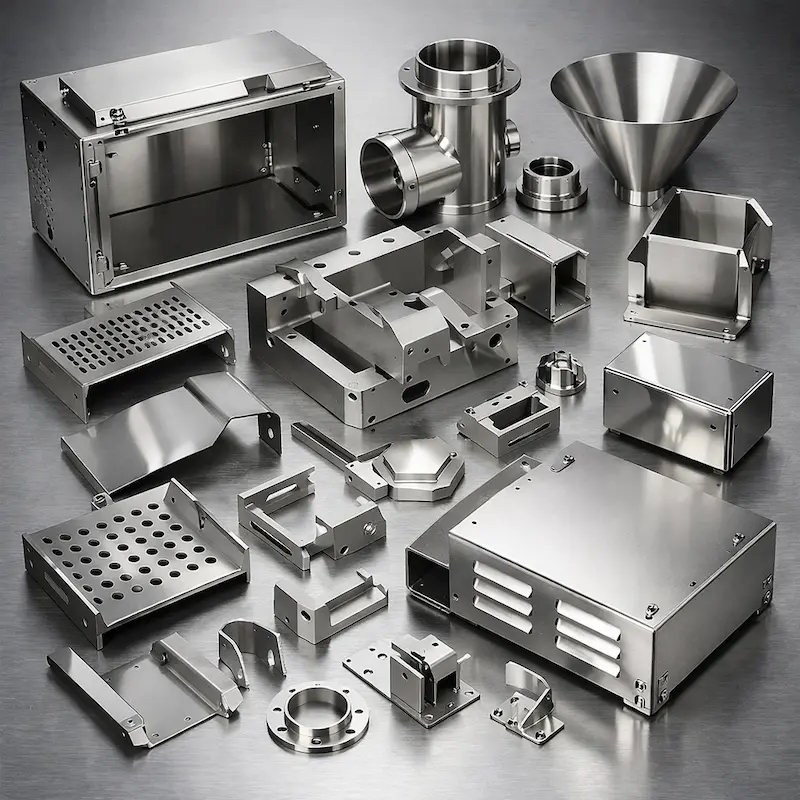
Stainless steel_SUS316 (sheet metal fabrication) is often used in corrosion-resistant and long-term use scenarios, such as chassis cabinets, shell panels, mounting brackets, connectors and equipment structural parts.
If you will use it in humid, salt spray or mild chemical media environments and want a more stable appearance and texture, SUS316 is usually more suitable.
Simple understanding: If your environment is more "harsh" (humidity, salt spray, mild chemical media) and you prefer corrosion resistance and stability, give priority to stainless steel_SUS316; if the environment is relatively mild and cost-sensitive, you can evaluate SUS304 (subject to engineering evaluation).
It is recommended to note the usage environment and cleaning and maintenance requirements when uploading files, and we will give more suitable material suggestions.
Commonly used key parameters of stainless steel_SUS316 (sheet metal fabrication) are as follows:
If you have key assembly hole locations/datum planes, please refer to the 2D drawing markings. We will conduct DFM confirmation based on the structure and process.
It is recommended to provide 3D + 2D combination to improve quote accuracy:
If only 2D is provided, please also clearly mark the plate thickness, bending information and assembly datum.
The cost of stainless steel_SUS316 sheet metal parts is usually related to the following factors:
If you want to get a faster and more accurate quote, it is recommended to note: quantity, lead time, appearance standards and usage environment.
Finishing supported by stainless steel_SUS316 (sheet metal fabrication) includes:
If it is an exterior panel part, it is recommended to write clearly in the remarks: visible surface, drawing direction, target gloss level (more matte/more bright), and whether the weld seam is allowed to be visible.
It is recommended that you specify the appearance standards in the order notes:
If the appearance requirements are high, it is recommended to evaluate polishing or electrolytic polishing at the same time and provide reference pictures for more efficiency.
Stainless steel_SUS316 is more suitable for use in humid, salt spray or mild chemical media environments, and has better overall corrosion resistance and stability.
Whether passivation is required depends on your usage environment and cleaning and maintenance requirements. It is recommended to indicate the medium (such as salt spray, detergent, oil stain) and usage cycle in the remarks, and we will give more appropriate finishing suggestions.
Common risks include large flat surfaces of thin plates, local deformation caused by welding heat input, and warpage caused by uneven thickness/stiffness of the structure.
Common ways to reduce risk:
In order to get a faster and more accurate quote, it is recommended that you also indicate when uploading the file:
You only need three steps: Upload drawings → Confirm project evaluation and quote → Production and delivery after confirmation.