
Brushing (appearance texture and direction control)
Suitable for panels, chassis shells and visible surfaces. Please note the drawing direction, appearance surface definition and acceptable scratch standards to improve consistency.
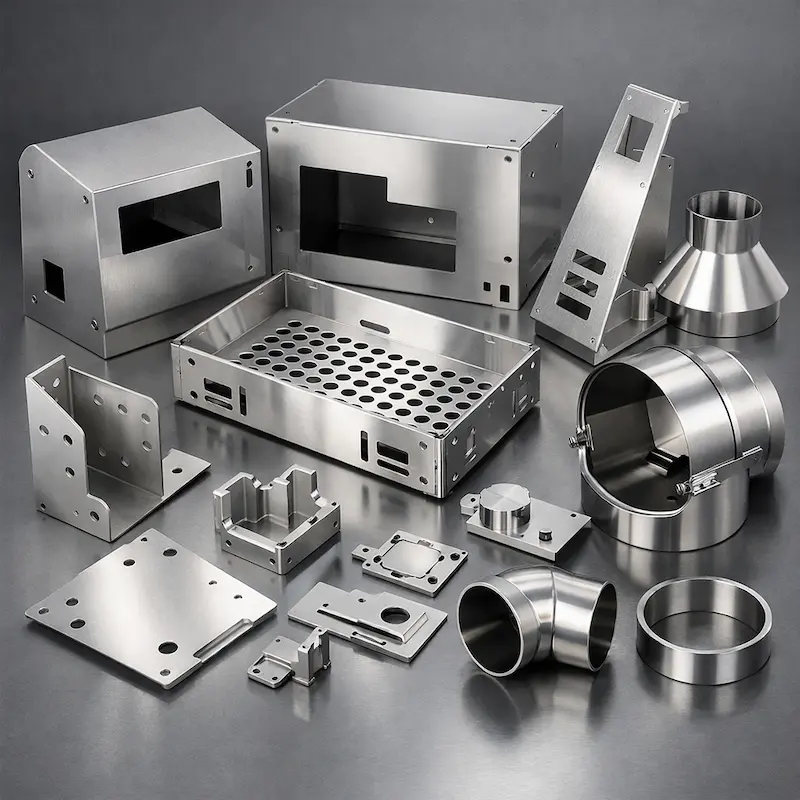
Stainless steel_SUS304 is a very common material option in sheet metal fabrication scenarios, suitable for you Corrosion resistance, appearance texture and cost Make a balance between them.
Quote checklist: Upload your 3D model and, when available, a 2D drawing. Identify the required process, material, quantity, critical dimensions, finish, appearance standard, and target delivery date.
Engineering note: Values below are typical reference ranges. Final manufacturability, tolerances, material condition, surface finish, cost, and lead time depend on the drawing, geometry, quantity, and selected process.
Upload CAD files and mark critical features for an engineering review before production.
| Process | Sheet metal fabrication (laser cutting/number punching/bending/welding/riveting, etc.) |
|---|---|
| Material | Stainless steel_SUS304 (304 stainless steel) |
| Accuracy | ±0.2 mm (common reference; it is recommended to provide 2D tolerance marking for key hole distance/assembly position) |
| Minimum wall thickness | 1.0mm (recommended; depends on structure, bending and appearance requirements) |
| Service temperature | 300–600℃ (engineering reference; actual related to usage conditions/surface condition) |
| Tensile strength | 450–1100MPa (range reference; related to status/standard/heat treatment) |
| Density | 7.7–8.5 g/cm³ |
| Bending recommendations (DFM) | It is recommended to mark the bending angle and benchmark in the drawings, and provide an expansion diagram if necessary; it is recommended to reserve a safe distance for holes/slots close to the bending line, and to set reasonable fillets and bending relief grooves for the inner corners to reduce the risk of cracking and deformation. |
| Hole and Margin Recommendations (DFM) | It is recommended to provide 2D markings (aperture, tolerance, datum) for assembly holes/positioning holes; holes that are too close to the edge/holes to the bend line will lead to an increased risk of deformation or cracking. We can do a DFM before quoting and give manufacturability suggestions. |
| Finishing | Brushing, polishing, electrolytic polishing, passivation, laser engraving |
| Typical lead time | Related to plate thickness, structural complexity, process (bending/welding/surface finishing) and quantity; clear delivery and expedited options will be given after uploading the file |
Suitable for panels, chassis shells and visible surfaces. Please note the drawing direction, appearance surface definition and acceptable scratch standards to improve consistency.
Suitable for cosmetic parts that require gloss and touch. It is recommended to provide the target effect (matte/glossy/mirror tendency) or reference sample/reference picture.
Suitable for parts that are more sensitive to surface cleanliness, detail consistency and corrosion resistance; it can be combined with appearance surface definition and functional condition evaluation.
Suitable for wet, lightly corrosive environments or parts requiring long-term corrosion resistance. If there are media/salt spray and other requirements, please note the usage environment and standards.
Suitable for logo, serial number, QR code, scale and other information. It is recommended to provide the vector file and position and size description, and make it clear whether it is an appearance surface.
Suitable for use in common environments such as chassis, shells, brackets and panels; more reliable for humid and lightly corrosive environments.
Supports various surface solutions such as brushing/polishing/electrolytic polishing/passivation, etc., suitable for projects that require appearance consistency.
Suitable for rapid trial production and small batch delivery of bent parts and box structures; cost and lead time can be optimized through DFM.
Common structures such as panels, guards, brackets, chassis, and mounting plates are all suitable; secondary processes can be used to achieve complete delivery according to assembly requirements.
Stainless steel_SUS304 (sheet metal fabrication) is commonly used in sheet metal structural parts such as chassis cabinets, panel shells, brackets, guards, and mounting plates. It is suitable for prototype trial production and small batch delivery.
Its advantages include stable corrosion resistance and multiple appearance treatment options (brushing/polishing/electrolytic polishing/passivation/radium engraving), making it suitable for projects that require texture and consistency.
The "goodness" of sheet metal parts often depends more on bending interference, hole edge distance, flanging length and welding deformation control; it is recommended to do DFM confirmation after uploading the file.
If there is an expansion diagram or bend table, it is also recommended to provide it together, which will help to accurately quote and confirm manufacturability more quickly.
It is recommended to write clearly in the remarks:
Yes. Stainless steel_SUS304 support polish with electropolishing:
It is recommended to provide the target effect (pictures/samples/descriptions), and we will evaluate the most suitable solution based on the structure and appearance.
If the parts will be in humid, lightly corrosive media or environments that are more sensitive to long-term corrosion resistance, it is usually recommended to add stainless steel_SUS304 Passivation process.
Please indicate the usage environment in the remarks (whether it is outdoors/whether it is exposed to salt spray/whether it is exposed to cleaning agents, etc.) so that we can give more suitable treatment suggestions.
After uploading the file, we will do a DFM check and provide more economical structural adjustment suggestions.
Suggestions:
Stainless steel_SUS304 supports laser engraving of logo, serial number, QR code, scale and other information. In order to avoid affecting the appearance, it is recommended to indicate in the drawings or remarks:
Process: Upload drawings → Project DFM and quote → Confirm process and appearance standards → Production delivery.