
Sand blasting (even matting)
Used to remove knife marks and improve surface consistency to form a uniform matte texture; suitable for unifying cosmetic parts with the bottom surface before subsequent processing.
316 Stainless Steel (containing Mo) is significantly more corrosion-resistant than 304, especially more stable against chloride ions, salt spray, and certain chemical media, making it suitable for CNC parts in "humid/seaside/chemical environments + long-term use."
Quote checklist: Upload your 3D model and, when available, a 2D drawing. Identify the required process, material, quantity, critical dimensions, finish, appearance standard, and target delivery date.
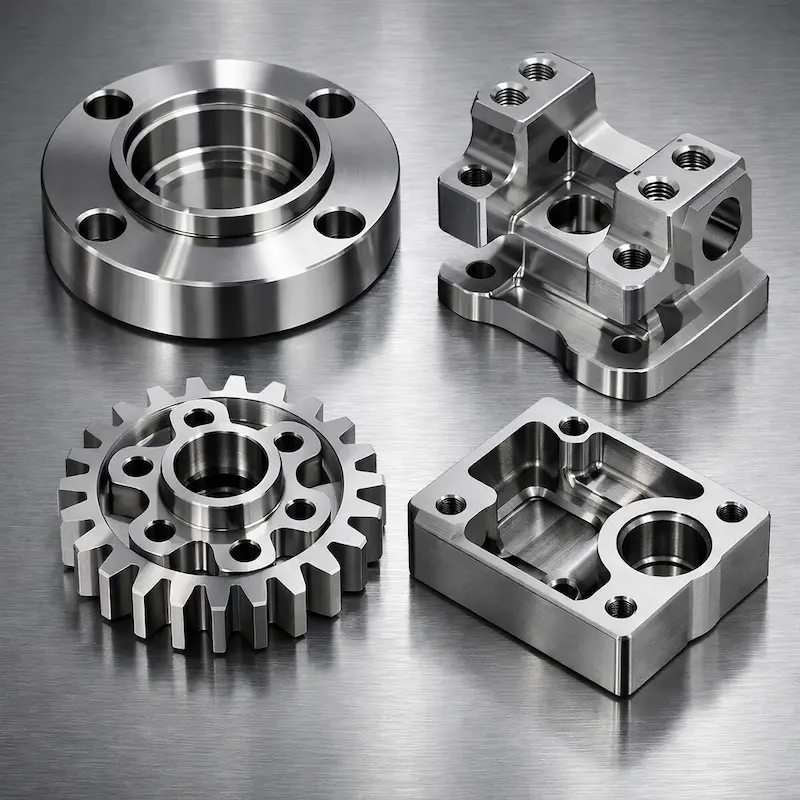
Engineering note: Values below are typical reference ranges. Final manufacturability, tolerances, material condition, surface finish, cost, and lead time depend on the drawing, geometry, quantity, and selected process.
Upload CAD files and mark critical features for an engineering review before production.
| Process | CNC machining (stainless steel 316) |
|---|---|
| Material system | Austenitic stainless steel (stronger corrosion resistance, suitable for seaside/chemical media environments) |
| Machining tolerance | ±0.20 mm (common reference; critical dimensions are subject to 2D marking tolerances) |
| Minimum wall thickness | ≥ 1.0 mm (recommended value; thin-walled/long thin structures are recommended to be reviewed by DFM first) |
| Temperature resistance reference | About 400℃ (short-time/environmental reference; specific subject to working conditions and standards) |
| Tensile strength | 480–650 MPa (common range, may vary with status and standards) |
| Density | 7.9 g/cm³ |
| Holes and threads | It is recommended that assembly holes/positioning holes comply with 2D tolerances; for deep holes and small threads, please mark the hole depth, thread standard and quantity (affects the tool and processing rhythm) |
| Inside angles and tools | It is recommended to reserve a rounded corner R for the inner corners (to avoid tool interference); if a right-angled inner cavity is required, please make a note and accept the process restrictions. |
| Surface requirements | If you need to specify Ra, drawing direction/texture or mirror polishing level, please write it clearly in the remarks and provide a reference sample/reference picture |
| Finishing | Sand blasting, wire brushing, polishing, electrolytic polishing, passivation, laser engraving |
| Typical lead time | Relevant to size, quantity, clamping difficulty and surface finishing; clear delivery and expedited options will be given after uploading the file |
Used to remove knife marks and improve surface consistency to form a uniform matte texture; suitable for unifying cosmetic parts with the bottom surface before subsequent processing.
It is suitable for "metal texture" presentation on the appearance surface; it is recommended to clarify the drawing direction, appearance surface and texture thickness standards to ensure batch consistency.
Used to improve surface gloss and touch; for parts with higher appearance requirements, it is recommended to clearly define the polishing area and accept slight corrugation/rounding changes.
Improves corrosion resistance while improving smoothness, suitable for parts that are sensitive to cleanliness, appearance and corrosion resistance.
Parts suitable for use in humid/salt spray/chemical media environments; it is recommended to note the use medium and environment in order to choose a more matching treatment method and inspection criteria.
Suitable for serial numbers, logos, scales and traceability information; it is recommended to provide vector file/font requirements and position and size instructions to avoid key mating surfaces.
It is more stable in salt spray, humid and chemical media environments, and is suitable for long-term use of structural parts, cosmetic parts and connectors.
Taking into account both strength and reliability, it is suitable for application scenarios and batch delivery that require "metal strength + long-term durability".
Different texture combinations can be made according to the appearance surface to achieve visual and tactile goals from matte to high gloss, which facilitates "finished product" presentation.
It supports passivation to strengthen corrosion resistance, and can be laser engraved to achieve permanent identification and traceability; it is more suitable for projects with quality management and consistency requirements.
316 Stainless Steel is often used in structural parts, cosmetic parts and connecting parts, especially suitable for humid/salt spray/chemical media environments. Core advantages include:
When selecting materials, you can make a quick judgment based on "corrosion resistance requirements":
If your parts will be in humidity/seaside for a long time or may be exposed to chemical media, stainless steel 316 (CNC machining) is usually preferred.
It is recommended to refer to the key tolerances marked on 2D drawings; common references are as follows:
If there are mating holes, sealing surfaces or positioning datums, please mark the tolerances and inspection diameters in the 2D drawings. We will prioritize the processing and inspection based on key surfaces.
We support mainstream engineering files and the recommended practices are as follows:
A combination of faster and more accurate quotes: STEP + 2D annotation (critical tolerance/roughness/appearance surface).
The quote of stainless steel 316 (CNC machining) not only depends on the volume, but also is affected by the following factors:
It is recommended to write clearly in the remarks: Usage/Environment + Critical Tolerance + Surface Target (Orientation/Grade), the quote is closer to the real target.
Common finishing of stainless steel 316 (CNC machining) includes:
It is recommended that you specify the cosmetic parts in the remarks: Appearance surface + drawing direction/polishing level + whether passivation is required, which can significantly reduce the risk of rework and color/texture inconsistency.
To ensure appearance consistency, it is recommended that you at least state in your 2D drawings or notes:
Tip: Multi-sided wire drawing may require multiple clampings. It is recommended to prioritize defining the "most critical display surface".
Common risks mainly come from "insufficient rigidity and insufficient tool accessibility", such as:
Recommendations for reducing risk:
It depends on your environment and appearance goals:
It is recommended to write clearly in the remarks: Using medium, temperature, whether salt spray As well as appearance targets, we will give a more matching processing combination.
In order to get a faster and more accurate quote, it is recommended that you provide/explain when uploading the file:
After uploading the file, we will provide feedback as soon as possible quote with Manufacturability recommendations(DFM), and confirm the process and inspection criteria according to your appearance/delivery requirements.