
Sandblasted (uniform matte finish)
Used to obtain a more uniform matte texture and weaken local knife lines; suitable for exterior parts and decorative surfaces.
303 Stainless Steel is a typical easy-to-machine stainless steel.
Quote checklist: Upload your 3D model and, when available, a 2D drawing. Identify the required process, material, quantity, critical dimensions, finish, appearance standard, and target delivery date.
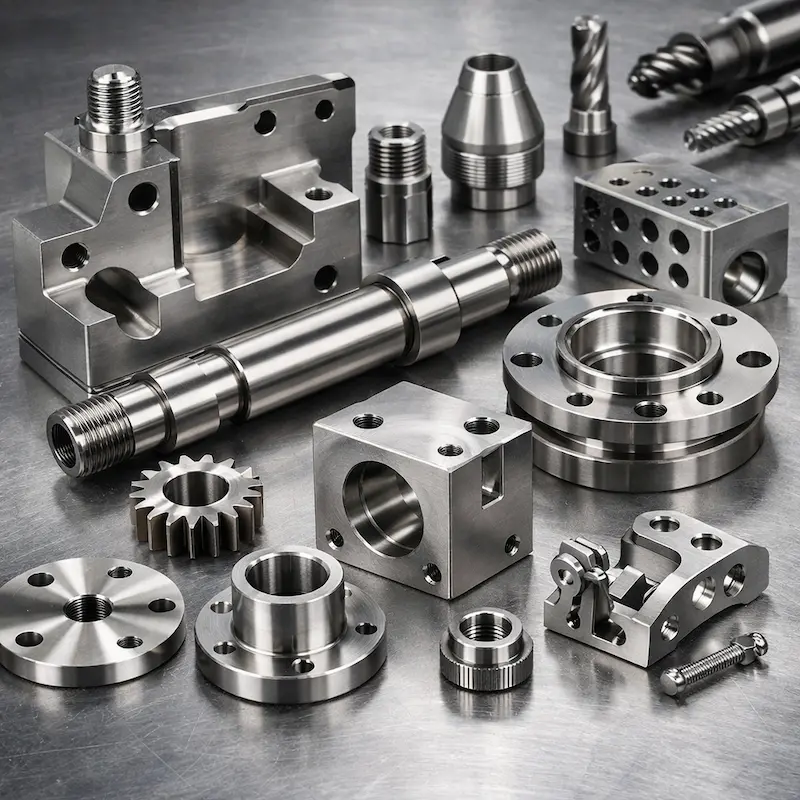
Engineering note: Values below are typical reference ranges. Final manufacturability, tolerances, material condition, surface finish, cost, and lead time depend on the drawing, geometry, quantity, and selected process.
Upload CAD files and mark critical features for an engineering review before production.
| Process | CNC machining (suitable for turning/milling; stainless steel 303 is easy to cut, and batch turning parts are more friendly) |
|---|---|
| Material | Stainless steel 303 (commonly used in CNC machining; one of the 300 series stainless steel with priority in processing efficiency) |
| Accuracy | ±0.2 mm (common diameters; it is recommended to mark tolerances in 2D drawings for critical fits) |
| Minimum wall thickness | ≥1.0 mm (For thin-walled parts, it is recommended to evaluate the clamping deformation and processing texture; the appearance surface can be appropriately thickened for more stability) |
| Service temperature | 300–600℃ (according to the material library criteria; the actual temperature is subject to working conditions and structure) |
| Tensile strength | 450–1100 MPa (according to material library criteria; different conditions/heat treatment and standards will vary) |
| Density | 7.7–8.5 g/cm³ |
| Minimum aperture | Recommended ≥1.5–2.0 mm (drilling/reaming or EDM/secondary process evaluation is recommended for small holes; please mark the key hole positions) |
| Thread/Tapping | Supports thread processing; please indicate the thread standard and grade (such as M3/M4, 6H/6g, etc.) and whether anti-loosening/sealing requirements are required |
| Chamfers and fillets | It is recommended to add chamfers/roundings to sharp corners (reduce burrs, improve assembly and appearance consistency) |
| Appearance suggestions | Please define the appearance surface/drawing direction/polishing target and acceptable processing texture in the drawing or remarks |
| Finishing | Sand blasting, wire brushing, polishing, electrolytic polishing, passivation, laser engraving |
| Typical lead time | Related to structural complexity, quantity, inspection requirements and finishing; clear delivery and expedited options will be given after uploading the file |
Used to obtain a more uniform matte texture and weaken local knife lines; suitable for exterior parts and decorative surfaces.
Suitable for shells/panels/decorative parts; it is recommended to note the drawing direction and appearance surface definition to facilitate consistency control.
Used to improve brightness and touch; complex inner cavities/deep hole locations may be affected by accessibility and need to be evaluated.
Suitable for parts that are more sensitive to surface cleanliness and fine burrs; the actual effect is related to the structure and current accessibility.
Used to enhance surface corrosion resistance stability and consistency (more suitable for humid/chemical environments); it is recommended to clarify whether it is a required option.
Suitable for serial numbers, logos, scales and traceability codes; it is recommended to provide vector files and location and size instructions.
More friendly to a large number of turning/repetitive parts, and suitable for projects that require higher processing efficiency and a more stable delivery rhythm.
Suitable for structural parts, connections and long-term use parts; more stable in humid/oily environments.
Suitable for threaded holes, studs/connection structures; critical fit recommendations specify tolerances and inspection criterias.
Supports sandblasting, wire brushing, polishing, electrolytic polishing, passivation and laser engraving to facilitate the realization of different appearance and marking requirements.
303 Stainless Steel is often used for turned parts, threaded parts and connecting structural parts. The advantages are concentrated in:
If you are more concerned about processing efficiency and delivery of turned batch parts, stainless steel 303 (CNC machining) is more "processing friendly"; if you are more concerned about higher corrosion resistance and versatility, you can evaluate stainless steel 304 (CNC machining).
It is recommended that you state in the remarks: the use environment (moist/chemical media), whether there is a large amount of turning, appearance standards and batch consistency requirements, and we will give more stable suggestions based on the working conditions.
You can refer to the key parameter criteria on this page:
If it involves key dimensions such as fitting holes, bearing locations, sealing surfaces, etc., please provide 2D markings (PDF/DWG), and we will evaluate accessibility and cost based on your inspection criteria.
303 Stainless Steel supports thread processing and is often used for threaded holes and connectors. For faster and more accurate evaluation, please note:
Finishing supported by stainless steel 303 (CNC machining) (subject to the material library) includes:
For cosmetic parts, it is recommended that you write clearly in the remarks: appearance surface definition, drawing direction (if necessary), target gloss/matt level and acceptable processing texture range to facilitate consistency control.
The quote of stainless steel 303 (CNC machining) does not only depend on the volume. Common influencing factors include:
Common appearance factors of CNC stainless steel parts include knife lines, knife marks and burrs. Ways to make stainless steel 303 (CNC machining) more "clean":
303 Stainless Steel can be used in humid environments and general chemical contact scenarios, but whether it must be passivated depends on the working conditions and appearance requirements.
If you are more sensitive to surface stability and corrosion resistance consistency, or the parts will be used in humid/cleaning medium environments for a long time, it is recommended to describe the working conditions in the remarks, and we will evaluate whether to recommend passivation and the corresponding inspection criteria.
Common "cost amplification points" of stainless steel 303 (CNC machining) mainly come from accessibility and rigidity:
Recommendations: Relaxing non-critical tolerances, optimizing groove width/round corners, splitting the structure or adjusting the datum system can usually significantly reduce cost and delivery risks.
In order to get a faster and more accurate quote, it is recommended that you provide/explain when uploading the file:
You only need three steps: Upload drawings → Confirm project evaluation and quote → Production and delivery after confirmation.