
sandblasting
Used to unify surface texture, improve paint adhesion and appearance consistency; suitable for primer treatment before powder coating/painting.
Hot rolled plate_SPHC is documented with typical properties, suitable applications, finishing options, and design guidance for Sheet Metal Fabrication.
Quote checklist: Upload your 3D model and, when available, a 2D drawing. Identify the required process, material, quantity, critical dimensions, finish, appearance standard, and target delivery date.
Engineering note: Values below are typical reference ranges. Final manufacturability, tolerances, material condition, surface finish, cost, and lead time depend on the drawing, geometry, quantity, and selected process.
Upload CAD files and mark critical features for an engineering review before production.
| Process | Sheet Metal Fabrication |
|---|---|
| Material | Hot rolled plate_SPHC (hot rolled carbon steel plate) |
| Accuracy | ±0.2 mm |
| Minimum plate thickness (reference) | 1.0mm |
| Service temperature | 300-600℃ |
| Tensile strength | 450-1100MPa |
| Density | 7.7-8.5 g/cm³ |
| Common process combinations | Laser cutting / digital punching / bending / drilling / riveting (according to drawings and demand assessment) |
| Assembly and welding | Suitable for structural parts and welding parts; if you have welding and appearance requirements, please indicate the weld appearance standards and grinding/painting goals in the remarks |
| Finishing | Sand blasting, blackening, oxidation, galvanizing, nickel plating, powder coating, painting |
| Typical lead time | Related to plate thickness, process combination, quantity and finishing; clear delivery and expedited options will be given after uploading the file |
Used to unify surface texture, improve paint adhesion and appearance consistency; suitable for primer treatment before powder coating/painting.
Used to obtain a black appearance and a certain anti-rust effect (a comprehensive evaluation combined with protection/painting requirements is usually still recommended).
Used to improve surface condition and appearance; if the requirements for corrosion resistance and salt spray are clear, please write down the goals and test standards in the remarks.
One of the common solutions to improve corrosion resistance; suitable for the protection needs of chassis cabinets, structural parts and general sheet metal parts.
Used to improve surface protection and appearance texture; suitable for parts that require both appearance and corrosion resistance.
Get a more wear-resistant, consistent coating appearance; suitable for uniform appearance of chassis cabinet shells, brackets and batch parts.
Color and texture (matte/semi-matte/high-gloss) control can be achieved; it is recommended to provide color number/reference picture and appearance definition.
For prototype and functional validation scenarios, SPHC is more suitable as a cost-effective solution for structural supports and general sheet metal parts.
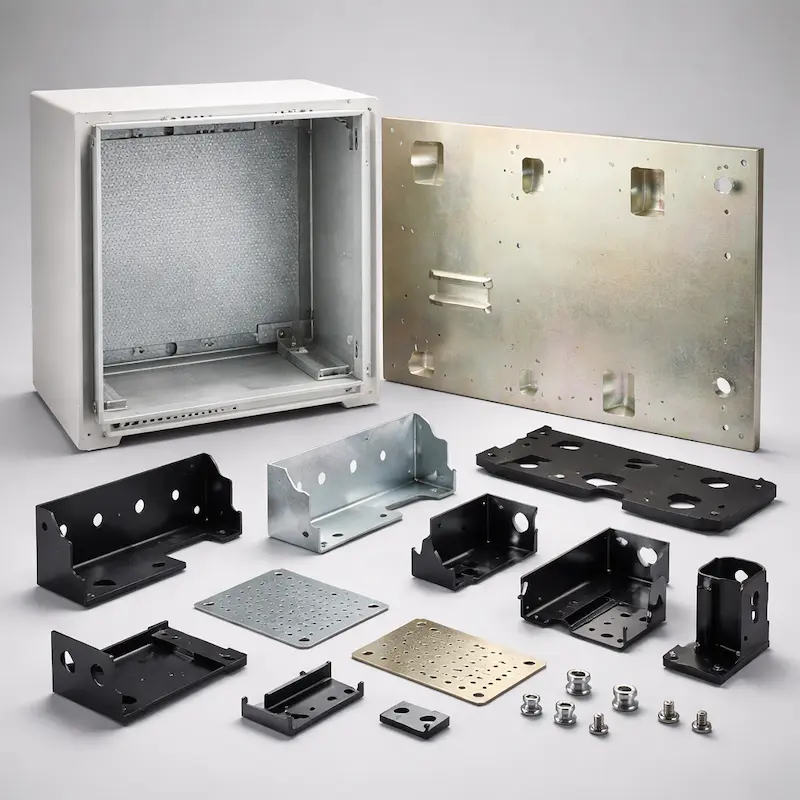
Can combine cutting, bending and common assembly processes; suitable for chassis cabinets, brackets, base plates and connectors, etc.
Supports sandblasting, blackening, oxidation, galvanizing, nickel plating, powder coating, and painting, making it easy to configure according to appearance and corrosion resistance goals.
Upload drawings to quickly assess manufacturability (DFM) and provide quotes and lead times, which is suitable for iterative prototyping and small batches.
Hot-rolled plate_SPHC is commonly used for prototypes and functional validation of sheet metal parts such as general structural parts, chassis cabinets, bracket bottom plates, connectors and welding parts.
If you are more concerned about corrosion resistance or appearance consistency, you can directly note the target when placing an order, and we will recommend more matching solutions such as galvanizing/powder coating/painting.
When choosing sheet metal, you can generally make a choice based on your goals:
You only need to note the usage and appearance standards, and we will give you more suitable material and surface route suggestions during the quote stage.
The key reference parameters of hot-rolled plate_SPHC include: accuracy ±0.2, minimum plate thickness 1.0mm, temperature resistance 300-600℃, tensile strength 450-1100MPa, density 7.7-8.5 g/cm³.
When placing an order, it is recommended that you focus more clearly on: Plate thickness, key holes/datum, tolerance requirements, whether to weld, surface treatment targets.
It is recommended to provide 3D files such as STEP/IGES, together with 2D annotations (PDF/DWG/DXF) to confirm hole locations, tolerances and assembly benchmarks; you can also only provide 2D drawings for quote evaluation.
If requirements such as bending/welding/riveting are included, please clearly indicate the process and appearance standards in the remarks to help get a faster and more accurate quote.
Hot rolled plate_SPHC sheet metal parts quote is usually affected by the following factors:
If you want to get a quote that is closer to your target, it is recommended to note: usage, quantity, lead time, appearance and surface finishing targets.
Hot rolled plate_SPHC supports: sandblasting, blackening, oxidation, galvanizing, nickel plating, powder coating, and painting.
Please write the clear color number/texture (matte/high gloss) and appearance definition in the remarks.
It is recommended to clarify in the drawings/notes: critical bending angles, critical dimension benchmarks and allowable deviations; if the assembly is sensitive, give priority to 2D markings and indicate the "priority control items".
During the quote stage, we can conduct a DFM review and provide more reliable bending and testing suggestions based on the structure and plate thickness.
For welded parts, it is recommended that you indicate in the remarks: the welding position, the appearance grade of the weld, whether it needs to be polished and smoothed, and whether it will be powdered/painted later.
If there are key assembly hole locations/datums after welding, it is recommended to clearly define the detection datums and tolerance requirements to facilitate control of deviations caused by welding deformation.
If you are more concerned about coating wear resistance and appearance consistency, powder coating is usually more suitable for chassis and cabinet parts; if you need more flexible colors and local repair solutions, you can evaluate painting.
No matter which one you choose, it is recommended to provide the color number/reference picture, and define the appearance surface and masking surface, so that it is easier to get it right at the quote stage.
If you want to get a faster and more accurate quote, it is recommended that you write clearly when uploading the file:
Process: Upload drawings → Project evaluation and quote → Production and delivery after confirmation.