
chamfer
It is used to remove sharp edges and improve the feel and safety of assembly; the chamfering size of the sealing surface/mating surface can be controlled according to the drawing requirements.
PTFE (polytetrafluoroethylene) is characterized by "extremely low friction coefficient, extremely strong chemical corrosion resistance, high temperature resistance, and good electrical insulation," making it a classic material for chemical and sealing applications.
Quote checklist: Upload your 3D model and, when available, a 2D drawing. Identify the required process, material, quantity, critical dimensions, finish, appearance standard, and target delivery date.
Engineering note: Values below are typical reference ranges. Final manufacturability, tolerances, material condition, surface finish, cost, and lead time depend on the drawing, geometry, quantity, and selected process.
Upload CAD files and mark critical features for an engineering review before production.
| Process | CNC Machining |
|---|---|
| Material name | PTFE |
| Machining tolerance | ±0.2 mm |
| Minimum wall thickness | 1.0mm |
| Service temperature | 300-600℃ |
| Tensile strength | 450-1100MPa |
| Density | 7.7-8.5 g/cm³ |
| Finishing | Chamfering, grinding, bonding, screen printing, laser engraving, surface treatment (plasma/sand blasting) |
| Typical lead time | Related to size, quantity, structural complexity, tolerance requirements and finishing; clear delivery and expedited options will be given after uploading the file |
It is used to remove sharp edges and improve the feel and safety of assembly; the chamfering size of the sealing surface/mating surface can be controlled according to the drawing requirements.
It is used to improve the consistency of local texture and appearance; for functional surfaces, the process route can be selected based on the roughness target.
Suitable for assembly after component processing; please note the bonding interface, strength requirements and whether medium/temperature resistance is required.
Used for logos, scales and other information; it is recommended to provide vector files and location and size instructions.
Applicable to numbers, QR codes and identification marks; it is recommended to note contrast/depth/area size requirements.
Used to adjust surface condition, improve adhesion or appearance; please note the purpose (such as improving bonding/printing adhesion) and target effect.
Suitable for parts and components that need to work in corrosive media or complex environments.
Suitable for parts with temperature resistance requirements; it is recommended to specify the operating temperature range and contact medium when placing an order.
Suitable for electrical isolation, insulating structural parts and other applications; can be combined with screen printing/laser engraving for identification.
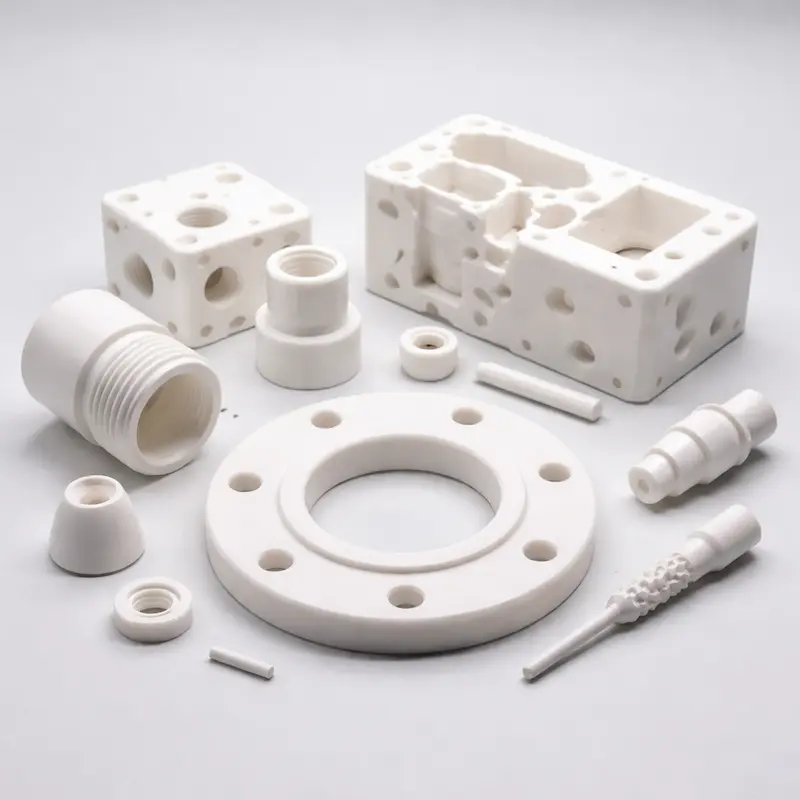
Quickly obtain assembly-ready, verifiable structural parts and end-use parts through CNC machining, which is suitable for prototyping and small batch production.
PTFE is often used when needed Corrosion-resistant, high-temperature-resistant or electrically insulating For the parts required, structural parts and end-use parts can be quickly obtained through CNC machining, which is suitable for prototyping and small batch production.
The key parameters for reference on this page are:
If your parts have critical fit tolerances or sealing surface requirements, it is recommended to provide 2D drawing annotations. We will evaluate the drawing requirements and provide feedback on manufacturability suggestions.
Polytetrafluoroethylene - PTFE (CNC machined) supports: Chamfering, grinding, bonding, screen printing, laser engraving, surface treatment (plasma/sand blasting).
It is recommended to write clearly in the remarks: finishing type, corresponding area (which side/which circle/which section), appearance or functional goals (such as "improving bonding adhesion/marking durability").
when you are right Surface condition, adhesion or appearance consistency Surface finishing (plasma/sand blasting) can be evaluated when there is a clear requirement. For example, when it is necessary to enhance bonding, improve print adhesion, or unify surface texture, it is recommended to state the goals and acceptable appearance standards in the remarks.
It is recommended to select the model according to your actual working conditions: operating temperature range, duration, whether it is exposed to chemical media, whether it can withstand long-term load, etc., and write it clearly in the remarks. We will give material and process suggestions based on structural and manufacturing feasibility.
Please provide 2D drawing annotations Critical Dimensions, Tolerances and Datums(For example, hole fit level, coaxiality/position, etc.). For key hole positions, you can indicate "accuracy priority/inspection requirements" in the remarks so that we can configure the plan according to the target in processing and inspection.
Our usual process is: Upload drawings → Project evaluation/DFM → Quotation and delivery confirmation → Production delivery.