
chamfer
It is used to remove sharp edges, improve assembly feel and reduce the risk of edge collision; it is recommended to mark the chamfer size and position on the drawing.
PPS is characterized by "high temperature resistance, chemical resistance, dimensional stability, flame retardancy, and excellent electrical performance," it is suitable for structural and insulating components operating in high-temperature and chemical environments.
Quote checklist: Upload your 3D model and, when available, a 2D drawing. Identify the required process, material, quantity, critical dimensions, finish, appearance standard, and target delivery date.
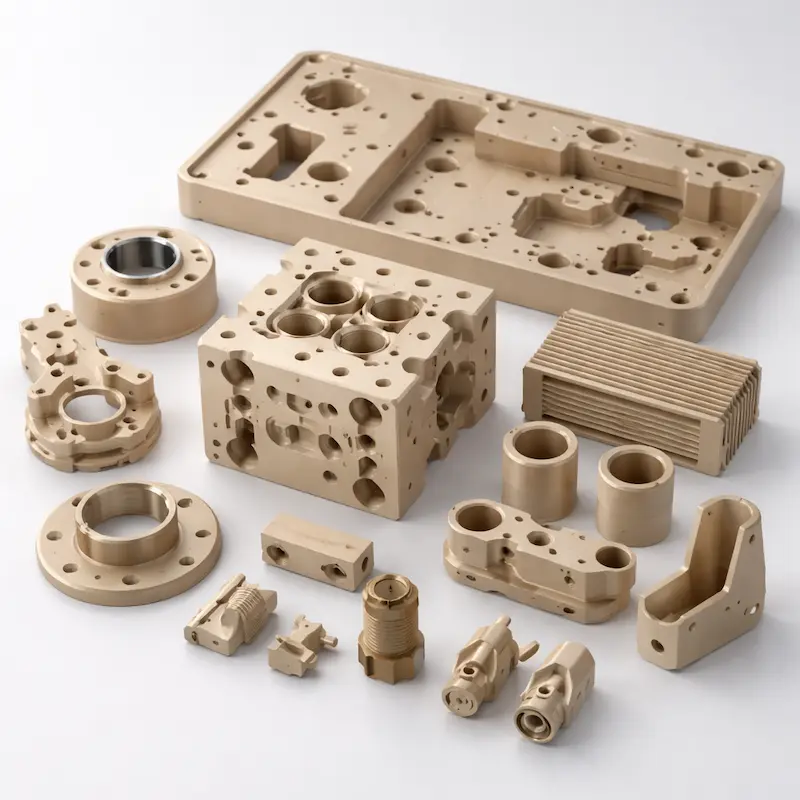
Engineering note: Values below are typical reference ranges. Final manufacturability, tolerances, material condition, surface finish, cost, and lead time depend on the drawing, geometry, quantity, and selected process.
Upload CAD files and mark critical features for an engineering review before production.
| Process | CNC Machining |
|---|---|
| Material name | PPS |
| Accuracy | ±0.2 mm |
| Minimum wall thickness | 1.0mm |
| Service temperature | 300-600℃ |
| Tensile strength | 450-1100MPa |
| Density | 7.7-8.5 g/cm³ |
| Requirements tag | Appearance prototype | High temperature resistance | Electrical insulation | Corrosion resistance |
| Finishing | Chamfering, grinding, bonding, screen printing, laser engraving, chrome plating |
| Typical lead time | Related to size, structural complexity, quantity and finishing; clear delivery and expedited options will be given after uploading the file |
It is used to remove sharp edges, improve assembly feel and reduce the risk of edge collision; it is recommended to mark the chamfer size and position on the drawing.
Used to improve processing texture and appearance consistency; if there are appearance surface requirements, please define key appearance surfaces and acceptable texture standards.
Suitable for component design and subsequent assembly; please note the bonding surface location and strength/sealing requirements to facilitate evaluation of process and reliability.
Applicable to logos, scales and batch information; it is recommended to provide vector files and location and size instructions.
For durable markings and serial numbers; please provide content, font/size and placement requirements, and describe visual contrast expectations.
For appearance enhancement and surface effect requirements; please indicate the target appearance, functional requirements and allowable thickness/size influence range in the remarks.
When parts need to maintain stable performance in higher temperature environments, PPS is often a common choice among engineering plastic solutions.
Suitable for insulating structural parts, isolation parts and components that require electrical performance considerations (please note the insulation standards and testing requirements).
For projects that are sensitive to media/environment, PPS is often used for material selection evaluation in the direction of corrosion resistance (it is recommended to provide media information).
Suitable for rapid processing and small batch production of structural parts and end-use parts; upload drawings to quickly get quotes, lead times and DFM recommendations.
Polyphenylene Sulfide (PPS) is often used for rapid processing and small batch production of structural parts and end-use parts. Common demands focus on:
It is recommended that you write down the working conditions (temperature, medium, whether it will be used for a long time) in the remarks, and we will give matching suggestions and DFM solutions more quickly.
Please refer to the key parameters of the material data on this page:
If you have tighter tolerances/fits or specified standards, please mark critical dimensions and datums in the 2D drawing or notes.
In order to more accurately evaluate the corrosion resistance matching of polyphenylene sulfide-Polyphenylene Sulfide (PPS), it is recommended that you provide:
This information can significantly improve the accuracy of quotes and material selection recommendations.
We support mainstream 3D/2D project files:
If there are critical fits and tolerances, please provide them first STEP + 2D annotation, the quote is faster and more accurate.
Polyphenylene Sulfide (PPS) quote is usually related to the following factors:
Suggested remarks: usage/working conditions + quantity + lead time + appearance standards + critical dimensional tolerances.
Finishing supported by this material (subject to material data) includes:
When placing an order, please note the target effect and appearance requirements so that it can be delivered in one go.
It is recommended that you do this to improve the consistency of the fit:
We will evaluate processing routes and accessibility in conjunction with DFM before quoting.
Material source data suggested Minimum wall thickness is 1.0mm. For thin-walled and small structures, it is recommended:
In order to implement logo processing faster, it is recommended that you provide:
If you want to get a faster and more accurate quote, it is recommended that you clearly write down the following when uploading the file:
Process: Upload drawings → Project evaluation and DFM → Confirm quote and lead time → Production delivery.