
chamfer
Used to remove sharp edges, improve assembly feel and reduce stress concentration; if there are specified chamfer dimensions or critical edges, please mark them in the 2D drawing.
Polypropylene (PP) is a common general-purpose plastic with excellent chemical corrosion resistance, good fatigue resistance, and relatively low material density.
Quote checklist: Upload your 3D model and, when available, a 2D drawing. Identify the required process, material, quantity, critical dimensions, finish, appearance standard, and target delivery date.
Engineering note: Values below are typical reference ranges. Final manufacturability, tolerances, material condition, surface finish, cost, and lead time depend on the drawing, geometry, quantity, and selected process.
Upload CAD files and mark critical features for an engineering review before production.
| Process | Injection Molding |
|---|---|
| Material | PP (polypropylene) |
| Accuracy | ±0.2 mm |
| Minimum wall thickness | 1.0mm |
| Service temperature | 300-600℃ |
| Tensile strength | 450-1100MPa |
| Density | 7.7-8.5 g/cm³ |
| Appearance points | Common appearance features of injection molded parts include gate marks, weld lines, ejector pin marks and slight sink marks; it is recommended that the appearance surface be marked in drawings or notes, and the acceptance standards be stated (which is more conducive to quote and process plan determination). |
| Structural points | It is recommended that the wall thickness be as uniform as possible to avoid sudden changes in thickness; attention should be paid to the risk of sink marks and warpage at ribs, columns, and large flat surfaces; demoulding slope, rounded corner transition, and avoidance of undercuts can help improve manufacturability and yield. |
| Finishing | Chamfering, grinding, bonding, screen printing, laser engraving |
| Quote and lead time | Related to structural complexity, quantity, appearance requirements and finishing; a clear quote and delivery period will be given after uploading the file |
Used to remove sharp edges, improve assembly feel and reduce stress concentration; if there are specified chamfer dimensions or critical edges, please mark them in the 2D drawing.
Used to improve the feel and appearance of local edges, mold lines or assembly interference locations; it is recommended to define standards and key areas in advance for the appearance.
Used for component assembly or local structural reinforcement; please note the bonding location, strength requirements and whether bonding traces are allowed to be exposed.
Suitable for logos, scales and other graphic information; it is recommended to provide vector files and position and size instructions, and clarify the direction of the appearance.
Suitable for serial numbers, QR codes, durable logos, etc.; please provide content, size, location and clarity requirements (confirm with samples first if necessary).
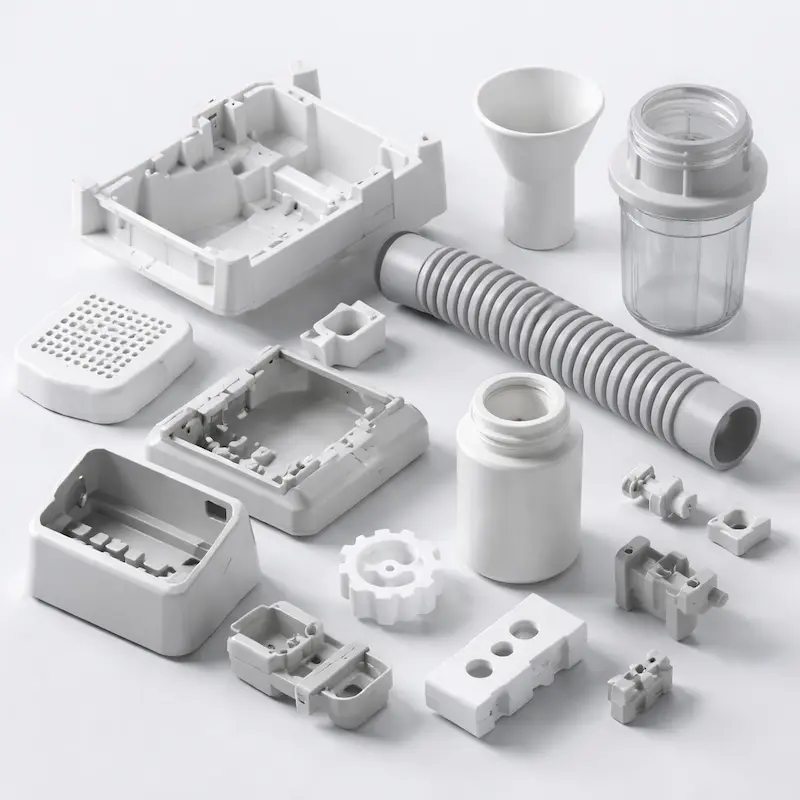
Suitable for batch manufacturing of general plastic parts, it is easier to strike a balance between cost, lead time and manufacturability.
It has certain tolerance to a variety of common media and is suitable for general structural parts and shell parts in many industries.
Reasonable wall thickness, rib position and demoulding design help to stabilize molding; suitable for batch delivery scenarios that pursue yield and consistency.
Supports chamfering, grinding, bonding, screen printing and laser engraving to facilitate assembly and marking requirements.
Polypropylene (PP) is suitable for general plastic parts and mass production projects. Common advantages include:
if you are right Extremely high temperature resistance/high strength, or have extremely strict appearance requirements (gate marks, weld lines, ejector pin marks, etc. are not allowed), it is recommended to first explain the standards and evaluate alternative materials or process solutions.
In addition, ultra-thin walls, ultra-large planes or complex undercut structures also require DFM review and structural optimization.
Please refer to this page for parameter information:
Actual capabilities are strongly related to structure, mold and process window. If there are assembly critical dimensions, please provide 2D annotations (PDF/DWG) for confirmation.
The appearance of injection molded parts is greatly affected by the mold and process. It is recommended that you specify in the remarks:
We will provide DFM suggestions and feasible process paths based on structural and appearance standards.
Finishing supported by PP (Injection Molding) includes: Chamfering, grinding, bonding, screen printing, laser engraving.
If you need to achieve clear appearance or assembly goals, it is recommended to clearly indicate the type, location and standard of finishing in the quote notes.
To ensure feasible bonding and controllable appearance, it is recommended to note:
It is recommended to provide:
Injection molding quotes not only depend on volume, but are also affected by the following factors:
It is recommended to provide 3D + 2D markings for faster and more accurate quote:
It is recommended that you also specify when uploading the file:
Submit according to the above information, and it will be easier for us to give you a quote and manufacturability suggestion (DFM) that matches your goals.