
chamfer
It is used to remove sharp edges and improve assembly feel and safety; chamfering of exterior parts can also improve the look and feel of "white edges/chips".
Polypropylene (PP) effect resin is used in vacuum casting replication mainly to meet the functional verification needs of "chemical resistance, lighterness, and certain toughness," suitable for containers, corrosion-resistant structural parts, and thin-walled parts that require repeated bending.
Quote checklist: Upload your 3D model and, when available, a 2D drawing. Identify the required process, material, quantity, critical dimensions, finish, appearance standard, and target delivery date.
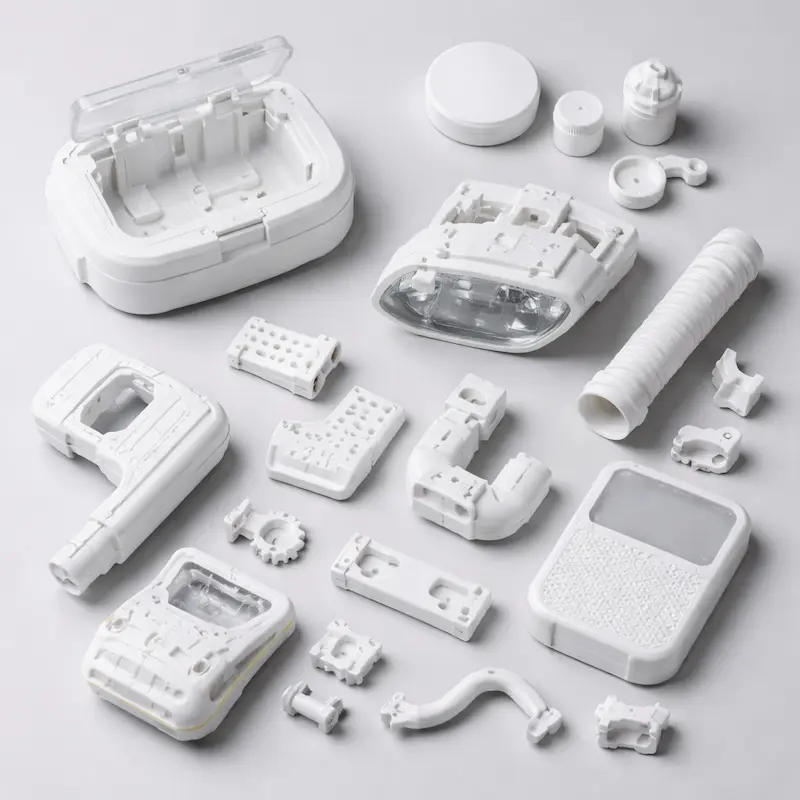
Engineering note: Values below are typical reference ranges. Final manufacturability, tolerances, material condition, surface finish, cost, and lead time depend on the drawing, geometry, quantity, and selected process.
Upload CAD files and mark critical features for an engineering review before production.
| Process | Vacuum casting (PP type molding material system) |
|---|---|
| Material name | Polypropylene (PP) |
| Dimensional tolerance | Routine evaluation based on structure and size; it is recommended to provide 2D markings for critical holes/mating surfaces and note "critical dimensions" |
| Minimum wall thickness | Recommended ≥ 1.0 mm; thin-walled areas need to be evaluated for casting filling and deformation risks |
| Minimum aperture | Recommended ≥ 1.5–2.0 mm; it is recommended to reserve a margin for key assembly holes and repair the holes twice. |
| Appearance points | There is a probability of parting line/gate position/exhaust mark; please define the appearance in the remarks, we can prioritize the optimization of placement and trimming standards |
| Resilience orientation | It is biased toward the "PP feel/toughness" direction and is suitable for trial assembly and light load function verification (extreme impact/high temperature long-term working conditions need to be evaluated separately) |
| Service temperature | Evaluate based on material system and working conditions; if it is close to a heat source or requires high temperature testing, please indicate the temperature and duration. |
| Typical uses | Appearance prototype, small batch verification, trial assembly parts, preliminary structural testing |
| Finishing | Chamfering, grinding, bonding, screen printing, laser engraving |
| Typical lead time | Related to structural complexity, quantity, and finishing; clear delivery and expedited options will be given after uploading the file |
It is used to remove sharp edges and improve assembly feel and safety; chamfering of exterior parts can also improve the look and feel of "white edges/chips".
Used to control parting line/gate trimming marks; it is recommended to define acceptance criteria and key processing areas in advance for exterior surfaces.
Suitable for over-long/large parts to be assembled after separate molding; it is recommended to reserve the positioning structure and bonding surface width during the design stage.
Suitable for logos, scales and other graphic information; it is recommended to provide vector files and location and size instructions.
Suitable for serial numbers, QR codes and wear-resistant logos; if you are sensitive to color contrast, it is recommended to make a sample first to confirm the effect.
Multiple samples can be obtained without steel molds, which is suitable for small batch verification, pre-trial production review and multi-department simultaneous confirmation.
Compared with the pure appearance resin solution, it is more suitable for trial assembly, feel evaluation and initial test of light load function.
Suitable for multi-version iterations and frequent engineering changes; it is more stable to confirm the first piece first and then increase the volume.
Supports chamfering, grinding, bonding, screen printing and laser engraving to facilitate clearer appearance and logo implementation.
Polypropylene (PP) (vacuum-cast parts) is more suitable for comprehensive verification at the small batch stage and is commonly used for:
Vacuum casting is more about "small batch verification and rapid iteration", and is different from injection molding mass production in terms of consistency and ultimate performance:
If you need mass production-level consistency/severe working conditions verification, it is recommended to upgrade to injection molded PP or other mass production routes.
It can be done, but it is recommended to clarify the key structures in the design and remarks. We will evaluate the filling and deformation risks:
It is recommended to provide 3D + 2D combination to improve quote accuracy:
If you only have STL, you can also upload it, but it is recommended to mark the key dimensions or make notes.
The quote is usually determined by a combination of the following factors:
There is a probability of parting lines/gate positions/exhaust marks in vacuum casting parts. The control methods include:
Finishing supported by polypropylene-PP (vacuum casting) includes:
Recommended practices:
The recommended process is: Confirm the first piece first → then increase the quantity according to demand.
This can more reliably identify appearance, assembly and key structural risk points, and is especially suitable for projects with buckles, thin-walls or sensitive exterior surfaces.
It is recommended that you write clearly when uploading the file: