
chamfer
Used to remove sharp edges and improve assembly and safety; if there is a mating surface/positioning surface, please mark the chamfer on the drawing or indicate the priority in the remarks.
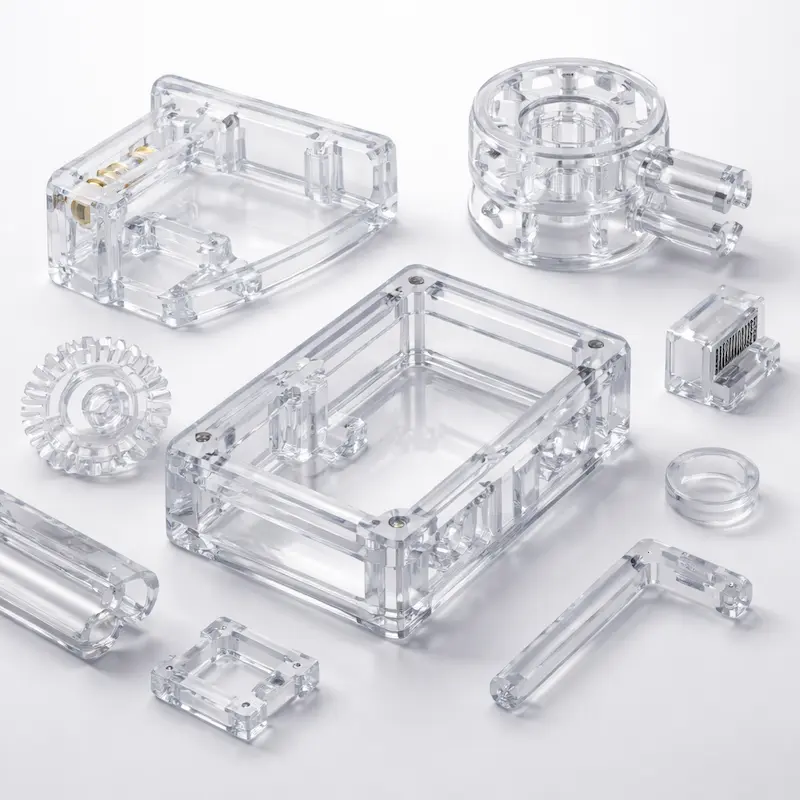
Polycarbonate (PC) is characterized by "high toughness, strong impact resistance, good temperature resistance, and can be made as transparent parts," making it suitable for transparent protective covers, impact-resistant enclosures, and structural components.
Quote checklist: Upload your 3D model and, when available, a 2D drawing. Identify the required process, material, quantity, critical dimensions, finish, appearance standard, and target delivery date.
Engineering note: Values below are typical reference ranges. Final manufacturability, tolerances, material condition, surface finish, cost, and lead time depend on the drawing, geometry, quantity, and selected process.
Upload CAD files and mark critical features for an engineering review before production.
| Process | CNC machining (engineering plastic machining) |
|---|---|
| Material | Polycarbonate (PC) (Polycarbonate, PC) |
| Accuracy | ±0.2 mm |
| Minimum wall thickness | 1.0mm |
| Service temperature | 300-600℃ |
| Tensile strength | 450-1100MPa |
| Density | 7.7-8.5 g/cm³ |
| Finishing | Chamfering, grinding, bonding, screen printing, laser engraving, painting, polishing (transparent edge) |
| Typical lead time | Relevant to size, quantity, structural complexity and finishing; clear delivery and expedited options will be given after uploading the file |
Used to remove sharp edges and improve assembly and safety; if there is a mating surface/positioning surface, please mark the chamfer on the drawing or indicate the priority in the remarks.
Used to improve the look and feel of the knife pattern and surface; if the appearance surface is required to be more delicate, please define the appearance surface and acceptable texture standards.
Suitable for assembly and sealing after sub-part processing; it is recommended to note the force direction, appearance requirements and whether fixture positioning is required.
Suitable for logos, scales and other graphic information; it is recommended to provide vector files and mark the location, size and color requirements.
Suitable for serial numbers, QR codes, and wear-resistant logos; it is recommended to provide content and location dimensions to confirm readability and contrast goals.
Used to unify texture and color to enhance the "finished" look; please note matte/semi-matte/high-gloss and provide a reference picture for better results.
Used to improve the visual effect of transparent edges or partial transparency; please clarify the polishing area and appearance acceptance criteria (edge clarity/haze/scratch tolerance).
Suitable for demonstration samples and structural appearance verification; can be polished/painted to improve consistency and texture.
Suitable for insulating brackets, covers, fixtures, etc.; 2D marking is recommended for key dimensions and mounting holes.
Supports screen printing and laser engraving, suitable for presenting information such as brand logos, scales, and serial numbers.
Optional when there are requirements for transparent edges/partially transparent vision Polished (transparent edge) And accept according to appearance standards.
Polycarbonate (PC) is often used for appearance prototypes, electrical insulation structural parts and functional validation parts. The advantage is that structural parts can be quickly obtained through machining, and can be combined with polishing/painting/screen printing/laser engraving to achieve a presentation closer to the finished product.
It is recommended to provide 3D + 2D annotation to improve the efficiency of quote and processing confirmation:
Please mark critical tolerances and datums in the 2D drawing, and describe "critical holes/critical surfaces/assembly surfaces" in the notes. We will conduct DFM and clamping evaluation before quoting, and adjust the processing sequence and inspection plan if necessary.
Supports screen printing and laser engraving. It is recommended to provide vector files (AI/PDF/SVG) or clear content descriptions, and mark the location, size, direction and color/depth requirements; it is recommended to reserve sufficient area for QR codes and other information to ensure readability.
The price is not only related to the volume, but also related to the structural complexity, the number of clampings, the difficulty of deep cavity/thin-wall, surface requirements (grinding/painting/transparent edge polishing), screen printing/laser engraving content complexity and quantity. It is recommended to clearly state the purpose, appearance standards and delivery target in the remarks.
A common combination is "polishing + painting" to unify the texture; if you need a logo, you can add screen printing/laser engraving; if you are concerned about the look and feel of the transparent edge, you can choose polishing (transparent edge). It is recommended to provide reference drawings and clarify the appearance and acceptable mark standards.
Supports bonding. It is recommended to add positioning steps/tongues and grooves to the structure to ensure assembly consistency; if you are sensitive to the appearance, you need to confirm the glue line position, glue overflow control and surface finishing plan in advance, and explain the force direction and usage environment in the remarks.
Deep-cavity knives, ultra-thin-walls, large-area thin plates, long cantilevers and sharp-angled inner cavities are more likely to bring risks of deformation, tool accessibility and clamping marks. It is recommended to do a DFM review first, and if necessary, process it in pieces before bonding or optimizing the structure.
Delivery time is related to structural complexity, quantity and finishing. If it is urgent, it may be necessary to make a choice in the appearance finishing plan; it is recommended to clarify the "required finishing" and acceptance criteria in advance so as to prioritize the delivery target.
It is recommended to state when uploading files:
Process: Upload drawings → Project evaluation/DFM → Quotation and delivery confirmation → Place order for production and delivery.