
polish
Used to remove parting line burrs, minor scratches and local defects; for transparent parts, it is recommended to control the direction and level of polishing texture on the appearance surface.
Acrylic (PMMA)(acrylic) is a transparent engineering plastic with extremely high light transmittance and excellent surface finish.
Quote checklist: Upload your 3D model and, when available, a 2D drawing. Identify the required process, material, quantity, critical dimensions, finish, appearance standard, and target delivery date.
Engineering note: Values below are typical reference ranges. Final manufacturability, tolerances, material condition, surface finish, cost, and lead time depend on the drawing, geometry, quantity, and selected process.
Upload CAD files and mark critical features for an engineering review before production.
| Process | Injection Molding |
|---|---|
| Material | PMMA (acrylic/plexiglass) |
| Accuracy | ±0.10–0.20 mm (related to size range/mold/structure; it is recommended to mark tolerances for critical dimensions and confirm with DFM) |
| Minimum wall thickness | ≥1.0 mm (it is recommended to keep the wall thickness as uniform as possible; for transparent cosmetic parts, it is recommended to avoid sudden changes in thickness) |
| Appearance concerns | Weld marks/gate marks/flow marks/scratches are more obvious for transparent parts; it is recommended to define the allowable area of A side and gate |
| Draft angle | Recommend 1°–2°; it is recommended to be more conservative for transparent high-gloss appearance to avoid strains and drag marks |
| Fillets and transitions | Sharp corners are prone to stress concentration and whitening; it is recommended to add rounded corners and smooth transitions. |
| Finishing | Grinding, screen printing, laser engraving, polishing (transparent edge) |
| Typical lead time | Related to structure, quantity, mold and finishing; clear delivery and expedited options will be given after uploading the file |
Used to remove parting line burrs, minor scratches and local defects; for transparent parts, it is recommended to control the direction and level of polishing texture on the appearance surface.
Suitable for logos, scales and functional graphics; it is recommended to provide vector files and clarify the location, size and color requirements.
Suitable for serial numbers, QR codes and wear-resistant logos; the laser engraving effect and contrast of transparent parts are related to the brand/surface condition, and you can make a sample to confirm first.
Used to improve the light transmission and appearance of transparent edges, and reduce the foggy feeling after trimming and chamfering; suitable for window edges, light guide edges and decorative edges.
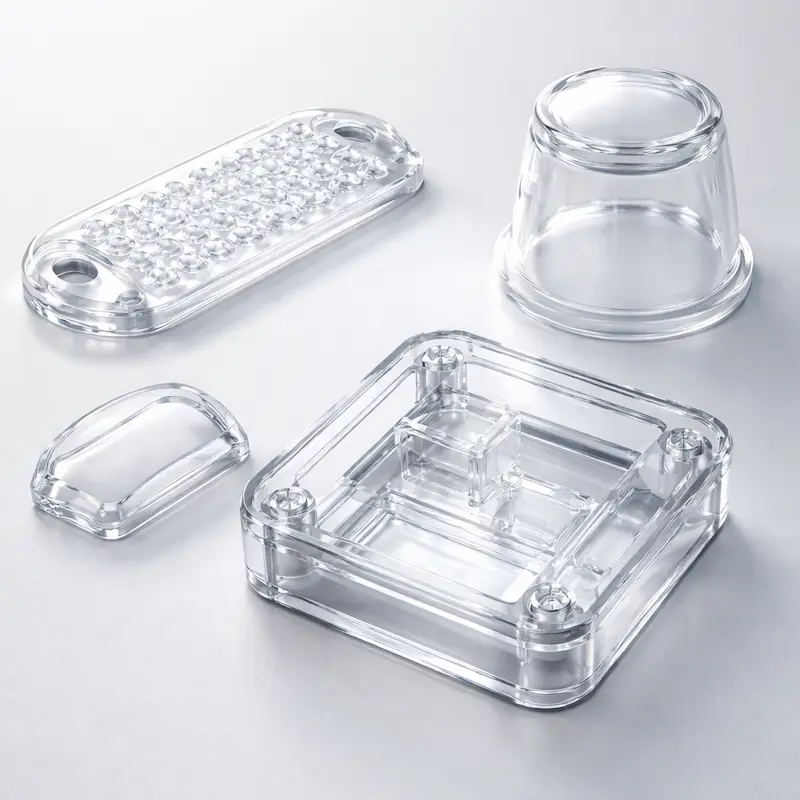
Suitable for transparent shells, window panels and display structural parts; more friendly to products with "visible internal structures".
Injection molding can achieve better batch consistency; it is suitable for product parts with clear appearance standards and small batch production.
Can achieve clear marking on transparent substrates; suitable for applications such as scales, logos, and panel graphics.
support Polished (transparent edge) Improves edge light transmission and appearance, suitable for enhancing the effect of lampshades, light guides and decorative edges.
PMMA (acrylic) injection molding is often used for transparent cosmetic parts and parts that require good surface texture, such as transparent shells, window panels, lampshades, and light guide parts.
If you are more concerned about drop toughness or high impact conditions, it is usually recommended to evaluate PC or modified material options.
Transparent parts are more sensitive to light and small surface differences, so weld marks, flow marks, gate marks, and minor scratches will be more easily visible.
It is recommended to specify the appearance surface (Side A) and defect standards in the order notes, and cooperate with DFM to optimize gates/parting lines/exhaust and flow paths.
It is recommended to keep the wall thickness as uniform as possible and avoid sudden changes in thickness to reduce the risk of shrinkage, ripples and stress whitening.
If local strengthening is necessary, priority should be given to rib position/structure optimization instead of "direct thickening".
It is recommended to provide STEP/STP (preferred) or IGES/IGS; if there are critical dimensions, tolerances and assembly relationships, it is recommended to provide 2D (PDF/DWG/DXF) at the same time.
For transparent cosmetic parts, please additionally note the appearance surface definition, transparency/light transmission requirements and defect standards (reference pictures can be provided).
Usually related to structural complexity, appearance standards (transparent appearance requirements), mold solutions, quantity and finishing requirements.
In order to get a faster and more accurate quote, it is recommended to write clearly in the remarks: usage, appearance (side A), quantity, lead time and whether screen printing/laser engraving/polishing (transparent edge) is required.
Finishing supported by PMMA (acrylic) injection molding includes: grinding, screen printing, laser engraving, and polishing (transparent edge).
Polishing (transparent edge) is often used for parts that require better edge light transmission and appearance, such as the edges of windows, edges of lampshades/light guides, and decorative edges.
It is recommended to mark the edge/surface range and appearance requirements that need to be polished in the drawings or notes.
The key lies in the gate location planning and the definition of the appearance surface (Side A): Place the gate as far as possible on the non-appearance surface or assembly shielding area, and perform DFM optimization based on the flow path and exhaust.
If you have a clear restricted area/visible area for appearance, please indicate it in the notes when placing the order, and we will give priority to giving suggestions based on appearance goals.
Can. Screen printing printing is suitable for panel graphics and scales, and laser engraving is suitable for serial numbers, QR codes and other logos.
It is recommended to provide vector files (AI/SVG/PDF, etc.) and clarify the position, size, direction and color/contrast requirements; if it is a transparent piece, please indicate whether screen printing on the back is allowed or whether it needs to be presented on the visible side.
It is recommended to upload 3D (STEP preferred) and supplement this information:
After submission, we will provide a quote, lead time and manufacturability recommendation (DFM).