
Support Hours: 09:00–18:00 (GMT+8) · Messages and quote requests are accepted 24/7.

PMMA (acrylic) vacuum casting material is designed for transparent prototypes and small batch display parts; it supports grinding, screen printing, laser engraving and polishing (transparent edges), and uploading files allows for fast quote and delivery.

Acrylic (PMMA)

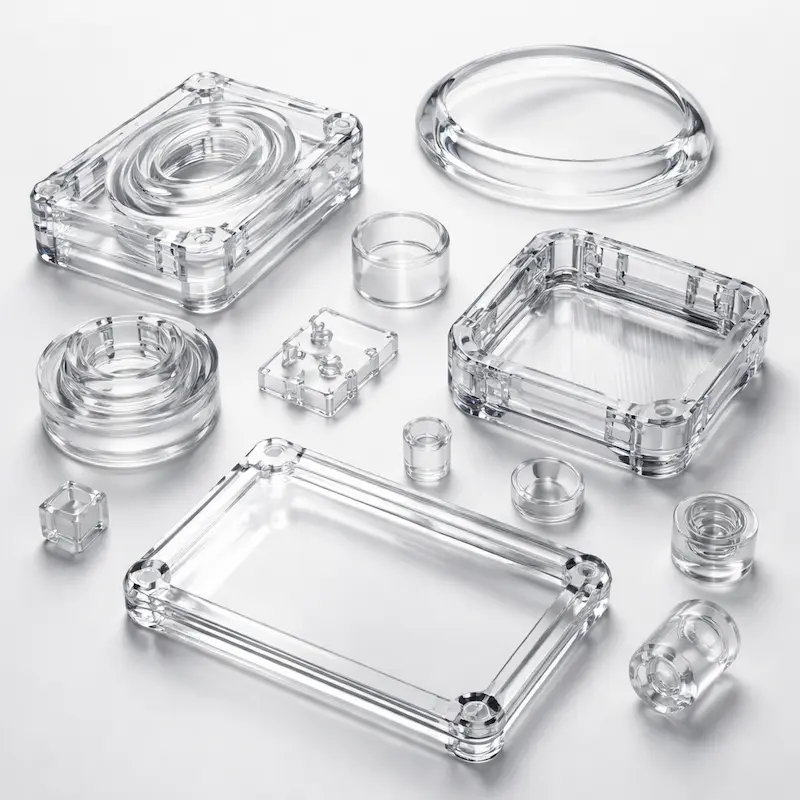
Acrylic (PMMA) effect resin is often used in vacuum casting to achieve "high light transmittance/high gloss" appearance prototypes and small batch parts.

Vacuum Casting PMMA (acrylic) Transparent cosmetic parts Small batch samples high surface quality Polishable clear edge

Quote checklist: Upload your 3D model and, when available, a 2D drawing. Identify the required process, material, quantity, critical dimensions, finish, appearance standard, and target delivery date.

PMMA (vacuum-cast parts) transparent appearance sample: suitable for transparent cover, lampshade and visual window prototypes, can be polished, screen printed, laser engraved and polished (transparent edge)

Key Material and Manufacturing Parameters

Engineering note: Values below are typical reference ranges. Final manufacturability, tolerances, material condition, surface finish, cost, and lead time depend on the drawing, geometry, quantity, and selected process.

Upload CAD files and mark critical features for an engineering review before production.

ProcessVacuum casting (silicone mold, small batch replication)
MaterialPMMA (acrylic) simulated transparent system (centered on appearance and light transmission performance)
ColorTransparent/natural color (can achieve fully transparent, semi-transparent or matte effect according to the target; subject to engineering evaluation)
Dimensional toleranceConventional ±0.20–0.30 mm or ±0.30% (whichever is greater); it is recommended to mark tolerances on critical mating surfaces and make targeted assessments
Minimum wall thicknessRecommended ≥1.0–1.5 mm; it is recommended to appropriately thicken or reinforce large-area transparent surfaces to reduce the risk of deformation and ripples
Minimum apertureRecommended ≥1.5–2.0 mm; it is recommended to reserve a margin for assembly holes/fitting holes and repair the holes twice.
Key points for transparent appearanceTransparent parts are more sensitive to parting lines, gate positions and exhaust; it is recommended to define the display surface in advance and give priority to avoiding key surface wiring and gates.
Surface qualityCan achieve a finish close to the appearance of injection molding (affected by the quality of the master mold and the condition of the mold); the transparent edge can be further improved by polishing
Finishing Grinding, screen printing, laser engraving, polishing (transparent edge)
Typical lead timeRelated to size, quantity, quantity of silicone molds and finishing; clear delivery and expedited options will be given after uploading the file
Adaptation quantityOften used for small batch (multiple pieces) reproduction; silicone molds have a lifespan, and the larger the batch, the more recommended it is to divide into multiple sets of molds or evaluate the injection molding route.

Finishing

Sanding (controlling parting lines and minor imperfections)

Transparent parts are more sensitive to parting lines, gate trimming and small scratches; it is recommended to specify the display surface in the remarks, and we will polish and trim it according to appearance standards.

Screen printing (logo and scale)

Suitable for logos, scales and function marks; it is recommended to provide vector files (AI/PDF/SVG) and location and size requirements to avoid blocking key light-transmitting areas.

Laser engraving (durable marking)

Suitable for serial numbers, QR codes, and simple graphics and text; laser engraving of transparent parts will produce local fogging/contrast changes. It is recommended to confirm the presentation effect and position first.

Polished (transparent edge)

It is used to improve the translucency of edges and the consistency of look and feel. It is commonly used in transparent covers/windows. It is recommended to choose this option for projects with high appearance requirements to enhance the finished product.

Why Choose PMMA (Vacuum Casting)

Transparent appearance is preferred

For transparent/high-gloss display needs, it can be used for appearance verification and review of visible windows, lampshades and transparent covers.

Small batches are more flexible

Multiple pieces can be copied without opening steel molds, which is suitable for small batch trial production, project phase review and multiple rounds of iterations.

Finishing can be used to enhance the “finished product feel”

Supports grinding and polishing (transparent edge), which can significantly improve the consistency of the transparent edge and the overall look and feel.

Logo craft friendly

Supports screen printing and laser engraving, which facilitates the presentation of information such as scales, logos, and identification codes.

Recommended Applications

  • Transparent cosmetic parts: Transparent window, transparent cover, lampshade shell, visual structural validation
  • Small batch copy: Multi-piece delivery, stage review samples, pre-trial production verification
  • Appearance and logo: Screen printing/laser engraving is required to present logo, scale, and identification information
  • There are requirements for translucent edges: Optional polishing (transparent edge) to enhance the finished product feel

It is not recommended to use it directly (it is recommended to change materials/processes)

  • Stringent optical requirements: If it is lens grade, low haze/high transparency and high consistency, it is recommended to conduct special evaluation or consider injection molding optical solutions.
  • Ultra-thin large flat transparent parts: Easily deformed/corrugated, structural reinforcement or evaluation of injection molding/other material systems is recommended
  • Super large batch long-term supply: It is recommended to use injection molding to obtain higher consistency and lower unit cost.
  • High temperature/long-term load: Evaluate material systems that are more temperature-resistant or fatigue-resistant according to working conditions

Design and DFM Guidelines

  • First define the display surface: Transparent parts are more sensitive to parting lines/gates/exhaust marks; please mark the display surface and "invisible mark area", and we will give priority to parting and pouring planning.
  • Control thin-walls and long flow channels: Thin walls, deep cavities and long flow channels are more susceptible to under-injection/air entrainment; it is recommended that the wall thickness be uniform and appropriately reinforced, and evaluation of component parts and bonding plans be carried out if necessary.
  • Avoid sharp corners and mutations: Sudden changes in thickness can easily cause local shrinkage and ripples; it is recommended to add rounded corner transitions, and transparent appearance surfaces are particularly important.
  • It is recommended to leave allowance for holes and fits: It is recommended to leave a margin for the mating holes/positioning holes and repair the holes twice; please use 2D to clearly mark key tolerances.
  • Transparent edges and transparent targets: If edge translucency is a key indicator, please note the selection. Polished (transparent edge) And provide target reference drawings to facilitate unified appearance standards.

FAQs