
Chamfering (anti-collapse/safer)
Sharp corners of transparent parts are more likely to chip and cause stress concentration; chamfering/rounding can also improve the feel and assembly safety.
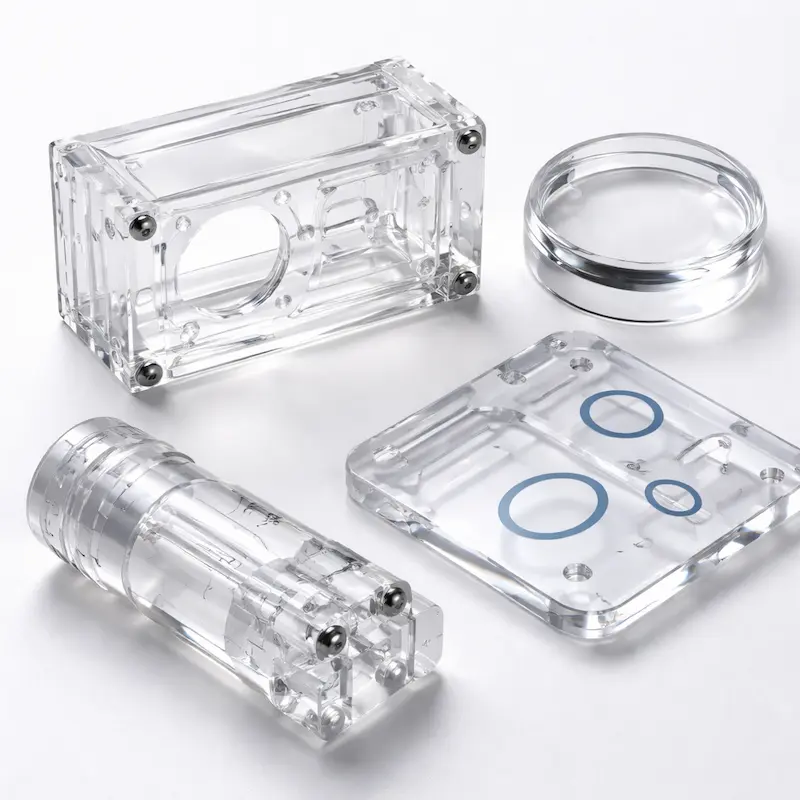
Acrylic (PMMA) features "high light transmittance, good texture, and easy polishing," suitable for transparent appearance and optical display parts.
Quote checklist: Upload your 3D model and, when available, a 2D drawing. Identify the required process, material, quantity, critical dimensions, finish, appearance standard, and target delivery date.
Engineering note: Values below are typical reference ranges. Final manufacturability, tolerances, material condition, surface finish, cost, and lead time depend on the drawing, geometry, quantity, and selected process.
Upload CAD files and mark critical features for an engineering review before production.
| Process | CNC machining (plastic machining) |
|---|---|
| Material | Organic glass-PMMA (acrylic/Acrylic) |
| Common appearance | Transparent/translucent (transparent parts are more sensitive to scratches and knife marks, it is recommended to define display surface and appearance standards) |
| Machining tolerance | ±0.2 mm (If there are critical dimensions/fitting holes, please mark the tolerance or note "precision first" on the 2D drawing) |
| Minimum wall thickness | 1.0mm (transparent thin walls are more likely to deform or crack, it is recommended to appropriately thicken/reinforce key areas) |
| Service temperature | 300-600℃ (subject to project requirements and review, please consult an engineer if you need clear test indicators) |
| Tensile strength | 450-1100MPa (subject to project requirements and review) |
| Density | 7.7-8.5 g/cm³ (subject to project requirements and review) |
| Recommended order form | STEP/STP + 2D annotation (PDF/DWG) is more conducive to quickly confirming appearance surfaces and tolerances |
| Typical lead time | Relevant to size, quantity, structural complexity and finishing; clear delivery and expedited options will be given after uploading the file |
| Finishing | Chamfering, grinding, bonding, screen printing, laser engraving, polishing (transparent edge) |
Sharp corners of transparent parts are more likely to chip and cause stress concentration; chamfering/rounding can also improve the feel and assembly safety.
More detailed polishing level control can be performed on the display surface; it is recommended to indicate "appearance priority/display surface definition" in the remarks.
Suitable for multi-piece splicing, transparent cover assembly and functional validation; please clarify whether the bonding position is a display surface and strength requirements.
Suitable for logos, scales, warning signs, etc.; it is recommended to provide vector files and location and size instructions.
Suitable for serial numbers, QR codes and wear-resistant logos; the laser engraving effect, contrast and depth of transparent materials need to be evaluated based on samples.
Used to improve edge light transmission and appearance, often used in window parts/transparent covers/lampshade casings. Please indicate "edges/surfaces that need to be polished" in the remarks.
Suitable for window parts, lampshade casings and display-type transparent parts to facilitate "finished product-like" appearance verification.
It can be combined with screen printing and laser engraving to achieve clear marking; it is more friendly to display parts.
The light transmission and appearance of the edges are significantly improved, and it is suitable for transparent parts with a clear "observation surface/display surface".
No mold opening is required, and it is suitable for prototypes, trial production and small batch iterations; it supports customized solutions according to appearance and tolerance requirements.
Plexiglas (PMMA/acrylic) is more suitable for parts with transparent appearance, such as window parts, transparent covers, lampshade shells and display samples. The advantage lies in the translucent appearance and large space for transparent edge processing, which can be improved with grinding and polishing.
Transparent parts are most likely to be affected by "knife lines/scratches/bonding marks". It is recommended that you specify the display surface, transparency level target and whether polishing (transparent edge) is required in the remarks, and try to provide reference drawings or appearance standards.
It is recommended to refer to drawing tolerances and critical dimension markings. If there are mating holes/locating surfaces, please provide 2D annotations (PDF/DWG) and note "precision first". Transparent thin-walled structures are more sensitive, and it is recommended to thicken/reinforce the critical areas and avoid sudden changes in thickness.
Please clarify: which edges/surfaces need to be polished, the target effect (clear/semi-transparent/slight texture allowed), whether it is a display surface, and the acceptable criteria for minor scratches. It is best to provide a reference picture or label the "observation surface/display surface".
Supports screen printing and laser engraving, suitable for logos, scales, serial numbers, QR codes, etc. It is recommended to provide vector files (AI/SVG/PDF) and position and size instructions; the contrast and depth of transparent materials can be confirmed by making a sample first.
It is recommended to keep the bonding lines away from the display surface and reserve steps/positioning ribs on the structure to ensure assembly consistency. Please indicate in the remarks whether the bonding position is visible, whether it is a display surface, and the strength target, and we will give suggestions for component parts and bonding solutions.
It is recommended to provide STEP/STP (3D) + PDF/DWG (2D annotation). 2D markings can significantly improve the efficiency of tolerance and display surface confirmation; if only 3D is available, please also use notes to describe key dimensions and appearance requirements.
In addition to size and quantity, the cost of transparent parts is also affected by the appearance level: display surface range, polishing level, whether polishing (transparent edge) is required, whether silk printing/laser engraving, as well as structural complexity and clamping difficulty. The clearer the remarks, the closer the quote will be to the target effect.
Sharp corners, large thin-walled surfaces, sudden changes in thickness, and strong assembly interference are more likely to cause chipping/cracking risks. It is recommended to add fillets/chamfers, keep the wall thickness more uniform, and leave enough clearance for assembly holes; key areas can be reinforced to improve stability.
When uploading the file, please write clearly: quantity, lead time, display surface definition, transparency level target, whether polishing is required (transparent edge), polishing level, whether screen printing/laser engraving, and key dimensions/tolerances (it is best to attach 2D markings). We will give more accurate quotes and process suggestions based on appearance and manufacturability.