
Chamfer (assembly and safety edge)
Used to remove sharp edges and improve assembly introduction and feel; it is recommended to clarify chamfering requirements for boundaries that require frequent assembly/contact.
PBT is a common engineering plastic option in injection molding scenarios, suitable for your Cost, appearance and performance Make a balance between them.
Quote checklist: Upload your 3D model and, when available, a 2D drawing. Identify the required process, material, quantity, critical dimensions, finish, appearance standard, and target delivery date.
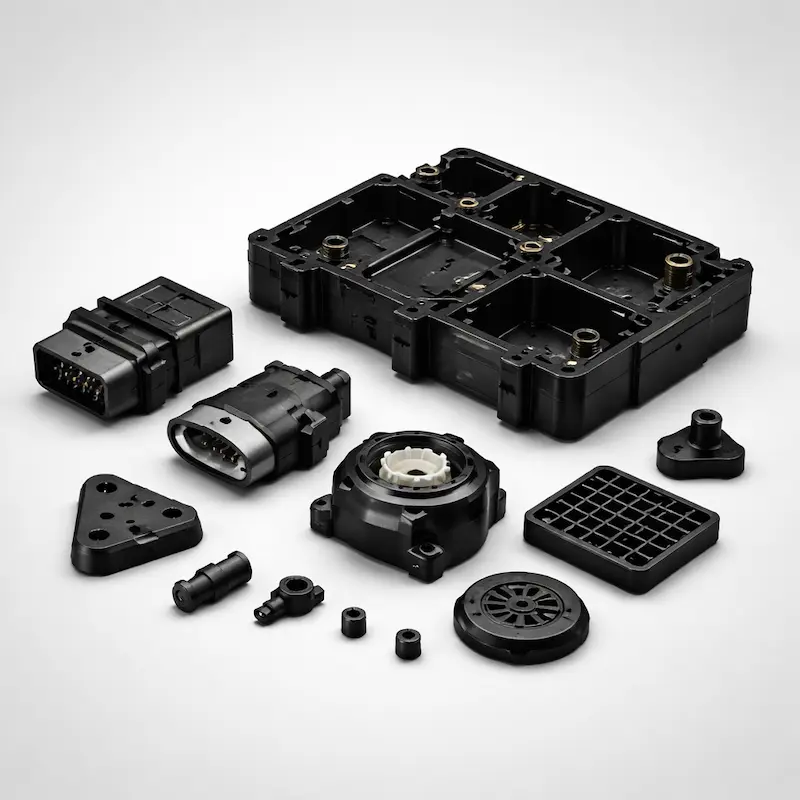
Engineering note: Values below are typical reference ranges. Final manufacturability, tolerances, material condition, surface finish, cost, and lead time depend on the drawing, geometry, quantity, and selected process.
Upload CAD files and mark critical features for an engineering review before production.
| Process | Injection Molding |
|---|---|
| Material | PBT (polybutylene terephthalate) |
| Accuracy | ±0.2 mm |
| Minimum wall thickness | 1.0mm |
| Service temperature | 300-600℃ |
| Tensile strength | 450-1100MPa |
| Density | 7.7-8.5 g/cm³ |
| Requirements tag | Low cost general parts/electrical insulation |
| Finishing | Chamfering, grinding, bonding, screen printing, laser engraving |
| Typical lead time | Related to structure, mold plan, quantity and finishing; clear delivery and expedited options will be given after uploading the file |
Used to remove sharp edges and improve assembly introduction and feel; it is recommended to clarify chamfering requirements for boundaries that require frequent assembly/contact.
Used to improve local burrs and improve appearance consistency; if it is the appearance surface/visible surface, please define the appearance standard in the remarks.
Optional when the structure needs to be divided into parts or subsequently assembled and fixed; it is recommended to indicate the bonding surface and assembly datum in the drawings/notes.
Suitable for logos, scales and graphic information; it is recommended to provide vector files and location and size instructions for quick confirmation.
Suitable for durable markings such as QR codes, serial numbers, model identifications; please mark the location, size and content rules.
Injection molding is more suitable for batch delivery and consistency control of repeated parts, and is suitable for stable supply and mass production rhythm.
It is easier to strike a balance between cost and performance, suitable for injection molded parts that you need to be "sufficient and stable".
Applicable to electrical insulation structural parts and related components; if there are any standards/test requirements, please indicate in the remarks.
Supports screen printing and laser engraving, making it easy to make brand/model/traceability markings; the exterior surface can be polished and chamfered to improve consistency.
PBT (injection molding) is suitable for general structural/functional parts and electrical insulation parts. Its advantages are usually reflected in:
PBT (injection molding) is more suitable for batch delivery after stable version:
You can note the expected quantity and iteration frequency when uploading, and we will recommend a more appropriate process path.
You can refer to the parameters on this page and focus on the part structure and appearance/tolerance requirements:
It is recommended to write down the key hole location/datum, tolerance level, appearance and marking method (screen printing/laser engraving) in the remarks.
We support mainstream 3D/2D project files:
Faster and more accurate way: STEP + 2D annotation(Especially assembly hole locations, tolerances and appearance surface definition).
PBT (injection molding) quotes usually not only depend on volume, but are also strongly related to the following factors:
PBT (injection molding) supports the following finishing (subject to this page):
The stability of injection molded parts is strongly related to the structure/mold plan. Common control points include:
Yes, but it is recommended that you specify the assembly conditions in the design and order notes:
It is recommended that you also provide/explain:
And mark "appearance surface/visible surface" in the remarks so that we can confirm the feasibility of the process together during the DFM stage.
In order to get a faster and more accurate quote, it is recommended that you also indicate when uploading the file:
You only need three steps: Upload drawings → Confirm project evaluation and quote → Production and delivery after confirmation.