
Chamfering (improves assembly and safety)
Used to remove sharp edges and improve assembly introduction and feel; it is recommended to unify chamfering standards for exterior parts and handheld parts.
Nylon 6 (PA6) is a commonly used engineering plastic with advantages such as "good toughness, wear resistance, and cost-effectiveness," making it suitable for lightweight functional parts, sliding parts, and assembly structures.
Quote checklist: Upload your 3D model and, when available, a 2D drawing. Identify the required process, material, quantity, critical dimensions, finish, appearance standard, and target delivery date.
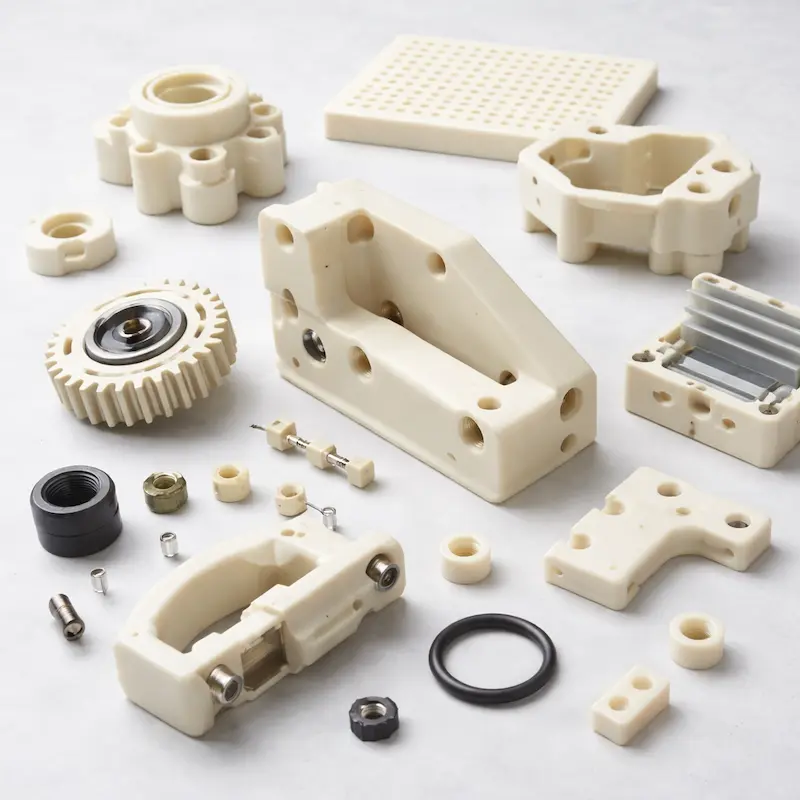
Engineering note: Values below are typical reference ranges. Final manufacturability, tolerances, material condition, surface finish, cost, and lead time depend on the drawing, geometry, quantity, and selected process.
Upload CAD files and mark critical features for an engineering review before production.
| Process | CNC machining (plastic machining) |
|---|---|
| Material | Nylon-PA6 (engineering plastic; balanced strength/toughness, good wear resistance, suitable for lightweight parts) |
| Machining tolerance | ±0.2 mm (common range; it is recommended to mark tolerances on key mating surfaces and confirm them separately) |
| Minimum wall thickness | ≥0.8 mm (recommended value; deformation and clamping solutions need to be evaluated for thin walls/large flat surfaces) |
| Service temperature | About 120℃ (related to working conditions, load and environment; please note the usage conditions if there is a sustained thermal environment) |
| Tensile strength | 45–55 MPa |
| Density | About 1.02 g/cm³ (lightweight and friendly) |
| Appearance and surface | It can be polished to improve the feel and knife pattern; it can be spray-painted to unify the texture; it can be silk-screened/laser-engraved to achieve logos. |
| Assembly method | Supports bonding assembly; hole position/thread/mating surface can be re-finished as required (2D marking is recommended) |
| Finishing | Chamfering, grinding, bonding, screen printing, laser engraving, painting |
| Typical lead time | Relevant to size, quantity, structural complexity and finishing; clear delivery and expedited options will be given after uploading the file |
Used to remove sharp edges and improve assembly introduction and feel; it is recommended to unify chamfering standards for exterior parts and handheld parts.
It is used to reduce knife marks and processing marks, and improve the consistency of touch and appearance; the appearance surface can improve the polishing level.
Suitable for assembly after sub-part processing; it is recommended to reserve a positioning structure and sufficient bonding area during the design stage, and describe the use environment in the remarks.
Suitable for logos, scales and graphic information; it is recommended to provide vector files and position and size descriptions, and define appearance surfaces.
Suitable for serial numbers, QR codes and wear-resistant marks; if there are requirements for color contrast, you can confirm the style first.
It can produce matte/high-gloss and other effects, significantly improving the "finished product feel"; it is recommended to provide reference pictures and color number/texture targets.
Suitable for functional validation and small batch delivery of structural parts and assemblies, providing a better balance between "durability/cost".
Density is lower than metal, suitable for weight reduction and handheld parts; more friendly to moving parts, brackets and shell parts.
Suitable for guides, sliders, bushings, wear-resistant gaskets, etc.; the service life can be further optimized through structural and surface solutions.
Supports polishing and painting to enhance appearance; screen printing/laser engraving facilitates the implementation of brand and traceability logos.
Nylon 6 (PA6) is often used in lightweight structural parts, assemblies and wear-resistant parts. Its advantages are concentrated in:
You can refer to the commonly used ranges on this page:
If you have positioning holes, mating surfaces or geometric requirements, it is recommended to provide 2D drawings (PDF/DWG/DXF) to mark key dimensions.
The surface of machined plastics usually has fine knife patterns, and the appearance of the surface can be improved by the following methods:
Nylon 6 (PA6) supported finishing includes:
If you want to be closer to the appearance of the finished product, it is recommended to clearly indicate the target texture (matte/high-gloss) and appearance when uploading.
Can be bonded. It is recommended that during the design phase:
It is recommended to indicate in the remarks: logo content, size, location and desired color contrast.
We support mainstream project files:
Faster and more accurate approach: priority delivery STEP + 2D annotation, and describe the use and appearance/assembly requirements in the remarks.
It is recommended to state when uploading files:
Process: Upload drawings → Project evaluation and quote → Production and delivery after confirmation.