
polish
Used to remove parting lines, small burrs and surface defects to improve assembly feel and appearance consistency.
Nylon (PA) effect resin is often used in vacuum casting for structural validation parts with "better toughness and stronger impact resistance," suitable for functional samples requiring snaps, drop resistance, or some elasticity.
Quote checklist: Upload your 3D model and, when available, a 2D drawing. Identify the required process, material, quantity, critical dimensions, finish, appearance standard, and target delivery date.
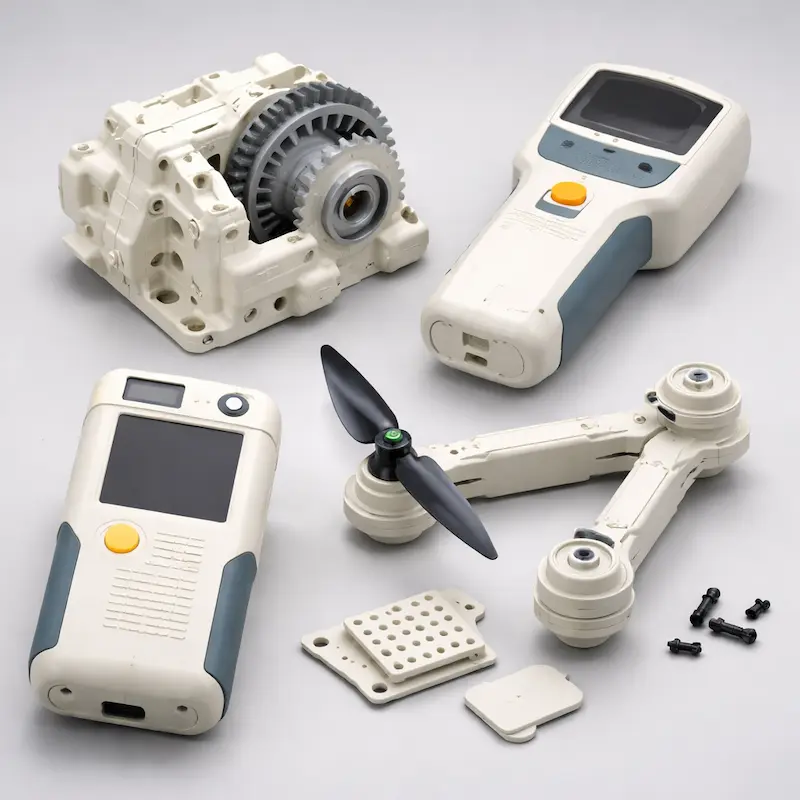
Engineering note: Values below are typical reference ranges. Final manufacturability, tolerances, material condition, surface finish, cost, and lead time depend on the drawing, geometry, quantity, and selected process.
Upload CAD files and mark critical features for an engineering review before production.
| Process | Vacuum casting (PA (nylon)) |
|---|---|
| Material positioning | Structural validation / lightweight-oriented functional prototype and small batch verification |
| Accuracy | ±0.2 mm |
| Minimum wall thickness | 0.8mm |
| Service temperature | 120℃ |
| Tensile strength | 45–55MPa |
| Density | 1.02 g/cm³ |
| Applications | Suitable for scenarios such as prototypes and functional validation, you can choose a more suitable material solution based on appearance, strength, temperature resistance and cost targets. |
| Finishing | Polishing, screen printing, laser engraving, painting |
| Typical lead time | Related to structural complexity, quantity and finishing; clear delivery and expedited options will be given after uploading the file |
Used to remove parting lines, small burrs and surface defects to improve assembly feel and appearance consistency.
Used to unify color and texture (such as matte/high gloss). It is recommended to provide reference drawings and clarify the appearance and acceptance criteria.
Suitable for logos, scales and other graphic information; it is recommended to provide vector files and location and size instructions.
Suitable for serial numbers, logos and durable text; it is recommended to describe the visual requirements of light and dark effect targets and positions.
For structural validation needs, it is suitable for functional prototypes and assembly evaluations (material selection and process routes can be further optimized based on working conditions).
Material positioning includes lightweight requirements, which is suitable for weight-sensitive prototype and verification parts solutions.
As a common option for vacuum casting, it is suitable for you to balance cost, appearance and performance and iterate quickly.
Supports polishing, painting, screen printing and laser engraving, making it easy to present the appearance and implement the logo information.
Nylon (PA) is suitable for scenarios such as prototypes and functional validation, especially structural validation and lightweight-oriented verification parts.
Key parameters can be referred to: accuracy ±0.2, minimum wall thickness 0.8mm, temperature resistance 120℃, tensile strength 45–55MPa, density 1.02 g/cm³.
It is recommended to write clearly in the remarks: purpose (structural validation/functional validation/appearance display), key dimensions/tolerances, quantity and lead time, and whether painting/screen printing/laser engraving is required.
The material data gives a minimum wall thickness of 0.8mm.
The temperature reference in the material data is 120°C.
If there is continuous high temperature, contact with heat sources, or strict thermal deformation requirements, it is recommended to describe the working conditions (temperature, time, load) in the remarks, and we will assist in evaluating whether it is necessary to change materials/process routes.
In order to provide a faster and more accurate quote, it is recommended to provide 3D (such as STEP/STP) + 2D (PDF/DWG) markings, which at least require clear descriptions of key dimensions and tolerances.
Only STL can also be evaluated, but when it comes to key structures such as assembly holes/locating surfaces, it is recommended to supplement 2D annotations or write down key dimensional requirements in the remarks.
Nylon (PA) supports: polishing, screen printing, laser engraving, and painting.
Nylon-PA (vacuum-cast parts) is often used in prototype and functional validation scenarios.
If it involves buckles, repeated disassembly or assembly, or critical assembly tolerances, please note: the number of uses/stressing methods, key hole locations and matching relationships, and provide 2D annotations. We will first conduct a DFM assessment and give structural optimization suggestions.
The quote of vacuum casting usually depends not only on the volume, but also on the structural complexity, parting and pouring scheme, finishing (painting/screen printing/laser engraving), as well as quantity and lead time.
It is recommended to write clearly in the remarks after uploading the file: usage, quantity, lead time and appearance standards. We will give you a quote and process suggestions that are closer to the target.
You can mark it in the 2D drawing (PDF/DWG) or explain the positioning datum and dimensions in the notes.
After uploading the file, we will give you a quote, lead time and manufacturability recommendation (DFM) based on the structure and requirements.