
Support Hours: 09:00–18:00 (GMT+8) · Messages and quote requests are accepted 24/7.

Red copper-T2 CNC machining material (T2 red copper/industrial pure copper/high conductive copper/high thermal conductivity copper) is suitable for rapid processing and small batch production of structural parts and end-use parts. It supports polishing, tin plating, nickel plating, anti-oxidation treatment and laser engraving, and provides fast quote and delivery.

T2 Copper

Pure copper T2 is a commonly used grade of high-purity copper, with advantages such as "good electrical and thermal conductivity and high ductility," making it ideal for electrical conductive components and heat dissipation structures.

Copper alloy (CNC machining) Structural parts end-use parts small batch production Optional surface finishing Quick quote

Quote checklist: Upload your 3D model and, when available, a 2D drawing. Identify the required process, material, quantity, critical dimensions, finish, appearance standard, and target delivery date.

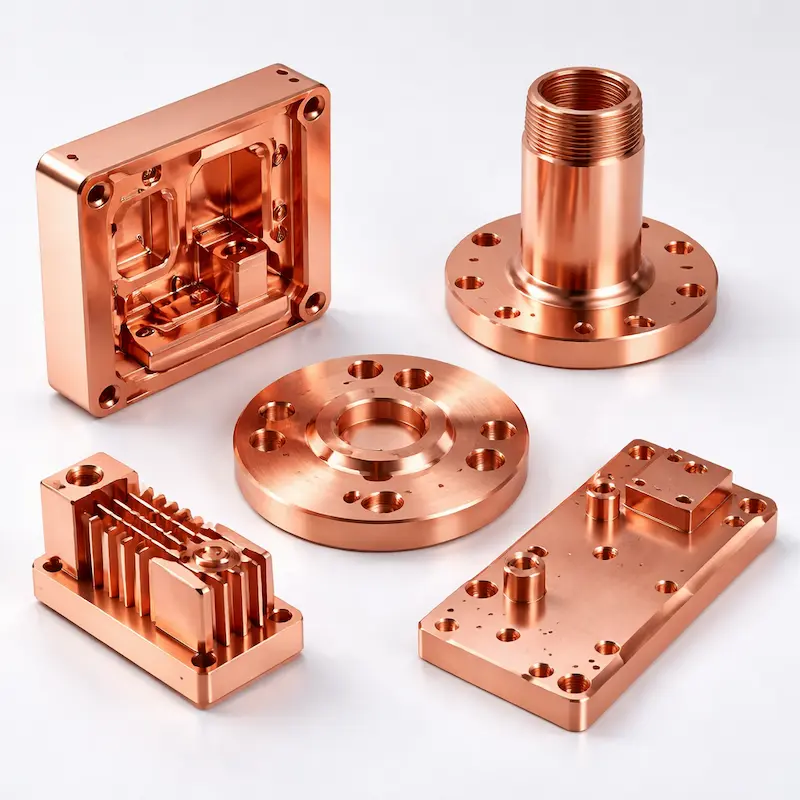
Red copper-T2 CNC machining sample: suitable for small batch processing of structural parts and end-use parts, optional polishing, tin plating, nickel plating, anti-oxidation treatment and laser engraving

Key Material and Manufacturing Parameters

Engineering note: Values below are typical reference ranges. Final manufacturability, tolerances, material condition, surface finish, cost, and lead time depend on the drawing, geometry, quantity, and selected process.

Upload CAD files and mark critical features for an engineering review before production.

ProcessCNC Machining
MaterialCopper-T2
Material subcategorycopper alloy
Accuracy±0.2 mm
Minimum wall thickness1.0mm
Service temperature300-600℃
Tensile strength450-1100MPa
Density7.7-8.5 g/cm³
Finishing Polishing, tin plating, nickel plating, anti-oxidation treatment, laser engraving
Typical lead timeRelated to size, structural complexity, quantity and finishing; clear delivery and expedited options will be given after uploading the file

Finishing

Polishing (appearance and contact surface optimization)

Applicable to appearance surfaces and functional contact surfaces; if mirror/fine lines and other targets are required, please indicate the appearance standards and reference samples in the remarks.

Tin plating (conductivity and solderability requirements)

Often used for parts that require surface weldability or specific contact characteristics; it is recommended to indicate whether there are coating thickness or area requirements.

Nickel plating (surface protection and appearance stability)

Used to improve surface protection and appearance consistency; if there are color/gloss preferences or masking area requirements, please mark them in the drawings/notes.

Anti-oxidation treatment (storage and appearance protection)

Used to reduce the risk of discoloration and spots caused by surface oxidation; suitable for delivery scenarios that are more sensitive to appearance stability.

Laser engraving (identification and traceability)

Suitable for model, logo, serial number and other information marks; please provide content, location, direction and acceptable line width/depth requirements.

Why Choose Copper-T2 (CNC Machining)

Suitable for rapid processing and small batches

For structural parts and end-use parts, it supports processing according to drawings and rapid delivery, and is suitable for trial production and small batch iteration.

Clear finishing path

Polishing, tin plating, nickel plating and anti-oxidation treatment can be selected according to the purpose, taking into account both appearance and functional surface objectives.

Logo traceability friendly

Supports laser engraving for model/batch/serial numbers, which facilitates on-site assembly, quality inspection and traceability management.

Quote and manufacturing collaboration

Upload the file to evaluate process feasibility and lead time; the clearer the critical dimensions and critical surfaces are marked, the faster and more accurate the quote will be.

Recommended Applications

  • Structural parts/end-use parts: Require fast delivery and stable processing route according to drawings
  • Small batch trial production: Need fast iteration and controllable lead time
  • Appearance and Surface Goals Clear: Appearance consistency can be achieved through polishing/electroplating/anti-oxidation
  • Need identification traceability: Laser engraving meets marking and management needs

Consider Another Material or Process

  • There are clearer limit requirements for corrosion resistance/strength/wear resistance: It is recommended to match and upgrade stainless steel/alloy steel/engineering alloy
  • Very strict requirements on appearance coating/specification: It is recommended to provide specification documents and make proofs for confirmation first.
  • The structure is extremely complex and requires significant cost reduction: Die casting/stamping/injection molding can be evaluated (depending on part type)
  • Extremely strict tolerances: It is recommended to provide a complete GD&T/benchmark system and conduct a process review in advance

Design and DFM Guidelines

  • Key dimensions and benchmarks: Please mark the tolerances and datums on the assembly holes, positioning surfaces, and contact surfaces; if there is no 2D, it is recommended to write down the "key dimension list" in the remarks.
  • Wall thickness and elongated structure: Slender parts/thin-walled parts rely more on clamping and tool path strategies; it is recommended to ensure the thickness of the stress-bearing parts and the transition fillet as much as possible to reduce the risk of processing deformation.
  • Threads and holes: It is recommended to distinguish between "finished holes/tapping holes/fitting holes" and indicate whether secondary finishing (reaming/expanding/finishing) is allowed.
  • Surface requirements prefixed: Polishing, electroplating (tin plating/nickel plating) and anti-oxidation treatment will affect the appearance and lead time; please clarify the target surface and shielding area during the quote stage.
  • Laser engraving readability: Provide vector files or clear text content; it is recommended to indicate the minimum font height, position and direction to avoid being invisible after assembly.

FAQs