
Polishing (increases shine and feel)
Suitable for exterior panels and decorative parts to improve mirror finish and texture; it is recommended to specify the target effect (high gloss/semi-gloss) and exterior surface range in the remarks.
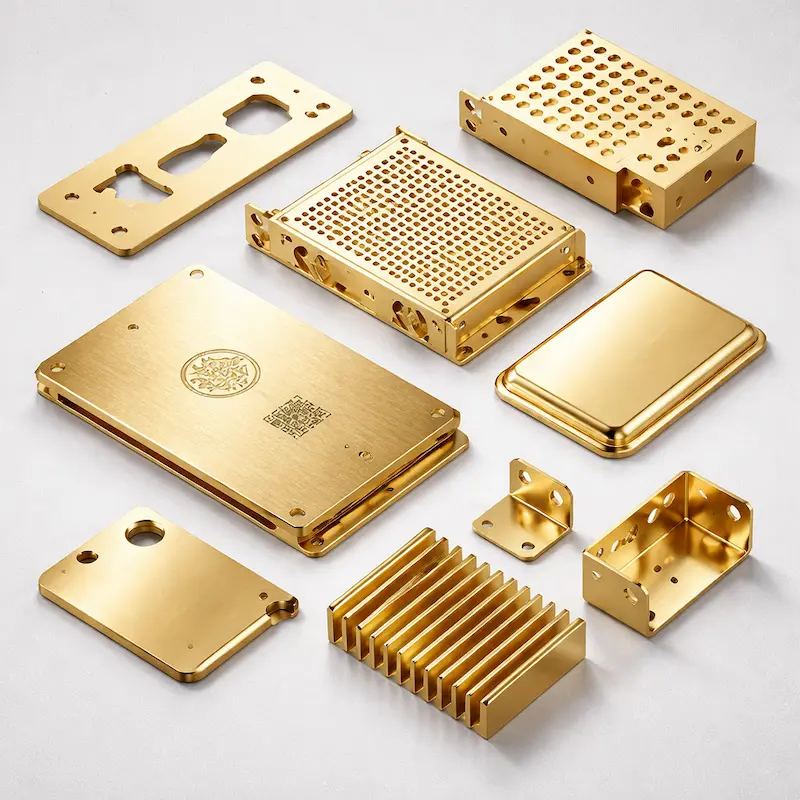
Brass is considered both in sheet metal fabrication Electrical and thermal conductivity with decorative texture One of the commonly used metal materials.
Quote checklist: Upload your 3D model and, when available, a 2D drawing. Identify the required process, material, quantity, critical dimensions, finish, appearance standard, and target delivery date.
Engineering note: Values below are typical reference ranges. Final manufacturability, tolerances, material condition, surface finish, cost, and lead time depend on the drawing, geometry, quantity, and selected process.
Upload CAD files and mark critical features for an engineering review before production.
| Process | Sheet metal fabrication (cutting/bending/stamping, etc.) |
|---|---|
| Material | Brass (both electrical and thermal conductivity and decorative texture; suitable for panels/decorative parts/shielding covers, etc.) |
| Accuracy | ±0.2 mm |
| Minimum wall thickness | 1.0mm |
| Service temperature | 300-600℃ |
| Tensile strength | 450-1100MPa |
| Density | 7.7-8.5 g/cm³ |
| Structural and bending suggestions | It is recommended to clarify the bending line, angle, direction and key benchmarks in the drawings; try to avoid holes/slots that are too close to each other at the bends, and add undercuts/process gaps if necessary to reduce the risk of cracking and deformation. |
| Appearance surface definition | If you are sensitive to appearance (mirror surface/uniform texture/electroplating color), please indicate it in the remarks Appearance and acceptable defect standards to facilitate priority arrangement of processing surfaces, fixture clamping and finishing plans. |
| Finishing | Polishing, electroplating (nickel/chromium/gold), sandblasting, laser engraving |
| Typical lead time | Related to plate thickness, structural complexity, quantity and finishing; clear delivery and expedited options will be given after uploading the file |
Suitable for exterior panels and decorative parts to improve mirror finish and texture; it is recommended to specify the target effect (high gloss/semi-gloss) and exterior surface range in the remarks.
Used to improve appearance consistency and corrosion resistance; it is recommended to provide reference colors or plating targets (bright nickel/matte nickel/bright chrome, etc.).
Gets a uniform matte texture and reduces small scratches; suitable for panels, covers and exterior parts that require a consistent texture.
Suitable for logos, scales, serial numbers, QR codes, etc.; it is recommended to provide vector files (AI/SVG/DXF) and mark the size and position.
The color and luster of brass is more "finished", and when combined with polishing/plating can achieve greater consistency and presentation.
Suitable for conductive contacts, shielding covers and sheet metal structure applications that require heat conduction/heat dissipation assistance (specific structures are subject to engineering evaluation).
It can be cut, bent, stamped and other routes, suitable for prototyping and small batch iteration; the external surface can be optimized for clamping and texture direction through process arrangement.
Supports polishing, sandblasting, electroplating (nickel/chromium/gold) and laser engraving, making it easy to transform "appearance goals" into executable process combinations.
Brass (sheet metal fabrication) is often used for sheet metal parts that have both appearance and function, such as:
If you are more concerned about ultimate strength or extreme low cost, you can also note the application scenario and we will recommend more matching materials or process routes.
Both methods are commonly used, the difference lies in the "gloss and texture target":
It is recommended to write clearly in the remarks: the target effect (high-gloss/semi-gloss/matte) and appearance range, and attach reference pictures to make it easier to achieve consistency.
You can first refer to the key parameters on this page for communication and quick assessment:
The actual achievable accuracy and appearance will be affected by plate thickness, structural shape, bending process and finishing. If there are critical assembly dimensions, please provide 2D callouts (DWG/DXF/PDF) and mark the critical datums.
It is recommended to specify in 2D drawings or notes:
If you have expansion drawing or bending coefficient requirements, you can also provide them together, and we will do DFM verification based on the process.
Can. Brass (sheet metal fabrication) supports electroplating (nickel/chromium/gold) to improve appearance consistency and protective performance.
In order to achieve the effect more accurately, it is recommended to note:
Brass (sheet metal fabrication) supports laser engraving of logos, text, scales, serial numbers and QR codes, etc.
It is recommended that you provide:
Brass (sheet metal fabrication) quotes are usually affected by the following factors:
In order to get a quote that is closer to the target, it is recommended to note: plate thickness, use, quantity, appearance standards and lead time requirements.
We support mainstream 3D/2D project files:
Recommended practice: Provide STEP + 2D annotation, which can significantly improve the efficiency of quote and DFM communication.
Common risks include stress concentration at bends, hole edge deformation, surface scratches and finishing chromatic aberration, etc. Suggestions:
If you provide key dimensions for appearance and assembly, we can conduct a targeted DFM review before quoting.
In order to get a faster and more accurate quote, it is recommended that you also indicate when uploading the file:
Process: Upload drawings → Project evaluation and quote → Production and delivery after confirmation. We will simultaneously provide manufacturability suggestions and more appropriate process combinations.