
Sandblasting (uniform texture)
Improves surface consistency and feel, suitable for uniform matte texture; also common as surface preparation before spray coating/anodizing.
Aluminum alloy_AL5052 is a very common material option in sheet metal fabrication scenarios, suitable for you Cost, appearance and performance Make a balance between them.
Quote checklist: Upload your 3D model and, when available, a 2D drawing. Identify the required process, material, quantity, critical dimensions, finish, appearance standard, and target delivery date.
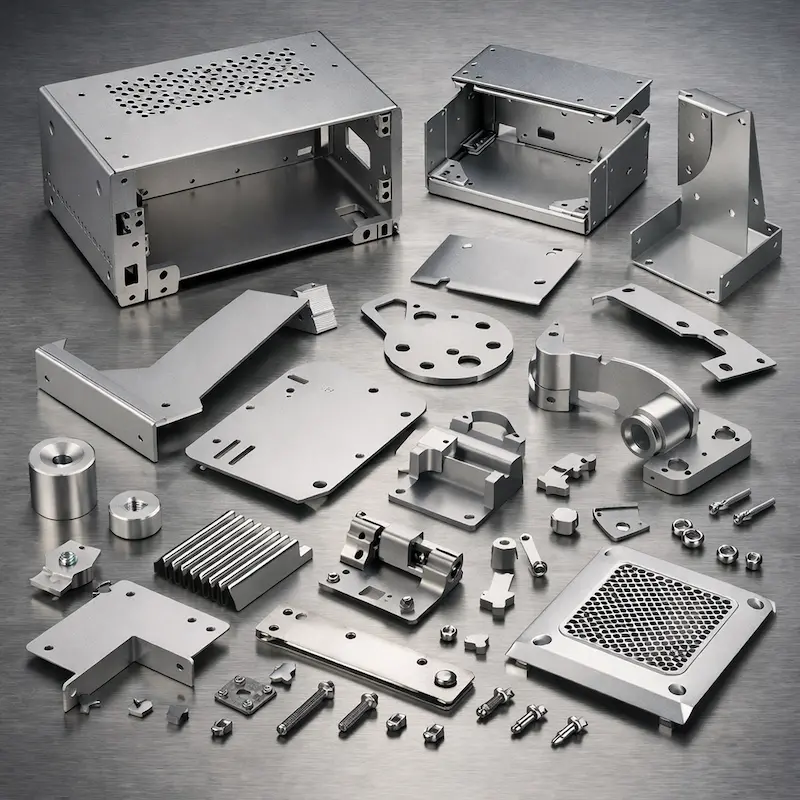
Engineering note: Values below are typical reference ranges. Final manufacturability, tolerances, material condition, surface finish, cost, and lead time depend on the drawing, geometry, quantity, and selected process.
Upload CAD files and mark critical features for an engineering review before production.
| Process | Sheet metal fabrication (cutting/bending/forming/assembly) |
|---|---|
| Material | Aluminum alloy_AL5052 (5052 aluminum plate, suitable for shells and lightweight structural parts) |
| Accuracy | ±0.2 mm |
| Minimum wall thickness | 1.0mm |
| Service temperature | 200℃ |
| Tensile strength | 320-460MPa |
| Density | 2.65 g/cm³ |
| Typical applications | Chassis shells, covers, brackets, fixtures, lightweight structural parts, prototypes and functional validation parts |
| Suggestions for ordering information | 3D: STEP / STP (recommended); 2D: DWG / DXF / PDF (please mark the plate thickness, bending line, key hole position, tolerance and surface treatment requirements) |
| Finishing | Sand blasting, anodizing, powder coating, painting, screen printing, laser engraving |
| Typical lead time | Related to plate thickness, number of bends, assembly complexity and surface finishing; clear delivery and expedited options will be given after uploading the file |
Improves surface consistency and feel, suitable for uniform matte texture; also common as surface preparation before spray coating/anodizing.
Suitable for shell parts and cosmetic parts; can improve corrosion resistance and wear resistance. When you are sensitive to color and appearance consistency, it is recommended to provide reference samples or clarify color number and gloss targets.
Suitable for batch cosmetic parts and durable surface requirements; good coverage and multiple color choices. Please describe the appearance and acceptable corner powder standards in the comments.
More suitable for projects with clear goals for color/gloss (matte/high gloss); it is recommended to provide reference pictures or clarify color numbers and appearance standards.
Suitable for logos, panel text, scales and operation marks; please provide vector files and location dimensions, and confirm the process sequence requirements for powder coating/painting/anodizing.
Suitable for QR codes, serial numbers, nameplate information and wear-resistant markings; content, size, position and contrast targets (depending on surface finishing) are recommended.
Suitable for common environmental usage scenarios such as chassis casings, covers, brackets, etc.; with anodizing/spray coating solutions, durability can be further improved.
Low density, easy to achieve lightweight; common in shell parts and sheet metal structural parts, taking into account both cost and performance.
It supports sandblasting, anodizing, powder coating, painting, screen printing and laser engraving, and is suitable for projects that require appearance consistency, logo and brand presentation.
The sheet metal route is mature and suitable for prototype iteration and small and medium-volume delivery; DFM feedback is provided to help reduce rework and assembly risks.
Aluminum alloy_AL5052 (sheet metal fabrication) is commonly used in sheet metal parts such as chassis casings, panels, covers, brackets and lightweight structural parts.
If you are looking for consistent appearance and corrosion resistance and want to quickly deliver prototypes or low-volume sheet metal parts, 5052 is often a stable and cost-effective choice.
References to commonly used parameters on this material page:
The most important thing when placing an order is to clearly explain the plate thickness, bending information, key hole positions/tolerances and surface finishing targets, which will directly affect the quote accuracy and lead time.
It is recommended to submit a 3D + 2D combination to get a faster and more accurate quote:
If only 3D is provided, it is also recommended to add plate thickness, bending direction and key assembly requirements in the remarks to avoid double confirmation of the stretching cycle.
Aluminum alloy_AL5052 (sheet metal fabrication) optional finishing is as follows:
If you want to get closer to the appearance of the finished product, it is recommended to specify in the remarks: appearance surface definition, target gloss (matte/high gloss), color target (color number or reference picture), and acceptable color difference and scratch standards.
The quote of plate metal usually depends not only on the expansion area, but also is affected by the following factors:
It is recommended that you specify when uploading files:
When anodizing requires a high level of appearance consistency, it is often most effective to provide a reference sample.
Both methods are common:
If you have clear goals for contrast, wear resistance or appearance texture, it is recommended to describe the usage scenario in the remarks, and we will recommend a more matching solution.
For a faster and more accurate delivery assessment, it is recommended that you provide:
The clearer this information is, the faster DFM and quote confirmation will be, and the overall lead time will be more stable.
Suggestions are provided STEP + 2D PDF/DWG, and annotated in 2D:
If you only provide 3D, please also indicate "which are the key holes/key surfaces" in the remarks, and we will confirm individually by key item.
In order to get a faster and more accurate quote, it is recommended that you also indicate when uploading the file:
You only need three steps: Upload drawings → Confirm project evaluation and quote → Production and delivery after confirmation.