
Sandblasting (unified texture)
Used to achieve a more uniform matte appearance and weaken knife marks; cosmetic parts can improve consistency through sandblasting grain size and appearance surface definition.
Aluminum alloy 6061 (Al-Mg-Si series) is one of the most commonly used general-purpose aluminum alloys in CNC machining.
Quote checklist: Upload your 3D model and, when available, a 2D drawing. Identify the required process, material, quantity, critical dimensions, finish, appearance standard, and target delivery date.
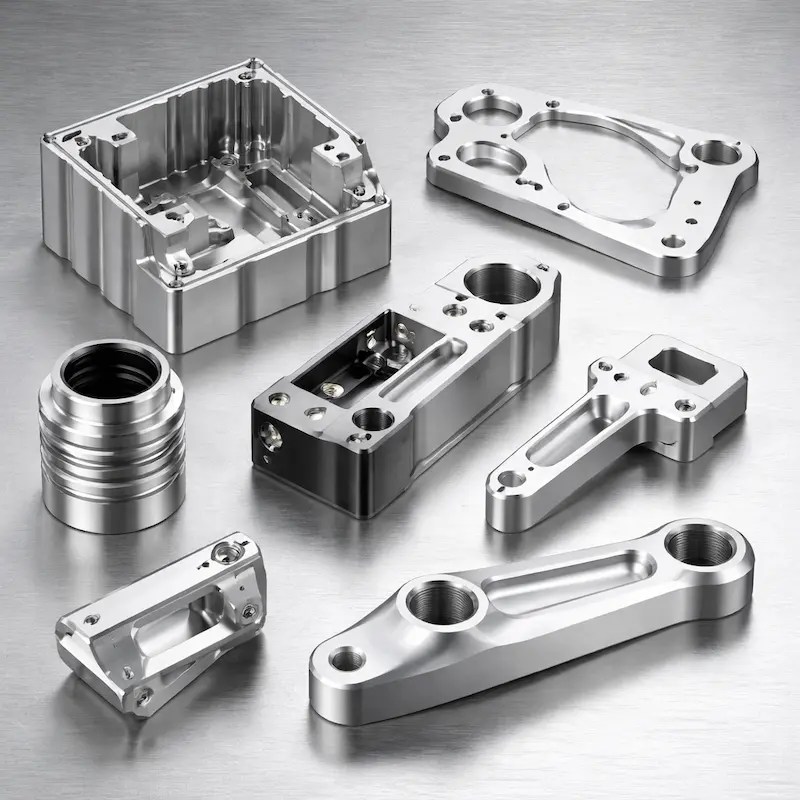
Engineering note: Values below are typical reference ranges. Final manufacturability, tolerances, material condition, surface finish, cost, and lead time depend on the drawing, geometry, quantity, and selected process.
Upload CAD files and mark critical features for an engineering review before production.
| Process | CNC machining (aluminum alloy 6061) |
|---|---|
| Material properties | Lightweight, easy to process, highly versatile; balanced in strength/machinability/cost, suitable for structural parts and cosmetic parts |
| Machining tolerance | ±0.2 mm (typical reference value; it is recommended to mark key dimensions on 2D drawings and indicate the datum) |
| Minimum wall thickness | ≥1.0 mm (recommended); Thin-walled/large planes need to evaluate the rigidity and clamping method, and reinforce or separate parts if necessary |
| Service temperature | 200℃ (material temperature resistance; actual working conditions need to be comprehensively evaluated based on structure, stress and surface treatment) |
| Tensile strength | 320–460 MPa (typical reference value; condition/heat treatment will affect it, please note if you need to specify the condition) |
| Density | 2.65 g/cm³ |
| Hole and Assembly Recommendations | It is recommended to provide 2D markings for assembly holes/positioning holes; when matching accuracy is required, you can note "Reaming/Enlarging/Finishing Priority" |
| Threads and Fastening | Threads can be processed; if higher assembly durability or anti-corrosion is required, nickel plating/passivation/chromium plating and other solutions can be noted |
| Recommended surface orientation | It is recommended that the appearance surface avoid the clamping indentation and tool path intersection; the appearance surface can be defined in the model and stated in the remarks. |
| Typical lead time | Relevant to size, quantity, processing difficulty and finishing; clear delivery and expedited options will be given after uploading the file |
| Finishing | Sand blasting, anodizing, powder coating, painting, screen printing, laser engraving, polishing, brushing, nickel plating, passivation, chrome plating |
Used to achieve a more uniform matte appearance and weaken knife marks; cosmetic parts can improve consistency through sandblasting grain size and appearance surface definition.
It is often used to improve corrosion resistance and appearance texture. Natural color/dyeing is optional. For high color consistency requirements, it is recommended to provide color plates or samples for reference.
Suitable for surface protection that requires more wear resistance and stronger coverage; it will change the details, corners and assembly fit, and key mating surfaces need to be defined in advance.
Suitable for specified color numbers and textures such as matte/high-gloss; it is recommended to note the color number, appearance and allowable defect standards.
Used for logos, scales and other graphic information; it is recommended to provide vector files and location and size instructions.
Ideal for serial numbers, QR codes and durable markings; confirm contrast and readability targets when combined with anodizing/spray coating.
Used to obtain higher gloss or partial mirror effect; for surfaces sensitive to knife lines/orange peel, it is recommended to communicate the target effect in advance.
Used to obtain metal texture and directional appearance; it is recommended to define the drawing direction and appearance surface range to avoid damaging the texture on the clamping surface.
Used to improve corrosion resistance and appearance texture; parts sensitive to fit dimensions need to be marked in advance or indicate whether coating coverage is allowed.
Suitable for parts that require corrosion resistance and surface stability; it is recommended to explain the medium and operating conditions before use in specific environments.
Used to improve wear resistance and decorative effects; it will affect size and fit. Key mating surfaces need to confirm the coating range and specified thickness in advance.
It has a balanced performance between strength, machinability and cost, and is suitable for various types of structural and cosmetic parts from prototypes to low- to medium-volume production.
It has low density and is suitable for weight-saving structural design; it is very cost-effective when used for parts such as brackets, shells and fixtures.
Suitable for rapid processing and iteration; "precision priority" can be used for critical dimensions through process arrangement and finishing strategies.
Sandblasting/anodizing/spray coating/screen printing/laser engraving/polishing/drawing, as well as nickel plating/passivation/chrome plating, covering the multiple goals of "appearance + protection + logo".
6061 Aluminum Alloy is commonly used in housing parts, brackets, clamps and general structural parts. Its advantages are concentrated in:
You can quickly judge according to "demand priority":
If you can provide the usage environment, load and appearance goals, we can make suggestions for material and finishing combinations more quickly.
It is recommended that the key requirements marked on the drawings prevail, and you can also refer to the typical reference values on this page:
If you have key features such as mating holes/locating surfaces, it is recommended to provide 2D markings and indicate the datum. We will arrange the process according to the "key dimensions first" strategy.
Quickly select by target:
For high appearance consistency requirements, it is recommended to note: appearance surface definition, target texture/color number, and allowable defect standards.
When you are more concerned about corrosion resistance, appearance or wear resistance, these three types of post-treatment are more common:
Tip: The coating will affect the fit dimensions. For sensitive areas such as mating holes/shafts, assembly surfaces, and positioning surfaces, please specify "whether plating coverage/scope is allowed" in the drawings or notes.
We support mainstream 3D/2D project files:
Faster and more accurate way: STEP + 2D annotation(Used to confirm tolerance, fit and critical surface requirements).
CNC quote usually not only depends on the volume, but also is affected by the following factors:
The following structures are more likely to cause deformation, tool inaccessibility or increased processing costs:
Suggestions: increase transition fillets, reinforce stiffness to improve rigidity, reduce deep cavities and narrow grooves, define benchmarks and machining strategies for key surfaces (separate rough/finish).
The two have different applicable goals:
If you want to do batch consistency, it is recommended to provide: vector file, position size, contrast/readability target and usage environment.
In order to get a faster and more accurate quote, it is recommended that you provide/explain when uploading the file:
Process: Upload drawings → Project evaluation and quote → Production and delivery after confirmation.