
polish
It is used to improve the feel of knife grain and edge, and improve the consistency of appearance; it is recommended for finer transition and texture control on the display surface.
ABS is a commonly used engineering plastic, with advantages such as "good processability, good appearance, and low cost," suitable for appearance prototypes and light-load structural parts.
Quote checklist: Upload your 3D model and, when available, a 2D drawing. Identify the required process, material, quantity, critical dimensions, finish, appearance standard, and target delivery date.
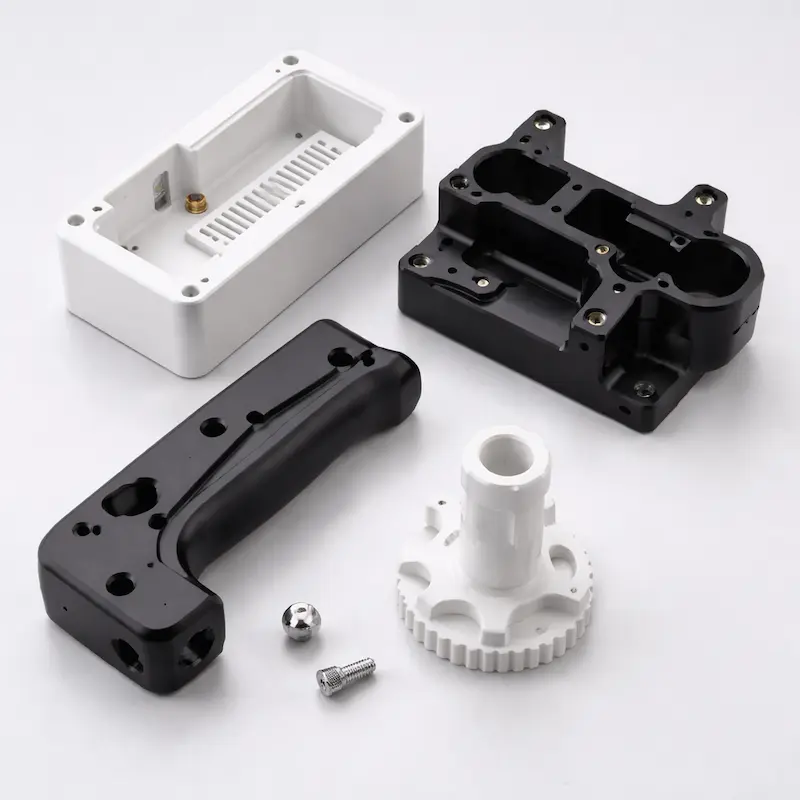
Engineering note: Values below are typical reference ranges. Final manufacturability, tolerances, material condition, surface finish, cost, and lead time depend on the drawing, geometry, quantity, and selected process.
Upload CAD files and mark critical features for an engineering review before production.
| Process | CNC machining (engineering plastics) |
|---|---|
| Material | ABS (acrylonitrile-butadiene-styrene copolymer) |
| Typical color | Natural color/black, etc. (Subject to spot plates/bars; painting is recommended for high appearance consistency requirements) |
| Dimensional tolerance | Conventional ±0.20 mm (subject to structure and datum); it is recommended to mark tolerances or note "accuracy first" for key holes/critical surfaces |
| Minimum wall thickness | Recommended ≥1.0 mm (thin-walls/large flat surfaces are recommended to be reinforced or increased in thickness to reduce the risk of deformation) |
| Minimum aperture | Recommended ≥1.5–2.0 mm; it is recommended to reserve a margin for mating holes/assembly holes and re-expand/ream holes |
| Chamfer/fillet | It is recommended that the inner angle be made R0.5 or above (to reduce the risk of stress concentration and cracking) |
| Strength and rigidity | General engineering plastic level, suitable for light-medium load structural parts; if high impact/high wear resistance, PC/PA/POM, etc. can be evaluated |
| Service temperature | Suitable for normal to medium temperature environments; it is recommended to evaluate more temperature-resistant material systems in scenarios close to heat sources/long-term high temperatures. |
| Electrical characteristics | Has certain electrical insulation properties (suitable for structural insulation parts in non-high voltage harsh environments) |
| Surface and Appearance | Machined surfaces can achieve a better appearance; it is recommended to polish + spray paint to unify texture and color difference for display parts. |
| Typical applications | Structural parts, cosmetic parts, fixtures and fixtures, assembly verification parts, small batch end-use parts |
| Finishing | Polishing, screen printing, laser engraving, painting |
| Typical lead time | Relevant to size, quantity, processing difficulty and finishing; clear delivery and expedited options will be given after uploading the file |
It is used to improve the feel of knife grain and edge, and improve the consistency of appearance; it is recommended for finer transition and texture control on the display surface.
Used to unify color and texture (matte/semi-matte/high-gloss, etc.) to significantly improve the "finished product" look and feel; it is recommended to provide reference pictures or effect requirements.
Suitable for logos, scales and other graphic information; it is recommended to provide vector files and position and size instructions to facilitate quick alignment and mass production consistency.
Used for durable markings such as QR codes, serial numbers, and nameplate information; if there are requirements for depth and contrast, it is recommended to confirm the style and position first.
It is more balanced between cost, processing efficiency and performance, and is suitable for rapid iteration and small batch delivery.
Combined with polishing and painting, a more unified display effect can be obtained; it can also be combined with screen printing/laser engraving to achieve clear identification.
Used for assembly verification, interference inspection, fixtures and light-medium load parts, with high delivery efficiency.
Suitable for structural insulation and shell parts in non-harsh environments; if there are any standard requirements, please state them in the remarks.
ABS Engineering Plastic are often used in structural parts, cosmetic parts and functional validation samples. The advantages are concentrated in:
If your working conditions are more extreme, it is recommended to change materials or do an engineering evaluation first:
Dimensional accuracy is related to structure, datum and clamping method. Recommended practices:
In order to balance processing stability and structural strength, it is recommended to refer to:
Common finishing of engineering plastics-ABS Engineering Plastic includes: Polishing, painting, screen printing, laser engraving.
For better appearance consistency it is recommended:
It can be used for assembly verification and light-medium load structural parts, but it is recommended that you indicate the assembly method and the number of disassembly in the remarks:
ABS machining quotes are usually determined by a combination of the following factors:
ABS is more susceptible to risks in the following designs:
Suggestions for reducing risk: keep wall thickness more uniform, fillet internal corners, reinforce or separate parts when necessary.
In order to get a faster and more accurate quote, it is recommended that you also indicate when uploading the file:
Process: Upload drawings → Project evaluation and quote → Production and delivery after confirmation.