
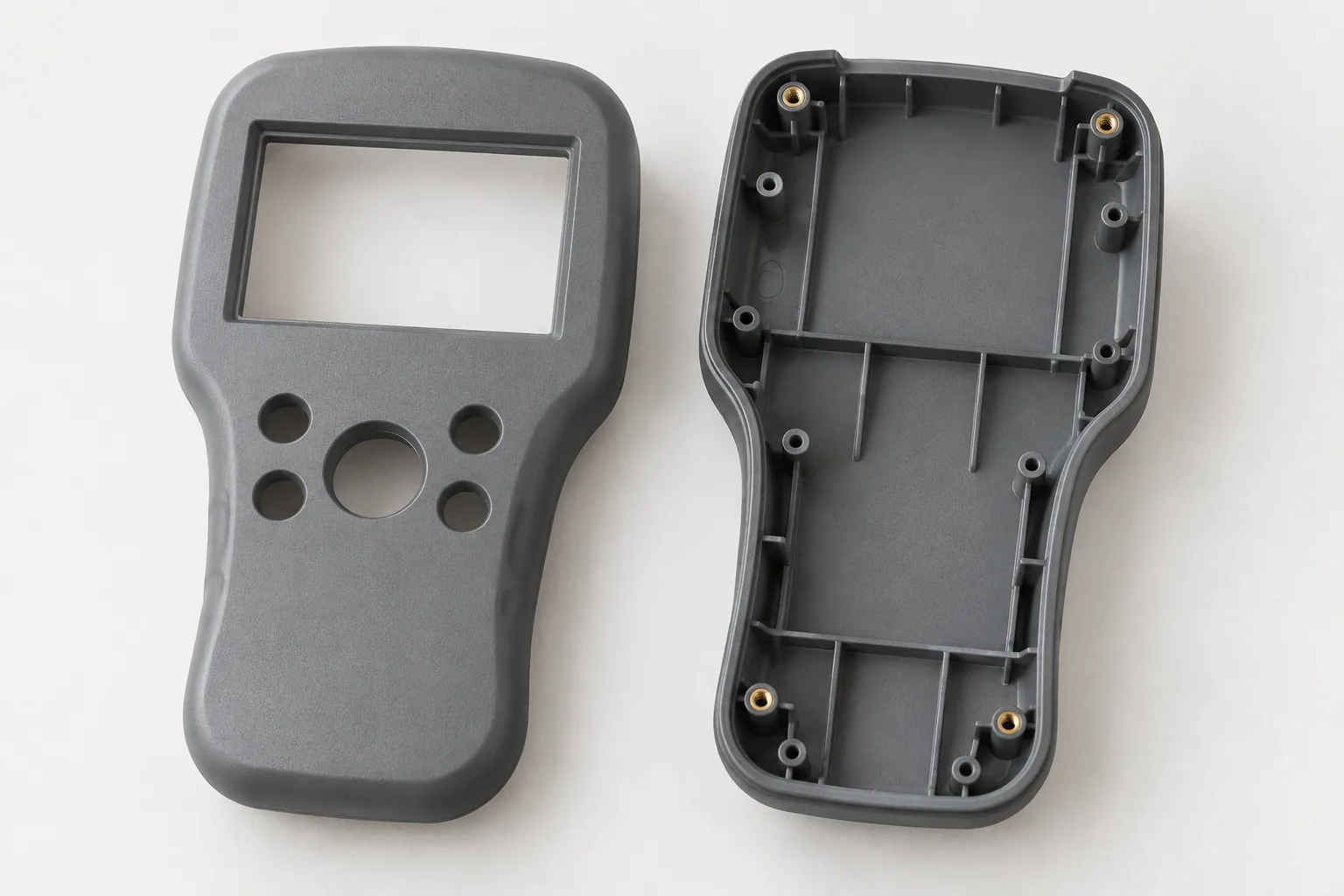
Project overview
Industrial robotics and automation
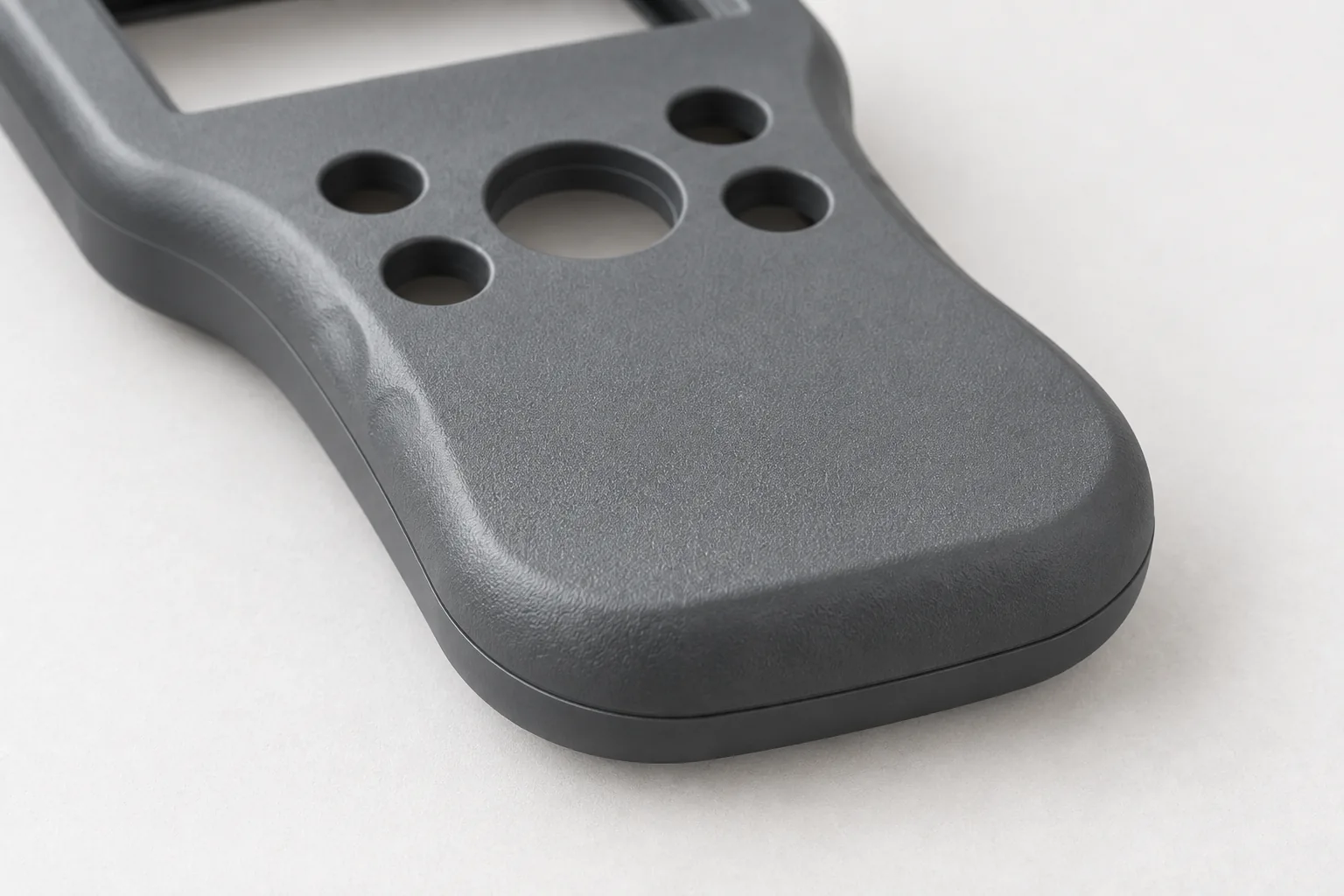
Robot teach-pendant housing shell
Functional validation or bridge-production planning; actual stage to be supplied from real project data
Vacuum casting an ABS-like polyurethane housing for an industrial robot teach pendant, with deep-rib fill, insert-boss stability, and enclosure fit as the central manufacturing challenge
What this case documents—and what it does not
Public evidence
No completed project facts were provided; the sector, component, material type, vacuum-casting process, and challenge are editorial planning anchors
Confirm from customer files
CAD, resin, master pattern, split-line acceptance, texture, color, insert details, quantity, tolerances, inspection scope, and outcome must be verified from approved files
Separate the editorial case premise from customer-file facts and never present a suggested vacuum-casting route as proof that a real project succeeded
Engineering focus
Mold split, vent, and fill path—explain how deep ribs and enclosed regions shape silicone-mold and casting strategy
Insert-boss support—show how insert positioning and local geometry can affect alignment and demolding risk
Mating-edge and cosmetic control—connect cure, trimming, secondary finishing, and assembly references to enclosure fit and appearance
Start with the enclosure’s working interfaces
A handheld teach pendant houses controls, display interfaces, fasteners, and electronics. Reproducible ribs, bosses, openings, and mating edges matter alongside its ergonomic exterior.
ABS-like polyurethane identifies a material family, not a verified resin. Review the selected system against service requirements. The project stage and master-pattern route need customer approval.
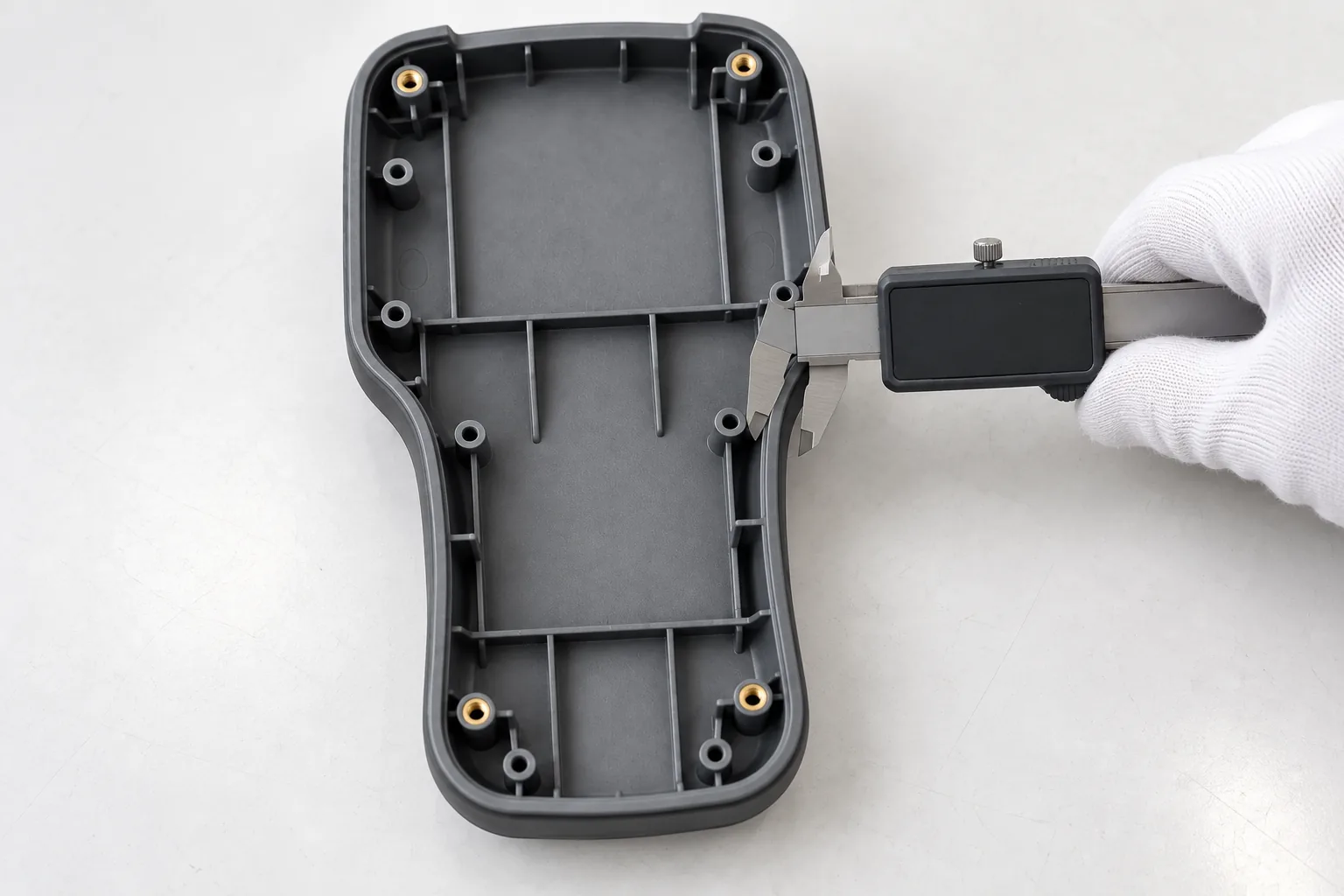
Give deep ribs a workable fill and release path
Deep rib recesses may fill poorly when incoming resin traps air. Vacuum helps manage air, but gates and vents still need workable paths. Plan the mold split so silicone can release without dragging on slender cast ribs.
Trace resin entry and air exit through the actual CAD. Where a recess ends away from the planned vents, revisit the gate, vent, or split arrangement. Inspect trial castings for rib continuity and local voids before attributing an incomplete feature to resin behavior.
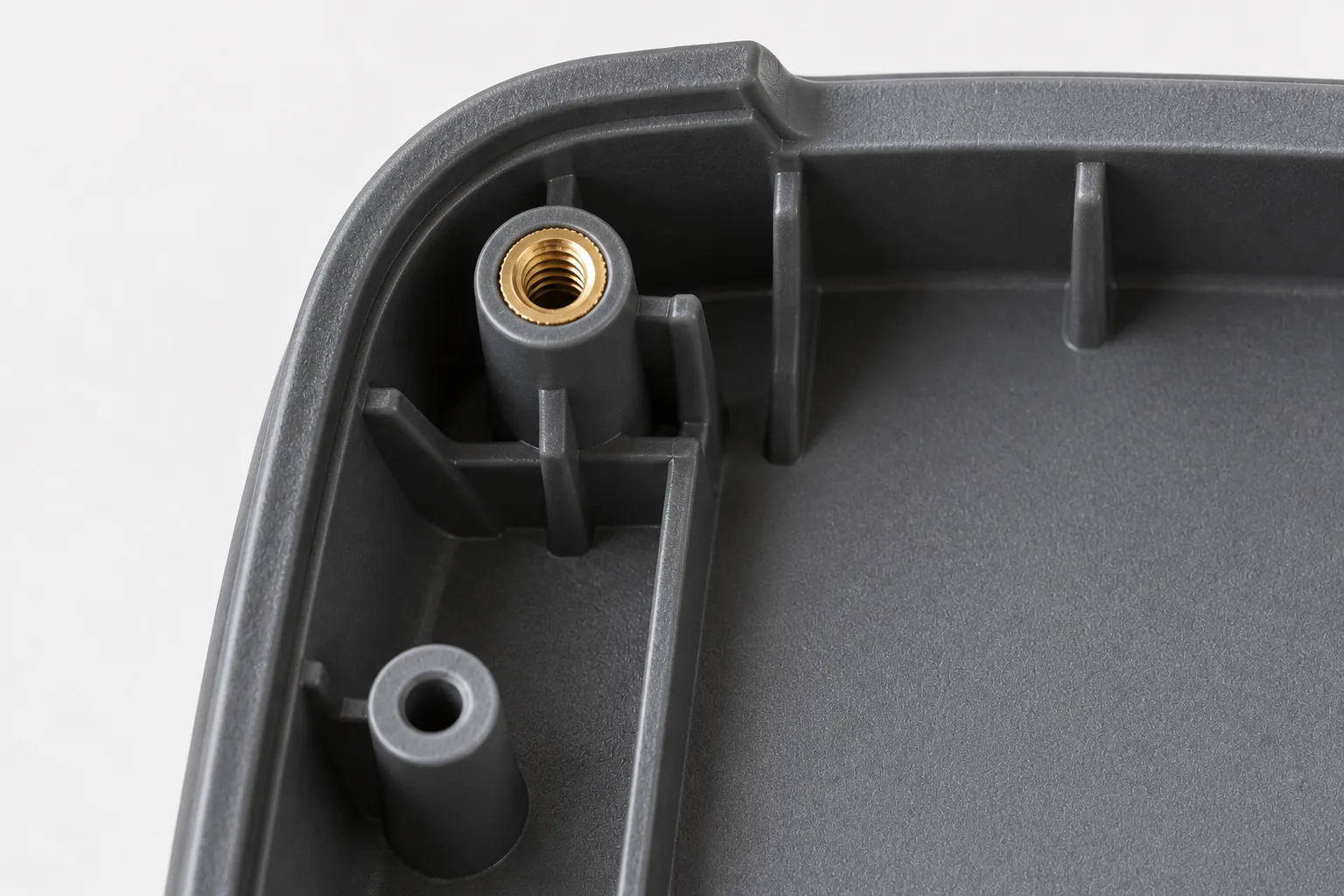
Support insert bosses without forcing alignment
Required inserts need stable locating support while resin surrounds them. Deep local geometry can resist release; the fixture should reference assembly features and allow demolding without unnecessarily loading the boss.
Compare boss axes and seating faces with the mating fasteners. A visible tilt, displaced insert, or damaged boss calls for investigation of locating support, filling, and demolding; appearance alone does not establish which operation caused it.
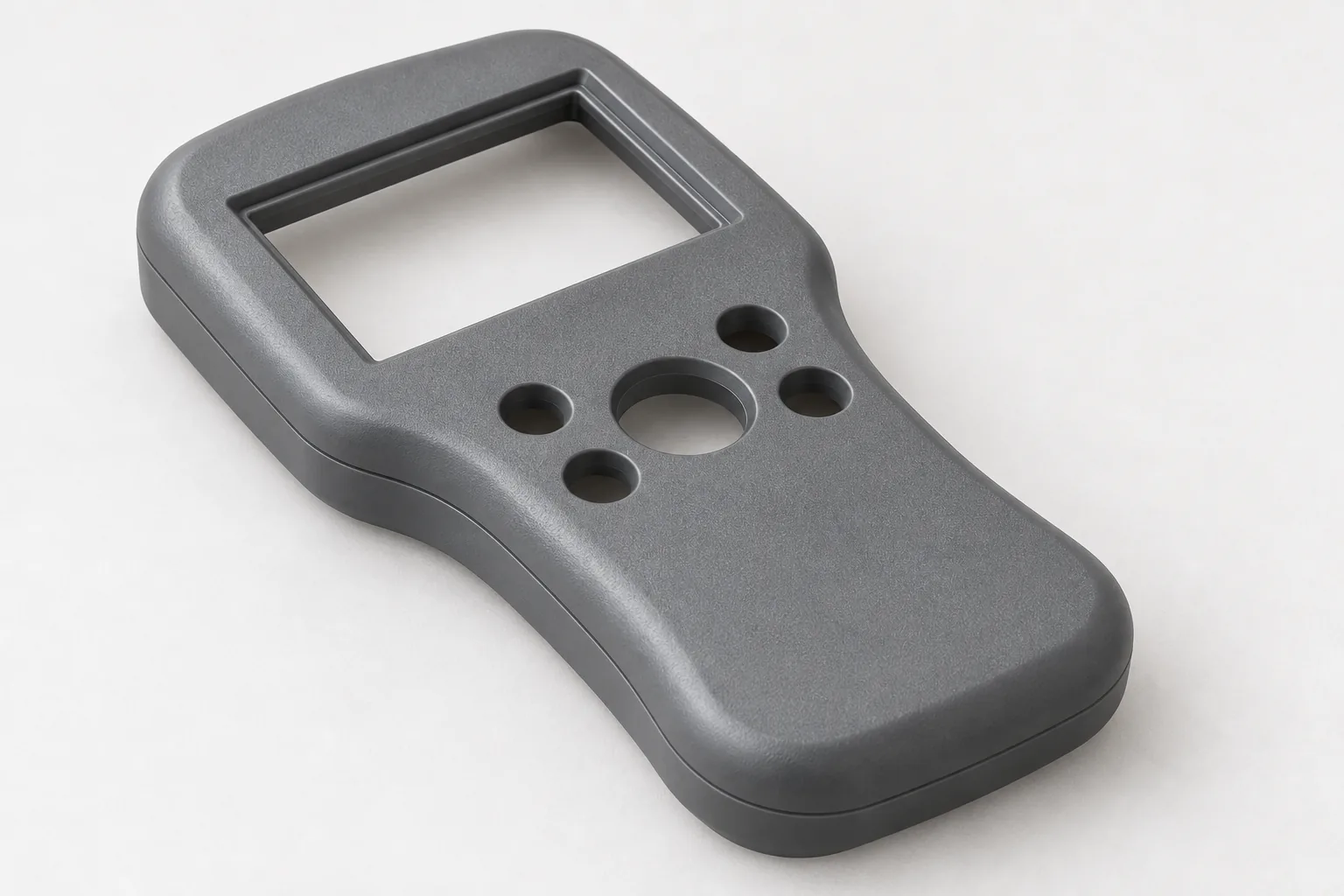
Treat cure and edge finishing as assembly decisions
Polyurethane gains its properties during cure. Plan shell support and handling around the resin’s approved cure requirements to reduce the risk of shape change.
Check mating edges against the specified assembly references before and after trimming or approved finishing. If the shells close only under force, investigate edge condition and geometry rather than using fastener tension to conceal the mismatch. Cosmetic approval should identify where split marks or finishing are acceptable.
Follow a proposed casting sequence
This proposed sequence organizes trials, not a completed production run.
- Review CAD, critical drawings, and the evidence needed for acceptance.
- Select a master-pattern approach suited to the geometry and appearance.
- Plan mold splits, gates, and vents around access and release.
- Create the silicone mold from the approved master.
- Prepare specified inserts and carry out vacuum casting.
- Cure, demold, trim, and apply the approved finish.
- Verify dimensions, cosmetics, and assembly against agreed criteria.
Match each feature to an acceptance check
Agree verification methods with the customer; these are typical options.
| Feature | Control intent | Typical verification |
|---|---|---|
| Mating perimeter | Consistent closure | Reference comparison and trial assembly |
| Deep ribs | Continuous feature reproduction | Interior visual examination; accessible dimensions |
| Insert bosses | Position and seating | Location gauge or dimensional inspection |
| Openings | Clearance for mating hardware | Approved interface gauge or component trial |
| Cosmetic surfaces | Accepted texture and visible zones | Comparison with an approved appearance sample |
| Edge condition | Clean, usable boundaries | Visual and touch inspection after trimming |
Use trial evidence to decide what changes next
Incomplete ribs call for a fill-route review; boss or edge mismatch calls for support and release checks. Adjust the relevant operation and repeat affected checks. After acceptable trials, compare the full route, including verification, finishing, and repeatability.
The lessons may inform similar low-volume housings, but vacuum casting is not automatically interchangeable with injection molding.
Process planning
- Use 7 steps: CAD and evidence review
- master-pattern strategy
- mold split, gate, and vent planning
- silicone mold creation
- insert preparation and vacuum casting
- cure, demold, trimming, and approved finish
- dimensional, cosmetic, and assembly verification. Keep every step a proposed production path
Quality control
| Feature / control / verification |
|---|
| Use Feature | Control Intent | Typical Verification for mating perimeter, deep ribs, insert bosses, openings, cosmetic surfaces, and edge condition. Treat visual checks, gauges, dimensional measurement, and trial assembly as typical options pending the approved plan |
Prepare your RFQ
3D CAD, 2D critical-dimension drawing, target resin properties, color and texture, master-pattern status, insert schedule, mating components, quantity, tolerance priorities, cosmetic zones, environmental requirements, inspection needs, and target lead time
Documented outcome and verification boundary
The eventual case may report only approved observations and evidence; no current data confirms rib fill, insert accuracy, fit, durability, mold yield, or production outcome
Do not claim injection-molded equivalence, perfect filling, exact shrinkage control, production-grade durability, guaranteed fit, fixed mold life, or guaranteed delivery
Prepare an RFQ that enables a manufacturing decision
Share CAD, critical drawings, resin properties, color, texture, master status, inserts, mating parts, quantity, tolerance priorities, cosmetic zones, environment, inspection scope, and delivery target.
These inputs let a supplier assess access, material suitability, assembly checks, and trial scope, then recommend trial casting, geometry changes, or another process.
Frequently asked questions
Does an ABS-like designation establish suitability for industrial use?
It does not establish the selected resin’s environmental resistance or durability. Identify the relevant service exposure and obtain material documentation and application-specific evidence.
Can a visual model replace mating components in a functional trial?
A visual model can support appearance review. Assembly evaluation needs representative interfaces; otherwise connector clearance, fastening, and enclosure closure may remain unresolved.
What should change when moving from a trial to bridge production?
Agree how repeated castings will be compared with the approved sample and what variation triggers correction. A successful trial does not establish ongoing yield or delivery capability.