
Start with the liquid the housing will actually see
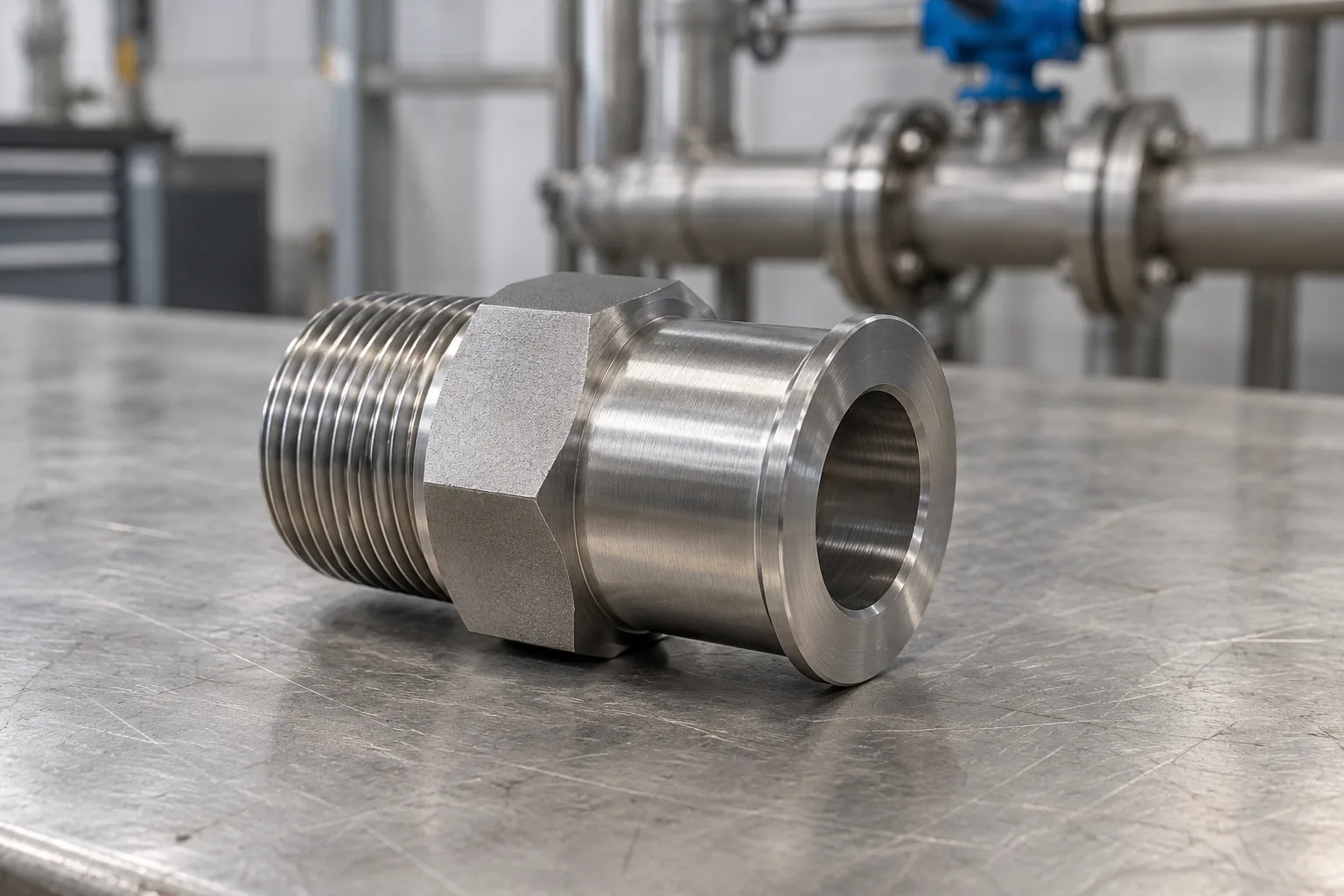
Consider a hypothetical threaded sensor housing with an internal bore and a sealing seat. Its wetted surfaces are the areas reached by process liquid, including any threads or recesses on the liquid side of the seal. The outside appearance gives little information about the exposure inside.
Record the normal fluid composition and the changes that can occur during operation, shutdown, and cleaning. Water-based equipment may expose the housing to additives or contaminants that the phrase water service does not capture. A cleaning solution can drive the decision even when the process liquid appears mild.
Ask the equipment owner for chloride information, cleaning products and concentrations, temperature range, exposure duration, and periods without flow. Include deposits and any concentration changes. If a cleaning recipe or seasonal fluid variation is unknown, keep the shortlist provisional and obtain that information before committing to stock.
Compare corrosion resistance against the same service conditions
The useful difference is resistance to the identified environment, rather than a general claim that one stainless grade is better. The molybdenum addition in 316 supports increased resistance to localized corrosion. This gives a reason to evaluate it ahead of 304 when chloride-related attack is the concern, but does not establish that it will withstand the proposed service.
Stainless steel relies on a protective surface film. Chlorides can promote local breakdown; hotter or more chemically aggressive exposure can change the risk. For the same housing, review the exact candidate specifications and producer guidance against the liquid and cleaning cycle. There is no universal chloride cutoff that selects a grade for every housing.
The following branches are engineering starting points. Keep geometry, intended use, operating loads, and acceptance objectives common to the alternatives so an easier duty does not make a weaker candidate appear equivalent.
| Relevant condition | 304 route | 316 route | Decision-changing evidence |
|---|---|---|---|
| Documented, less aggressive liquid; clean surfaces with effective flushing | Retain as a candidate if producer information supports the exposure. | Evaluate whether additional corrosion resistance serves an identified need. | Actual chemistry and cleaning conditions may change the initial preference. |
| Chloride-related localized attack is a credible concern | Require evidence appropriate to that exposure before accepting. | Favor evaluation because of its molybdenum-related resistance advantage. | Temperature, concentration changes, and sealing gaps determine whether this advantage is sufficient. |
| Persistent liquid traps, aggressive cleaning, or inadequate evidence for either material | Do not assume accessible-surface guidance qualifies trapped areas. | A grade upgrade alone does not resolve the uncertainty. | Improve the design or exposure conditions and reopen the material investigation if support remains inadequate. |
The seal interface can make the local environment harsher
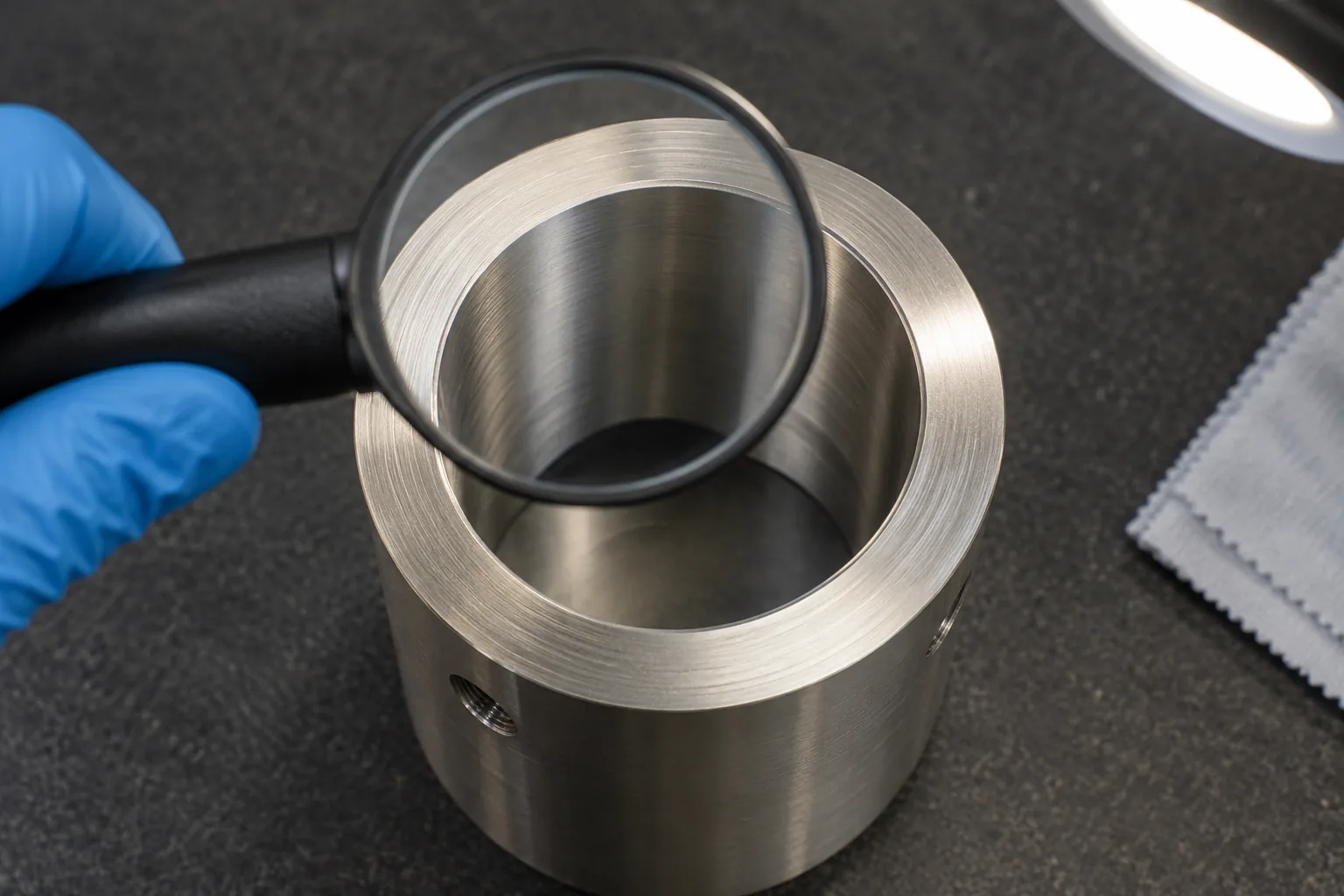
A narrow liquid-filled gap beneath a seal can behave differently from the freely washed bore. Restricted exchange can reduce oxygen availability and allow the local chemistry to become more aggressive. Deposits can create similar sheltered areas. This explains why guidance for an exposed surface may not answer the question at the sealing seat.
Inspect the drawing with the seal shown in its assembled position. Trace how liquid reaches the seat, whether wetted threads form a trapped pocket, and how cleaning reaches the bore. An exposed groove on a loose housing may become a sheltered gap after assembly; evaluate the assembled condition.
Where a recess retains liquid, first examine whether drainage, flushing, or a geometry change can remove the trap without compromising the approved seal design. If the gap must remain, include it in representative verification rather than relying on a flat specimen alone. Visible marks after exposure warrant investigation of their location and character; they do not by themselves establish the alloy as the cause.
Translate the shortlist into a manufacturable specification
Both candidates still need a defined stock condition and a machining route that produces the intended bore, threads, and seat. Ask the machinist how the tools will reach recessed wetted areas and remove burrs without damaging the sealing surface. A material change cannot correct an inaccessible feature or an omitted finish requirement.
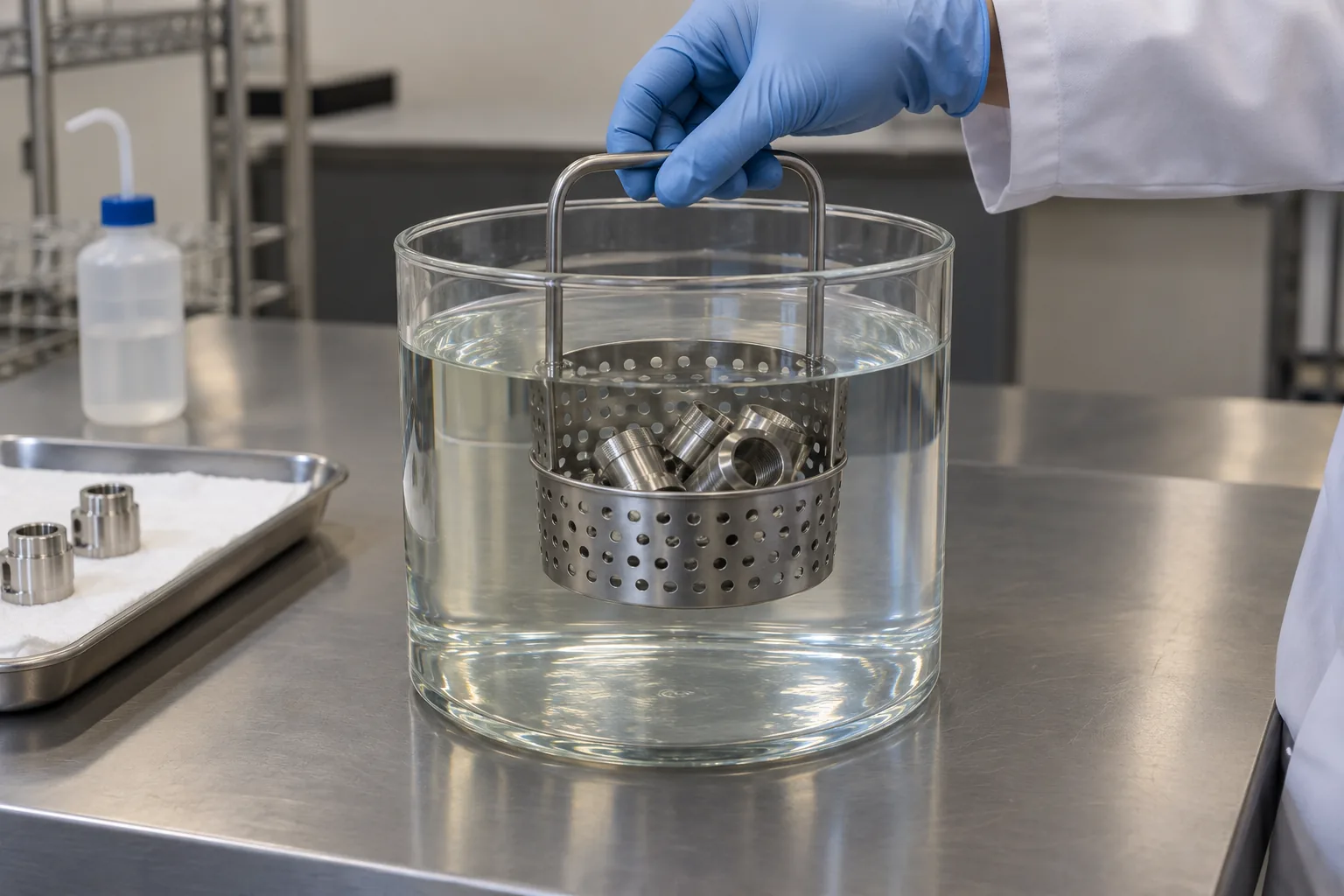
Compare plans for surface preparation and cleanliness as well as alloy names. Passivation is a controlled treatment intended to support a clean, protective stainless surface; it is not a remedy for an unsuitable fluid-material pairing. Specify the required final surface and evidence of treatment, rather than requesting a shiny appearance as a substitute for inspection.
Request quotations against the same drawing and delivery scope. The relevant costs include available stock, machining operations, finishing, documentation, inspection, quantity, and potential rework. Delivery depends on material availability and the manufacturing or verification steps still needed. Obtain actual offers for the approved alternatives instead of assigning a fixed price premium or machining-time penalty to 316.
Keep the purchase specification precise. Check any proposed substitution among 304, 304L, 316, and 316L against the approved material requirements. Preserve the link between incoming material records, the manufacturing batch, and the finished housings; a generic stainless certificate is not evidence for a particular delivered part.
Verify the assembled duty, then decide how to proceed
Producer corrosion tables are screening evidence, not a service-life prediction. Their laboratory conditions may differ from the process fluid, impurities, stock condition, and finished surfaces. Use entries that match the proposed exposure and ask the material supplier to clarify mismatches.
Define acceptance before testing: the required chemical resistance, permitted surface change, dimensional requirements, and any lifetime objective. Assign responsibility for the assessment. Compare candidates using the same intended fluid, cleaning exposure, temperature conditions, assembly features, and applicable loading. Inspect the internal surfaces and sealing recesses after the agreed exposure; a representative assembly can reveal a risk that an open specimen misses.
If a candidate fails the agreed corrosion assessment, investigate the affected location and exposure. A result at a trapped seat calls for reviewing the gap and cleaning access as well as alloy selection. Adjust the relevant design, service condition, or material and verify the revised route. If neither material has credible support, expand the investigation rather than naming 316 by default.
When alternatives meet the same acceptance objective, compare their complete delivery conditions: verification effort, post-processing, traceability, cleaning and maintenance requirements, and procurement reliability. Pressure integrity and sealing-system performance need separate design approval; neither follows from an alloy designation or from CNC machining.
Prepare an RFQ that can support a material decision
Send the geometry together with the service description. A supplier can then identify machining access issues, quote a defined scope, and flag where a material specialist or application test is needed. Use the following package to turn a provisional shortlist into a reviewable manufacturing proposal.
- Provide the 3D CAD model and dimensioned drawing, including threads, datums, tolerances, and the assembled seal interface.
- Mark every wetted surface and identify areas that remain exposed during shutdown or retain cleaning solution.
- Supply process-fluid and cleaning specifications, possible composition changes, operating temperatures, and exposure timing.
- State the exact material alternatives and stock requirements, with substitution approval assigned to a named responsible party.
- Define finish, cleanliness, deburring, and any required surface-treatment deliverables for the bore and seat.
- List material certificates, batch traceability, and dimensional or surface inspection records required with delivery.
- Set chemical-resistance acceptance criteria and verification responsibilities; provide pressure requirements for the separate design review.
- Give the required quantity, delivery objective, and maintenance constraints so quotations reflect the intended supply scope.
Frequently asked questions
Does a marine-grade description settle the purchasing decision?
No. Request the explicit material specification and check it against the intended liquid and cleaning exposure. A marketing description neither identifies every permitted stock variant nor qualifies the assembled housing.
Can a clean-looking trial part establish suitability for longer operation?
Appearance alone is weak evidence. A trial may omit shutdown deposits, changing fluid composition, or repeated cleaning exposure. Compare its exposure history with the intended duty before using it to support a lifetime claim.
What if the supplier proposes a lower-carbon variant to improve availability?
Treat it as a proposed specification change, not an administrative substitution. Have the responsible engineer review the producer data, required material records, and application basis before accepting the alternative or its delivery offer.